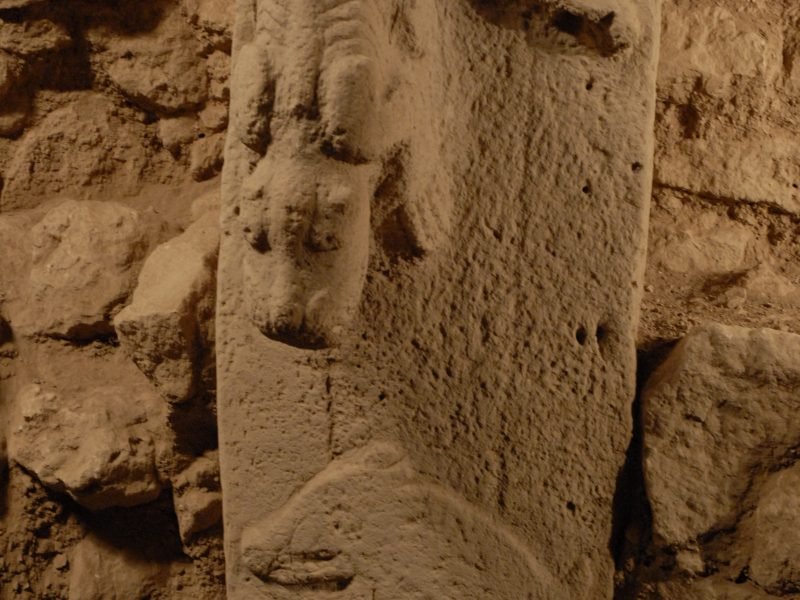
On Pillar 27 in Enclosure C, a predator is carved crawling head-down the face of the stone — teeth bared, ribs showing, muscles tensed. Unlike almost everything else at Göbekli Tepe, it is worked in high relief, standing so far out from the pillar that it reads as a three-dimensional animal frozen mid-descent. Below it, a smaller animal is caught in flatter, low relief — the hunter and the hunted, on a single stone.
Rare in three dimensions
Almost all of Göbekli Tepe's animals are carved in low relief — shallow silhouettes raised a centimetre or two from the stone. Pillar 27's predator is different. It projects boldly outward, its head and shoulders nearly free of the pillar, so that from below it looks less like a picture and more like a living animal climbing down toward you.
Carving like this is far harder and far riskier — one bad strike and the whole beast breaks off. That the makers took the risk, on one animal, on one pillar, tells you this image mattered.
Pillar 27 carries a predator in high relief descending the stone head-first, with a smaller animal in low relief nearby. The predator is a carnivore; whether it is a leopard, lion, or another big cat is not settled.
Our reading: this is about power, and probably about protection. Across Göbekli Tepe, the animals chosen for carving are overwhelmingly the dangerous ones — the creatures that could hurt or kill a person. Predators guard thresholds. A snarling beast set at the heart of a gathering space may have been a guardian: a warning, a protector, or a force the community wanted on its side.
It connects to a wider pattern. At neighbouring Karahan Tepe, excavators found the actual bones of predators — leopard, wolf, vulture — handled with striking care, as if their power were being deliberately brought into human space. The carved predator and the collected predator seem to be two expressions of the same idea: dangerous animals were not to be feared and forgotten, but held close.
Why the dangerous animals?
It is one of the quiet puzzles of Göbekli Tepe. These were hunters — yet they rarely carved the gazelle and wild sheep they actually ate. Instead they covered their monuments with foxes, snakes, scorpions, vultures, and predators like this one. Whatever the pillars were for, it was not a menu. It was a world of powerful, threatening beings — and the predator of Pillar 27 is one of its clearest faces.
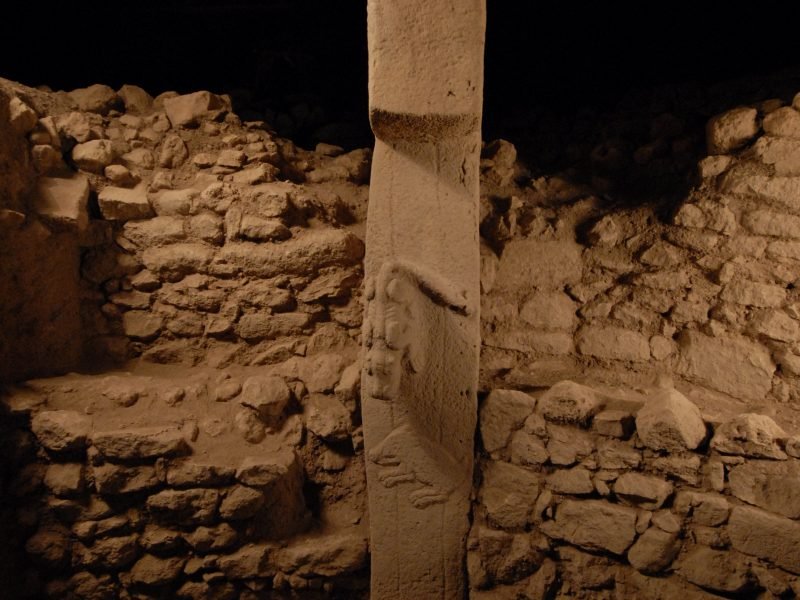
Pillar 27, Enclosure C, Göbekli Tepe. © DAI / Göbekli Tepe Project.
German Archaeological Institute, Göbekli Tepe Project, Predator and boar detail, Pillar 27, Göbekli Tepe, Copyright: DAI — used with permission, via .
German Archaeological Institute, Göbekli Tepe Project, Pillar 27, Göbekli Tepe, Copyright: DAI — used with permission, via .
Sources & further reading3 references
- Peters, J. & Schmidt, K. (2004). Animals in the symbolic world of Pre-Pottery Neolithic Göbekli Tepe, south-eastern Turkey: a preliminary assessment. Anthropozoologica 39(1): 179–218.
- Schmidt, K. (2012). Göbekli Tepe: A Stone Age Sanctuary in South-Eastern Anatolia. Berlin: ex oriente. The foundational monograph by the site's first excavator.
- The Tepe Telegrams (official research blog of the Göbekli Tepe Project, DAI). The Tepe Telegrams. Deutsches Archäologisches Institut. link Accessible, authoritative running commentary from the excavation team.
Full bibliography: the Taş Tepeler reference library →