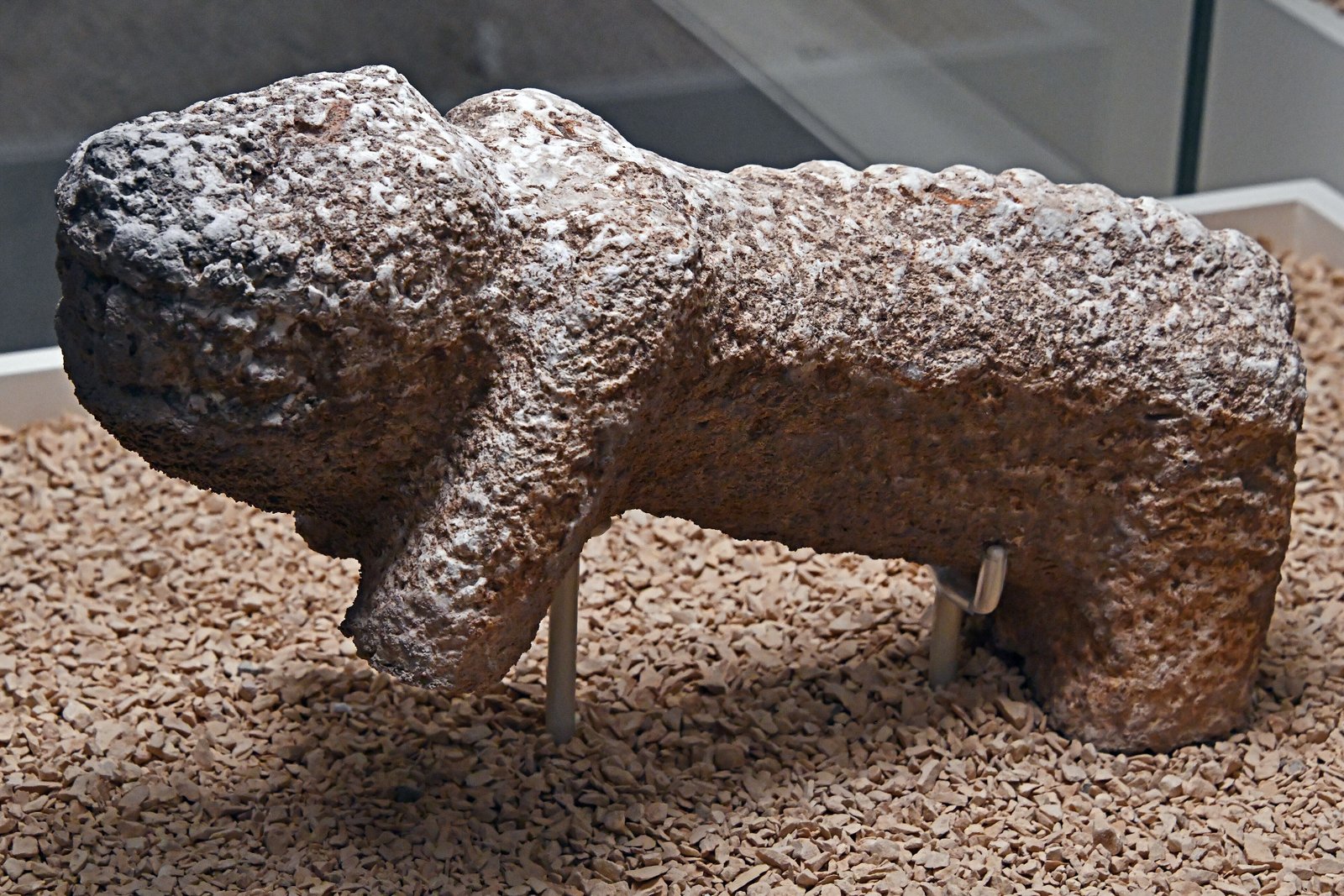
Karahan's wider excavation has produced an unusual field of selected animal parts — wolf jaws, leopard bones, vulture remains, fox pelt, bull horns set in a floor — handled with striking care. Our reading is that Karahan wasn't just picturing animals; it was bringing dangerous animal power into human space and, perhaps, into the human body.
Karul-linked reporting describes an unusual public-building, hearth, vessel, and animal-deposit context: wolf jaws, leopard bones, vulture remains or wings, fox bones/paws/claws with pelt, many hearths or fire pits, possible ovens, stone vessels and plates, black chlorite vessels with geometric and animal decoration, beads, baton-shaped tools, red sterile fill, and bull horns and skulls embedded in a floor. Later reporting adds nested vessels with fox, vulture, and boar figurines.
Each animal carries a different pressure. Together they suggest a world where animal bodies were handled as power, not just food. And in a site built to put the body under pressure, the leopard raises the sharpest question: was the predator only seen — or could it be carried into a person? This is our reading, offered as an open, specific hypothesis.
The leopard initiation
Put the pieces together and a reading emerges — our reading, and one of the most original in the whole project. A person who kills, carries, wears, or ritually brings the leopard into a phallic chamber does not merely display a trophy. He brings into the male field the animal that could have ended him. Architecture, descent, phallic pressure, gaze, channel, hiddenness, and predator comparison all converge around bodily transformation — which is why Karahan can be read as a candidate for an initiation site, even though the evidence never hands us a complete ceremony.
The hinge is the eleventh stone inside Structure AB — the one placed element among ten bedrock pillars. We read it as a possible carried-in form, echoing Karahan's leopard-carrier figure: predator power arriving inside the field of generative stone. A hypothesis, held open, and kept clearly separate from the published inventory.