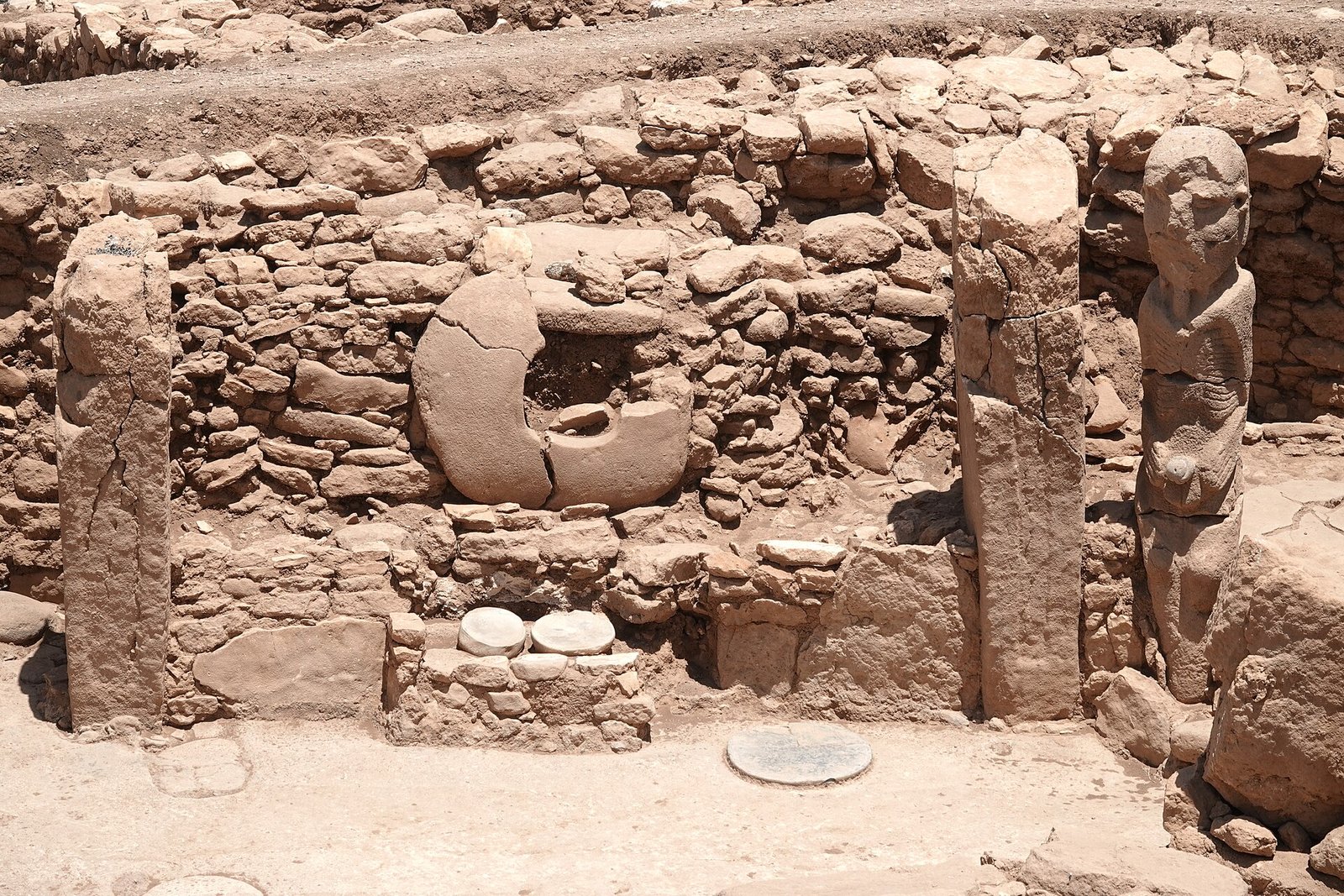
Inside Karahan's Structure AB, ten pillars were shaped directly from the living bedrock — described by the excavator Necmi Karul as phallus-shaped. An eleventh, a placed flat plate, was set among them. To enter the room was to descend into a field of upright, generative stone.
Structure AB holds ten pillars carved from the bedrock itself. Four taller ones — roughly 1.6–1.7 m — face the chamber's carved human head; six shorter ones, about 1–1.4 m, stand behind them. The count rises to eleven because one extra shaped flat plate was placed into a shallow bed. Karul describes the uprights as phallus-shaped. Ten belong to the room's own carved body; one was brought in.
Because they are cut from the ground, these uprights feel less like installed architecture than like organs of the hill. To enter is to stand inside a field of male generative force. And fertility here is not a soft symbol of abundance: in a world of injury, infant mortality, hunting danger, hunger, and fragile group continuity, fertility is survival pressure.
This is our reading — photo-based, specific, and deliberately unresolved. It is offered as interpretation, not as settled fact.
The eleventh stone
The placed plate is the hinge. Because it is not one of the fixed bedrock phalluses, we read it as an arrival inside the room — a brought-in form that may echo Karahan's leopard-carrier figure, a human bearing, wearing, or becoming entangled with a leopard. If the fixed room already carries generative male force, the different placed stone may carry predator power into that field. An authorial hypothesis, held open on purpose.
- Ten pillars carved from bedrock; one placed flat plate added — eleven in total.
- Four taller front pillars (~1.6–1.7 m) face the carved human head.
- Six shorter rear pillars (~1–1.4 m).
- Described by the excavator as phallus-shaped.
- Later deliberately filled: stones were placed among the pillars and the south stair blocked.