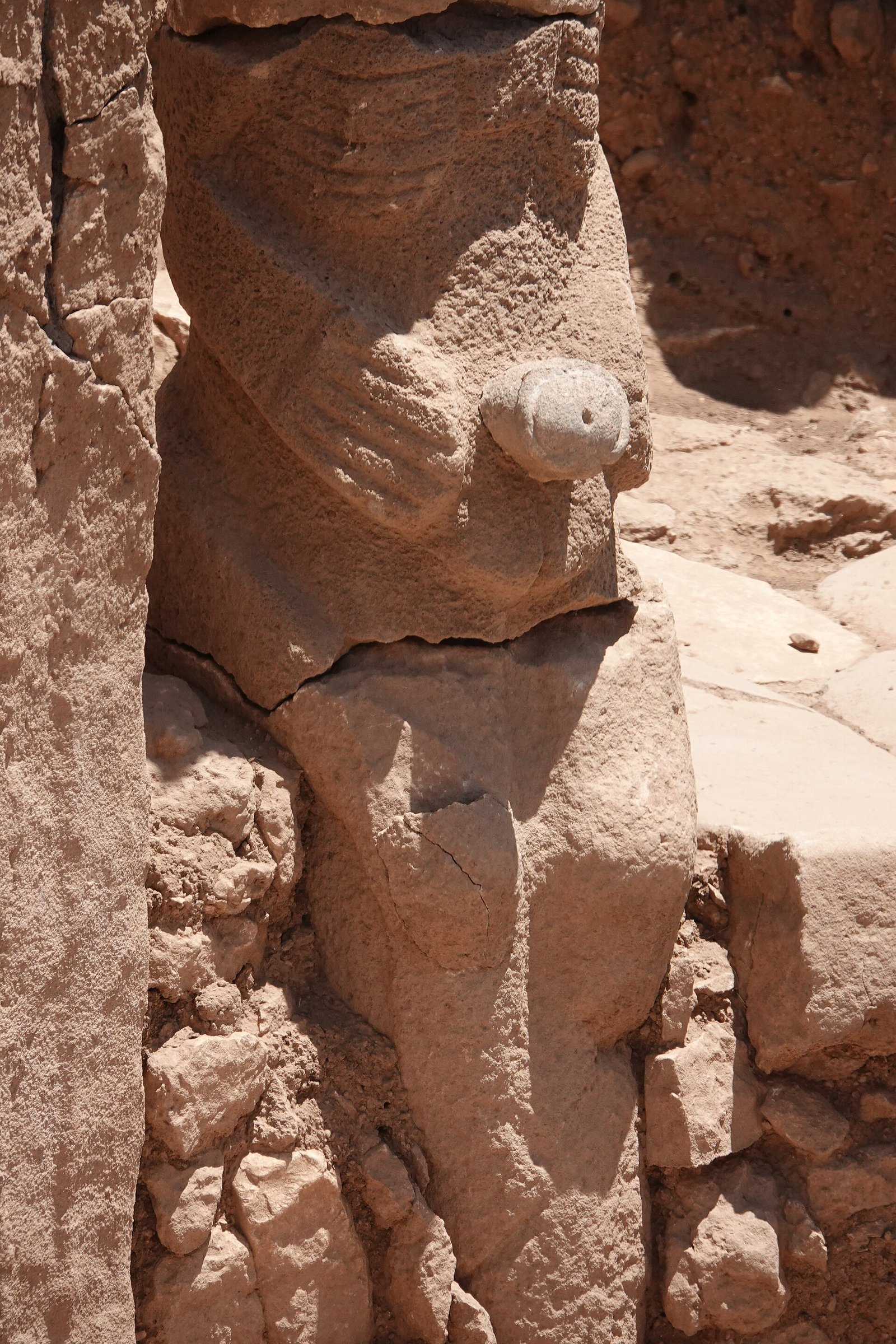
A roughly 2.45-metre human figure with deeply marked ribs and emphasized genitalia — a corpse-like body that, in our reading, holds death and life in a single image. It sits within a Karahan field of skull, vulture, and bench that keeps pressing the living against the dead.
A large human statue, about 2.45 metres tall, is reported with deeply carved ribs and pronounced genitalia. In the wider account it is associated with reports of a skull or skull fragments in a square portal or niche, a vulture stone, human bones, bowls or plates, and a U-shaped bench near a carved bedrock chamber.
This is not a tidy symbol. It is a collision. The ribs expose mortality. The phallus insists on life. The vulture belongs to the conversion of flesh. The skull is what remains when face and softness vanish. Karahan repeatedly places life under the pressure of death — and the Ribbed Man is where that pressure takes human shape.
Offered as interpretation. The exact context of several associated finds is still being confirmed.
The two Karahan bodies
Karahan gives at least two great bodily images, and they should not be merged into one ceremony. Structure AB gives the living, initiated body: a person descending into a phallic, watched, channelled room. The Ribbed Man gives the death-fertility body: ribs cut into stone, phallus emphasized, skull and vulture questions nearby. One body enters to change. One body sits as if death and generation have been forced into the same form. Their power comes from relation, not forced identity.
Why it matters
Together these images make Karahan the most bodily site in the whole Taş Tepeler landscape. Where Göbekli is the public shock of upright stone presence, Karahan is the stone world asking what must happen to the human body before it can return changed. The Ribbed Man is the moment that question stops being architecture and becomes a person.
- Large corpse-like human figure, roughly 2.45 m tall.
- Deeply marked ribs; emphasized genitalia.
- Associated in our synthesis with a skull/skull-fragment niche, a vulture stone, human bones, plates and a U-shaped bench.
- Read as the 'death-fertility body,' in relation to — not merged with — Structure AB.