Karahan Tepe · Structure
A large rectangular building on Karahan Tepe's western terrace, reported with continuous benches and T-shaped pillars, and best known as the ritual setting where the life-size seated 'Ribbed Man' statue was found still installed.
01
02
Structure BD is a monumental building, oval-rectangular with square outer corners and rounded inner ones, fitted with stepped benches and T-shaped pillars. Karul's 2025 report describes two large T-pillars facing each other at its centre, both fallen eastward when the building was abandoned, with more pillars set along the walls — earlier press accounts put the full count at around a dozen, which the report neither confirms nor breaks down, since only a little over half of BD has been dug. It is the central building of Karahan's final, rectangular phase, ringed not by honeycomb huts (those belong to the earlier round-plan phase) but by other rectangular buildings such as BE.
03
Karul's 2025 excavation chapter places BD at the top of the western slope, as the central communal building of Karahan Tepe's final, rectangular phase — the stage after the early round-plan complex (AD, AB, BF) and the transitional rounded-corner buildings. Only a little over half of it has been dug. It is a large oval-rectangular building, about 16 × 17 m, cut into the bedrock with a finely levelled floor; its outer corners are square but the inner corners stay rounded, and the walls are about 60–70 cm thick. A three-step bench runs along the south wall — its top step coated with clay — while to the east the benches rise in two tiers of flat stones and reused pillars. Two large T-shaped pillars stood facing each other at the centre, both fallen eastward when the building was abandoned; their narrow faces carry paired V-shaped reliefs at neck height. The north wall is the focal point: two fractured pillars frame a bench, and a stone with a central window-like opening is set into the wall.
It is here, on the bench in front of that wall, that the seated statue stood, with a vulture statue behind it — its beak deliberately broken off and laid in front — and, in the adjacent building BE, a white terrazzo floor and a broken boar statue left beside a pillar.
04
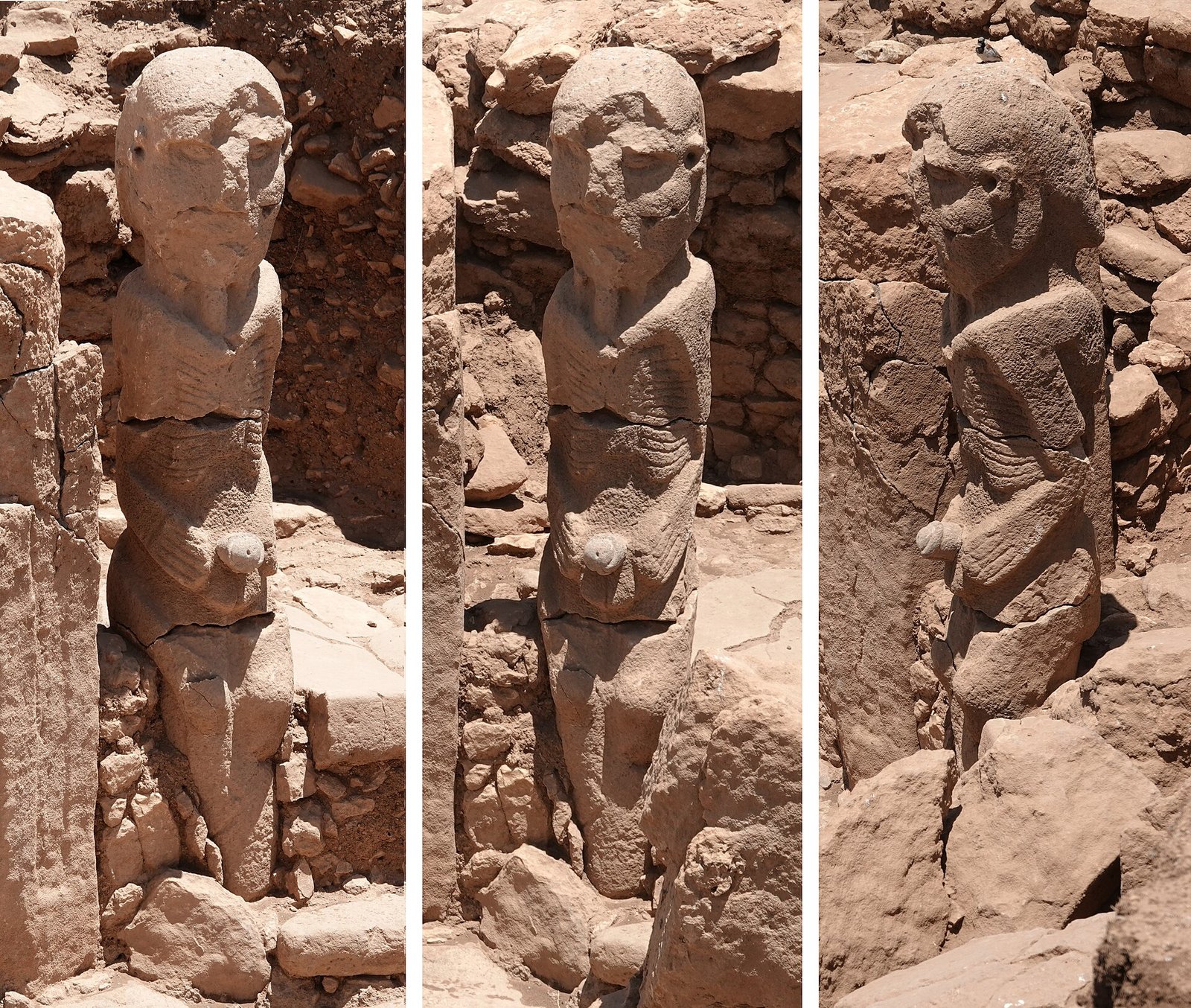
BD's importance rests above all on what was found inside it. Announced in 2023, a gaunt, life-size seated male statue — the 'Ribbed Man' — was recovered here: in Karul's 2025 report about 2.45 metres tall (earlier accounts said ~2.3 m), carved from a single limestone block, with a bald head, a realistic face, ribs, collarbone and vertebrae in deep incised lines, and the hands brought to the front near an explicitly carved phallus (rough date around 9400 BCE). Karul reads the figure as holding both life and death together — lifelike in its seated posture, yet with its skeleton showing.
Crucially, the statue was not toppled or discarded but installed — set into position and fixed, seated, in a chamber that carried clear signs of ceremony. Around it excavators recorded a bench, stone plates and bowls read as offerings, human bone, and a vulture sculpture — the bird tied across this world to death. Because the figure stayed where its makers placed it, the relationship between statue, niche and surrounding objects can be studied together. At the building's closure the figure was, like other Karahan statues, deliberately broken: the legs and lower torso stayed fixed to the base while the head, upper torso and phallus were detached and laid on the floor (Karul 2025) — the same act of ritual dismantling seen across the site's abandoned buildings.
05
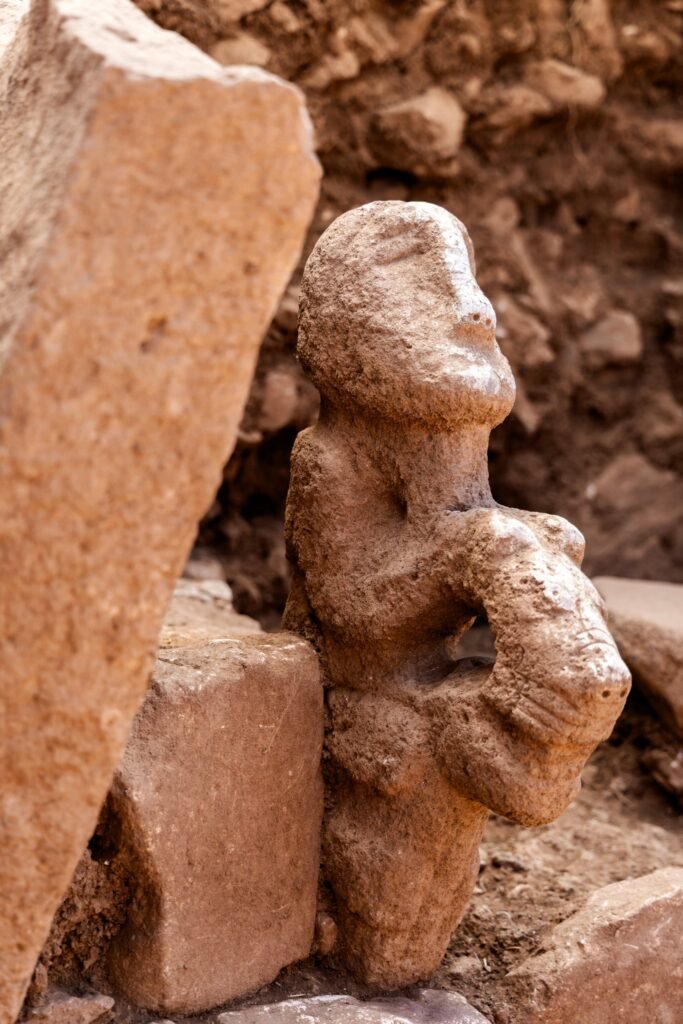
The most widely held reading is that the Ribbed Man represents a deceased ancestor bound to the building, with the exposed ribs perhaps signalling death; this is an interpretation, while the skill and deliberate installation are not in question. In late 2025 a second full-bodied statue in the same pose was reported from the same complex, found near a wall niche holding a human skull — pointing to a developed tradition of the human figure rather than a single carving. That second figure is recent, reporting-grade material still awaiting full publication.
What remains open is the building's precise plan, phasing and dimensions, and how the sculpture assemblage relates stratigraphically to the architecture. Karahan Tepe is a live excavation and BD's definitive account has not yet been published.
06
The “Ribbed Man”, still in place
A gaunt, life-size seated male — about 2.45 m in Karul's 2025 report — with a bald head, a realistic face, ribs, collarbone and spine in deep incised lines and the hands brought to the front near a carved phallus. It was not toppled but installed, fixed seated in the room, which is why it can be read together with everything around it.
Photo: Wikimedia Commons
Full page →
Dosseman, Urfa museum Karahantepe Statue of Griffon Vulture Neolithic age in 2024 7308, CC BY-SA 4.0, via Wikimedia Commons.
The vulture sculpture
A stone vulture recovered from the same setting (now in the Şanlıurfa museum). Across this Neolithic world the vulture is tied to death and the treatment of the dead — fitting company for a figure whose bared ribs may themselves signal death.
Şanlıurfa Archaeology Museum · Wikimedia Commons
Full page →
A human figure carrying a leopard (2025)
Recent seasons in the same complex have produced further full-bodied statues, including a figure holding a leopard against its body and a second seated man found near a niche with a human skull. These are reporting-grade finds still awaiting full publication — evidence of a developed human-figure tradition rather than a single carving.
Photo: Karahan Tepe excavation / press image
07
The most widely held reading: the Ribbed Man is a deceased ancestor tied to the building, the exposed ribs perhaps marking death. The skill and the deliberate installation are not in doubt; the identification is interpretation.
The later statues in the same pose — including the leopard-carrier and a seated man by a skull niche — point to a repeated way of showing the human body, not a single masterpiece. This is recent field material and may be refined in print.
The building's exact plan, dimensions and phasing, and how the sculptures relate stratigraphically to the architecture, all await the excavation's own report.
08
The objects recorded for this building, gathered as one catalogue. Where a full object page exists, it is linked from the card.
Object
The reported basalt human sculpture
A human sculpture in the Structure BD area recorded in the site's own working notes as basalt — a promising lead that we have not been able to confirm against published or independent reporting.
Full page →Object
Griffon Vulture Sculpture
Full page →Object
The seated 'Ribbed Man'
A gaunt, life-size man with his ribs showing and his hands brought to the front of his body, seated and fixed into the ground — one of the most complete human figures in the entire Neolithic record.
Wikimedia Commons
Full page →Object
The T-Pillars of Structure BD
The T-shaped pillars of Structure BD — two tall central ones facing each other, with more set along the walls — the plan that ties Karahan's largest late building to the great enclosures of Göbekli Tepe.
Wikimedia Commons
Full page →09
Full bibliography: the Taş Tepeler reference library →
Last reviewed 11 October 2026. Something wrong?