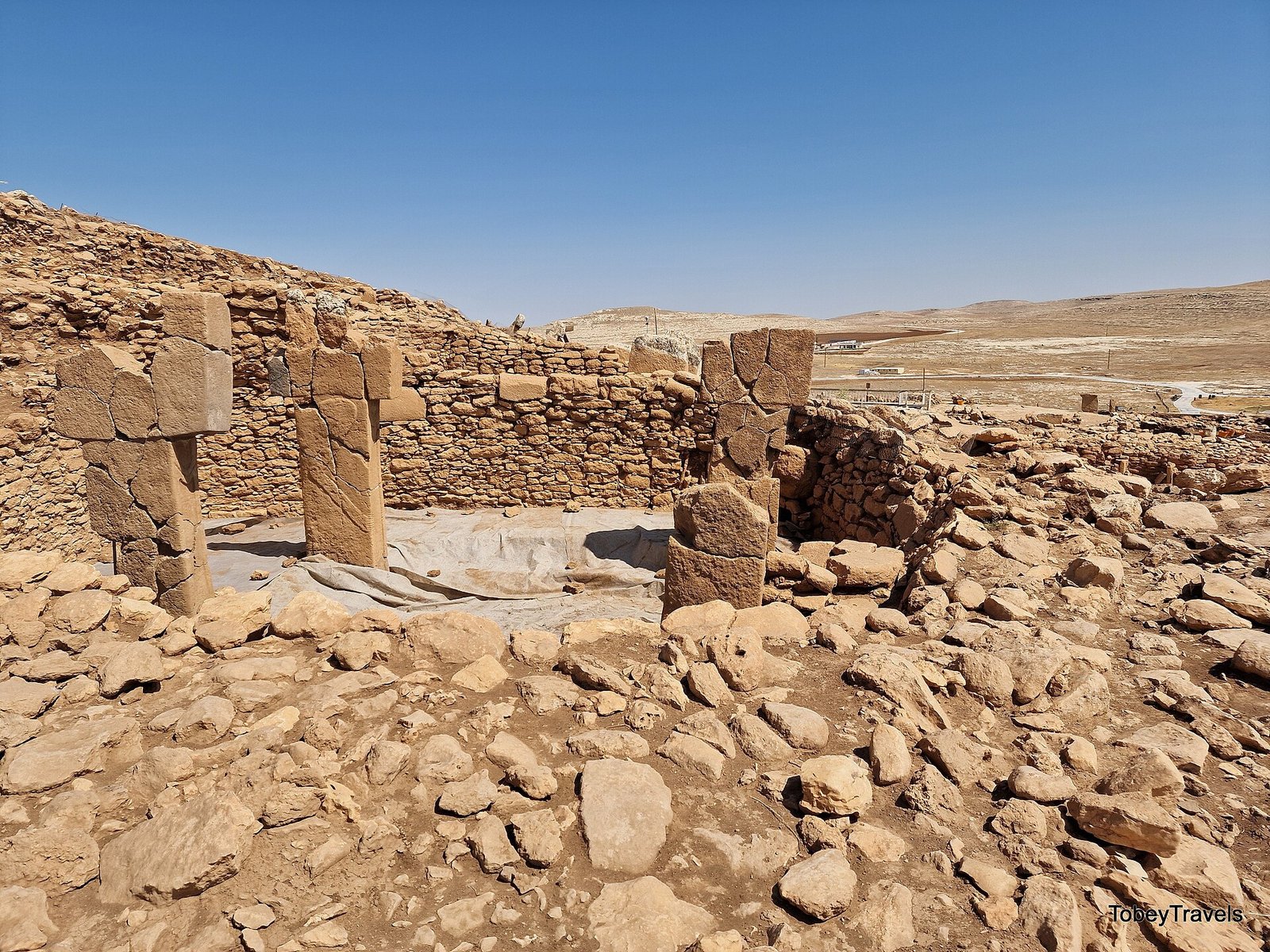
Two at the centre, more at the walls
Karul's 2025 report describes two large T-shaped pillars facing each other at the exact centre of Structure BD, both fallen eastward when the building was abandoned; their narrow inner faces carry paired V-shaped reliefs at neck height. Further pillars are set along the walls, some reused horizontally within the stepped benches. Because only a little over half of BD has been excavated, the report does not give a firm total — earlier press accounts spoke of about a dozen, a figure the excavator neither confirms nor breaks down.
BD belongs to Karahan's latest, rectangular phase, so these are among the last T-pillars raised at the site before the tradition wound down. The hall's plan — paired central pillars inside a ringed, benched space — is the clearest echo at Karahan of the great circular enclosures at Göbekli Tepe.
T-pillars as bodies
Across this Neolithic world the T-shape reads as an abstracted human: a flat 'head' set crosswise above the tall 'body' of the shaft, sometimes with arms, hands or a belt worked in low relief. The V at the neck, seen on BD's central pillars, is usually read as a collar or a stylised collarbone — the same motif that turns up on Karahan's human sculptures. At Karahan the symbolism travels indoors and even into ordinary houses, where paired pillars stand at the core of domestic rooms.
What is uncertain
The exact number of pillars, their full arrangement and the building's phasing await complete excavation and publication. The popular 'twelve pillars' label is older shorthand that Karul's 2025 report does not carry; what the report does establish is the two tall central pillars and the pillared, benched plan of the hall.
Sources & further reading3 references
- Karul, N. (2025). Karahantepe. The Neolithic in Türkiye: Archaeology and Art Publications, Istanbul: 199–238.
- Karul, N. (2021). Buried Buildings at Pre-Pottery Neolithic Karahantepe. Türk Arkeoloji ve Etnografya Dergisi 82: 19–29. link
- Şanlıurfa Neolithic Research Project — Taş Tepeler (2026). Official project site (Istanbul University / Şanlıurfa Museum). tastepeler.org link
Full bibliography: the Taş Tepeler reference library →