What we actually know
Pillar 37 is the western central pillar of Enclosure C (Building C), the partner of the eastern central pillar. Unlike most of the objects given their own page here, it is not a well-preserved carving: it was destroyed in prehistory, and what can be said about it is deliberately limited.
It is documented from an excavation figure recorded in 2009 that pairs Pillar 37 with the nearby, better-known Pillar 27, and notes that both pillars carried relief bands along their entire front sides — the vertical garment-like banding seen on the site's central figures. That pairing gives Pillar 37 a firm locator relationship to a pillar people can still see, even though its own imagery is largely gone.
The destruction of Enclosure C's central pillars
Pillar 37 belongs to a wider, well-recorded story: the central pillars of Enclosure C were smashed in antiquity. Broken pieces were recorded in a destruction pit, and the excavation project has used laser-scanning and virtual reconstruction to model the central pillars — work that indicates an original height in the region of five metres — while the pedestals that once held the central pair survive, cut from the bedrock.
Pillar 37 should be understood as part of that destruction context rather than as a pillar carrying its own recoverable picture. It is honest to link it to the reconstruction work without assuming that every recovered fragment or motif belongs to Pillar 37 specifically.
What is uncertain
Because the pillar was destroyed, its full motif programme cannot be reconstructed, and the safest public account is about its position and its ruined state, not a detailed scene. One later figure caption (2023) lists Pillar 37 among Göbekli Tepe pillars bearing fox images; we flag this as an unconfirmed, source-review note rather than an established feature, pending a motif-specific publication. Any richer description of Pillar 37 would be reconstruction, and we do not present it as fact.
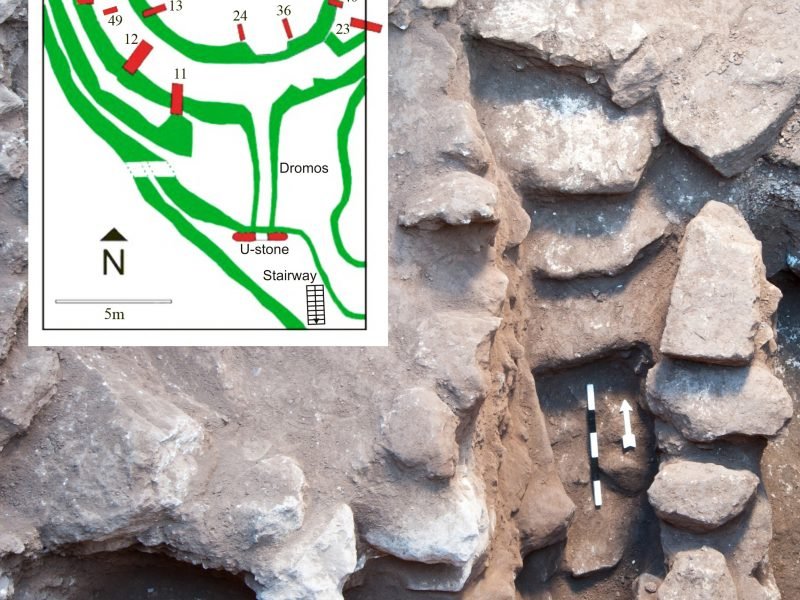
Note on the image: because Pillar 37 was smashed in antiquity, there is no photograph of an intact pillar to show. The picture on this page is a plan of the Enclosure C entrance area, shown for context — not a photograph of this find.
Where it belongs
Pillar 37 stood at the centre of Enclosure C, one of the great circular buildings of Göbekli Tepe's earliest, Pre-Pottery Neolithic A phase, raised in the centuries around 9500 BCE. Its value now is as a locator and a caution: it fixes the western half of Enclosure C's central pair and reminds us that some of these monuments reach us broken, known more by their setting than by a surviving scene.
Sources & further reading3 references
- Peters, J. & Schmidt, K. (2004). Animals in the symbolic world of Pre-Pottery Neolithic Göbekli Tepe, south-eastern Turkey: a preliminary assessment. Anthropozoologica 39(1): 179–218.
- Schmidt, K. (2012). Göbekli Tepe: A Stone Age Sanctuary in South-Eastern Anatolia. Berlin: ex oriente. The foundational monograph by the site's first excavator.
- Notroff, J., Dietrich, O. & Schmidt, K. (2014). Building Monuments, Creating Communities. Early monumental architecture at Pre-Pottery Neolithic Göbekli Tepe. In J.F. Osborne (ed.), Approaching Monumentality in Archaeology: 83–105. Albany: SUNY Press.
Full bibliography: the Taş Tepeler reference library →