Short answer
The animals carved at Göbekli Tepe — foxes, snakes, boar, vultures, scorpions — form a shared symbolic language we can clearly see but cannot fully read, because the carvers left no writing.
The choices are far from random: the walls favour dangerous, wild creatures rather than the gazelle people actually ate, and specific animals cluster on specific pillars and buildings. Archaeologists propose totemic emblems, links to death and the treatment of the dead, or a cast of mythic characters — but any claim of a fully decoded message, such as a star map, goes well past the evidence.
The short answer: a symbolic world we can see but can't fully read
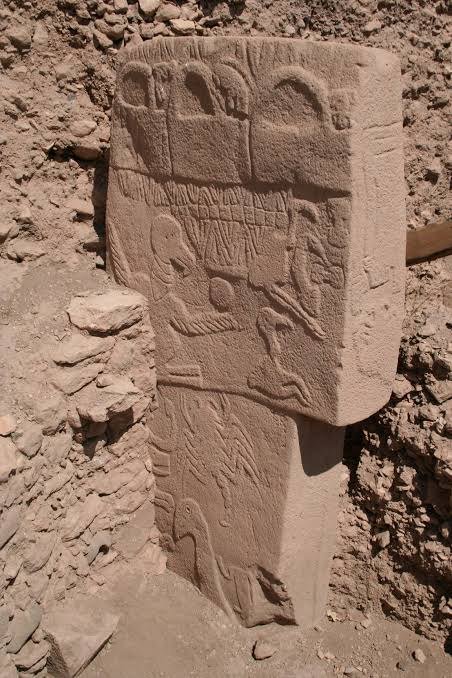
The pillars and walls of Göbekli Tepe are covered with animals — foxes, snakes, wild boar, aurochs (wild cattle), scorpions, spiders, and birds including vultures and cranes. What they meant to the people who carved them is not recoverable in detail, because those people left no writing. But the choices are far from random, and they tell us something real: this was a shared symbolic language, taken very seriously, that everyone in that world understood and we have largely lost.
The first clue: the wrong animals
The most telling pattern is what's missing. The bones at Göbekli Tepe are dominated by gazelle — the animal people actually hunted and ate. Yet gazelle are almost absent from the carvings. Instead the walls favour dangerous, wild and powerful creatures: predators, snakes, scorpions, boar, vultures. Peter Pfälzner, Joris Peters and Klaus Schmidt noted this mismatch early on. Whatever the imagery was for, it was not a record of the menu. It was about something the animals represented, not something people ate.
The patterns that do emerge
Look closely and the bestiary is organised. Certain animals cluster in certain buildings — snakes dominate some pillars; foxes recur on the great central human-figures, sometimes carved as if held against the body like an attribute. Enclosure C is heavy with boar; the Vulture Stone in Enclosure D gathers birds around a headless human figure. This looks less like decoration sprinkled across the stone and more like specific creatures assigned to specific places and figures — a grammar, even if we can't translate the words.
What archaeologists actually propose
A few serious readings recur. One is that particular animals were emblems of particular groups — a kind of totemism, where different communities or lineages who gathered at the hill were marked by different creatures (this would explain why animals cluster by enclosure). Another links much of the imagery to death: vultures across the Neolithic Near East are tied to the treatment of the dead, and Göbekli Tepe has produced human skull fragments with deliberate cut-marks — so the animals may sit at the meeting point of belief, death and identity. A third, simpler reading is that these were the powerful and dangerous beings of the people's cosmology — the forces you carve because they matter, not because you eat them. These aren't mutually exclusive.
A perspective you won't often see
Here's an angle competitor pages tend to skip: the same idea — gathering dangerous animals into human space — shows up at Göbekli Tepe in two different forms. On the pillars, predators are carved. Thirty-five kilometres away at Karahan Tepe, excavators found the actual bones of predators — leopard, wolf, vulture — collected and handled with unusual care. Carved predators and collected predators look like two expressions of one belief: that the dangerous animals were not to be feared and forgotten but deliberately brought close and kept. Read that way, the Göbekli carvings aren't a bestiary to admire; they're a way of holding power in the room.
Where honesty draws the line
Being specific about uncertainty matters more than a blanket 'we don't know.' Take the foxes: they are clearly, unmistakably foxes, and they clearly cluster on the central pillars — but archaeologists genuinely cannot say whether a fox stood for a social group, a dangerous trickster-like being, a mythic character in a story now lost, or something specific to those particular enclosures. That is the real state of knowledge. What we can rule out is the opposite error: anyone who claims a fully decoded message — a calendar, a star map, a dated catastrophe — is reaching well past the evidence.
Not a catalogue of local wildlife
One reading can be set aside fairly confidently. Lee Clare has stressed that the pillar imagery should not be treated as a record of animals people happened to see in the landscape around them.
The crane, the boar, the fox and the rest are better understood as narrative material — figures belonging to stories that a Neolithic viewer would have recognised, carved into a built environment rather than sketched from life. The animals are characters, not observations.
That is why the selection is so skewed towards the dangerous and the inedible. A catalogue of the local fauna would look nothing like this. A cast of characters might.
Common questions
What animals are carved at Göbekli Tepe?
Foxes, snakes, wild boar, aurochs, scorpions, spiders, and birds such as vultures and cranes — overwhelmingly wild and dangerous animals rather than the gazelle people actually ate.
Do the carvings tell a story?
Probably, but we can't read it. The recurring, patterned imagery — animals clustered by building and figure — suggests a shared mythology or system of emblems, though its specific meaning is lost. Claims of a single decoded message go beyond the evidence.
Why carve dangerous animals and not prey?
It's one of the site's defining puzzles. Gazelle dominate the bones but are nearly absent from the walls, while predators, snakes and vultures dominate the carvings — a strong sign the imagery was symbolic rather than a record of diet.
Sources & further reading4 references
- Peters, J. & Schmidt, K. (2004). Animals in the symbolic world of Pre-Pottery Neolithic Göbekli Tepe, south-eastern Turkey: a preliminary assessment. Anthropozoologica 39(1): 179–218.
- Schmidt, K. (2012). Göbekli Tepe: A Stone Age Sanctuary in South-Eastern Anatolia. Berlin: ex oriente. The foundational monograph by the site's first excavator.
- Notroff, J., Dietrich, O. & Schmidt, K. (2014). Building Monuments, Creating Communities. Early monumental architecture at Pre-Pottery Neolithic Göbekli Tepe. In J.F. Osborne (ed.), Approaching Monumentality in Archaeology: 83–105. Albany: SUNY Press.
- Clare, L. (2025). Public lectures and interviews on Göbekli Tepe (Göbekli Tepe Project, DAI). Transcribed talks and interviews held in the Taş Tepeler research atlas. Spoken material rather than a peer-reviewed publication; positions may be refined in print.
Full bibliography: the Taş Tepeler reference library →