Short answer
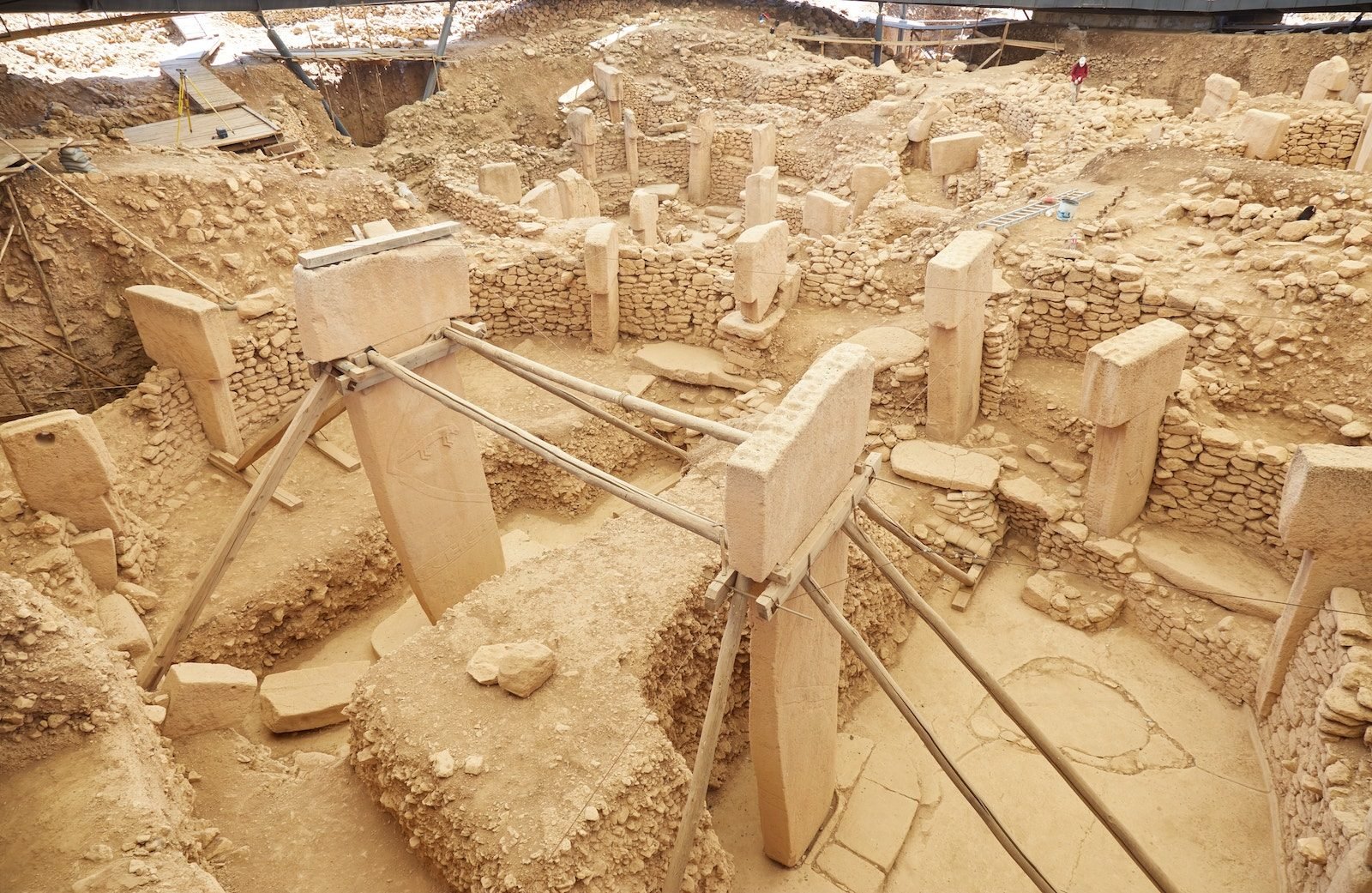
The T-pillars are Göbekli Tepe's signature: colossal T-shaped limestone monoliths carved as stylised human figures, with arms, hands and belts, standing in rings and covered in animal reliefs.
The tallest top five metres and weigh several tonnes; two giant pillars face each other at the centre of each enclosure, ringed by smaller ones set into the walls. The excavators now think these were roofed interiors rather than open-air stone circles, and read the central pairs as important beings — ancestors, spirits or mythic figures — presiding over those who gathered.
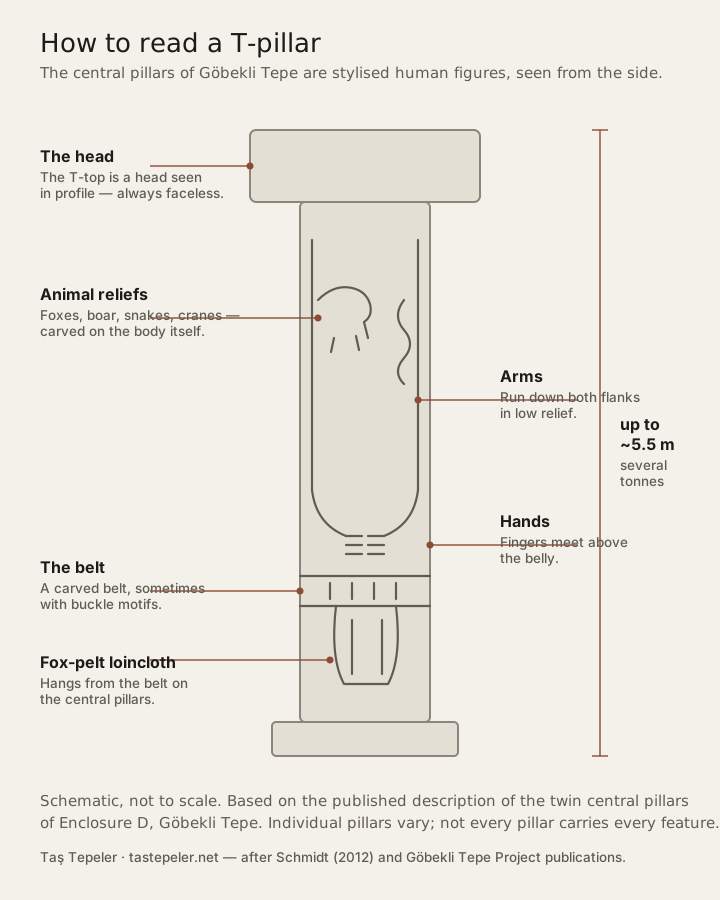
Reading a T-pillar
Left: Göbekli Tepe Project. Right: schematic diagram, Taş Tepeler.
Stone figures, not just posts
The T-shaped pillars are the signature of Göbekli Tepe. Each is a single piece of quarried limestone, shaped like a capital T — a tall shaft with a broad horizontal top. The largest stand over five metres and weigh several tons. Rings of them line the walls of each enclosure, with two much larger pillars set facing each other at the centre.
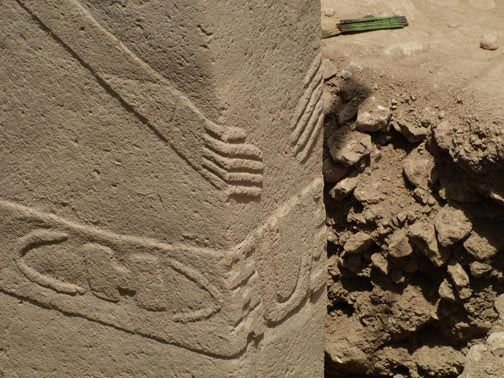
They are not abstract markers. The central pillars are human figures rendered in stone: the flat top is a head seen from the side, arms run down the flanks, and hands reach around to meet over the belly, above a carved belt and a fox-pelt loincloth. Once you see it, you can't unsee it — these are colossal, faceless people, standing in a ring as if in council.
A gallery carved in stone
What makes the pillars endlessly rewarding is what's carved on them. Their surfaces crawl with animals — foxes, snakes, wild boar, aurochs, cranes, scorpions, spiders, and vultures — chosen almost entirely from the wild and the dangerous, not the everyday. Each pillar is different, and many read like a page from a story we can see but not translate.
A few go further still. On Pillar 27 in Enclosure C, a snarling predator is carved in rare high relief, almost climbing off the stone in three dimensions, with a smaller animal caught beneath it. Predators like this seem to speak of power, threat, and protection: guardians as much as decorations. On the famous Vulture Stone (Pillar 43), a vulture, a scorpion, and a headless human figure compose a scene about death itself. The animals aren't a menagerie. They're a language.
How they were made — and how long they mattered
The pillars were cut from limestone in quarries a short walk away, where at least one unfinished example still lies half-freed in the bedrock. Moving and raising them — without metal tools, draft animals, or the wheel — took timber, rope, and the coordinated effort of many people.
And they mattered for a very long time. Göbekli Tepe was not a single event but a place built on, altered, and returned to across many centuries — well over a thousand years of gathering and rebuilding on the same hill. Whole generations lived and died in the shadow of these stone beings.
What they represent
The prevailing reading is that the central pairs are important beings — ancestors, spirits, or mythic figures — presiding over the gathering, while the ring of surrounding pillars may stand for a community gathered around them. The animals carved across each one likely tied that figure to particular stories, powers, or identities we can no longer fully read. What's certain is that to raise a ring of five-metre stone people, over and over, for centuries, these figures had to mean something enormous.
They were probably not open-air stone circles
Almost every popular image of Göbekli Tepe shows rings of freestanding stones standing open to the sky, like a Neolithic Stonehenge. The excavation's own reading is different.
Lee Clare has argued that the T-pillar buildings were not freestanding circles at all. The wall-pillars were set into walls rather than standing alone, the tall central pillars would have needed structural support, and the buildings were most likely roofed.
That changes what you should picture. Not an open ring under the sky, but an enclosed room — dim, walled, entered deliberately, with the two great pillars carrying the roof above the people gathered between them. It also makes better sense of the benches around the walls, which are furniture for an interior.
This is a case where the popular image and the excavation's interpretation have drifted apart, and the popular image is winning.
Pillars to meet
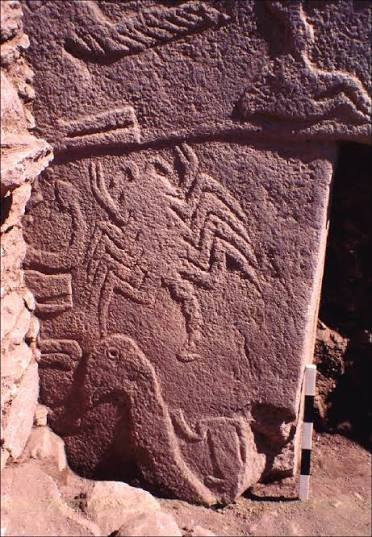 The Vulture Stone (Pillar 43)A vulture, a scorpion, and a headless figure — the most argued-over carving at the site.
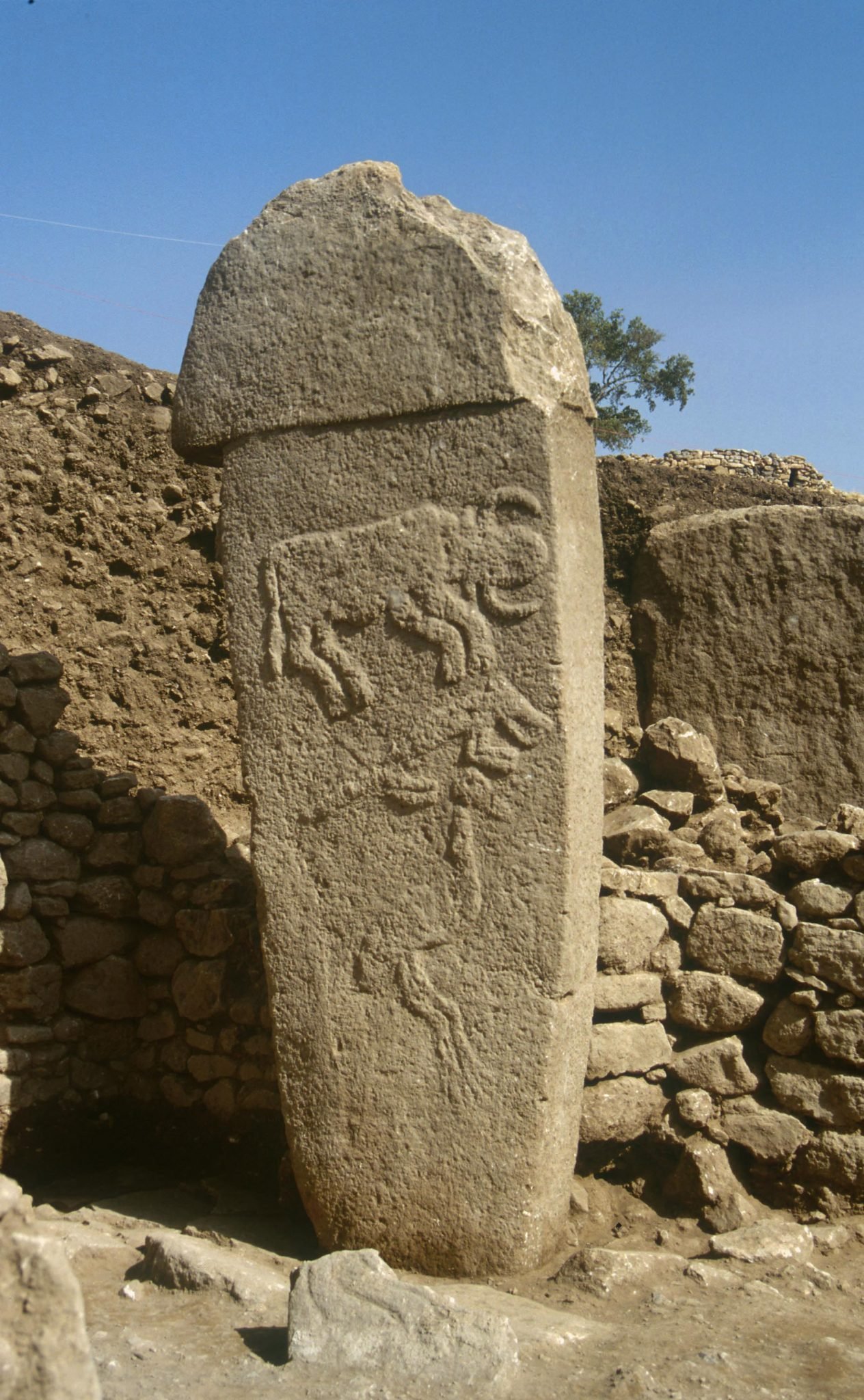 A central pillar (Pillar 2, Enclosure A)A central T-pillar carved down its side with an aurochs, a fox and a crane.
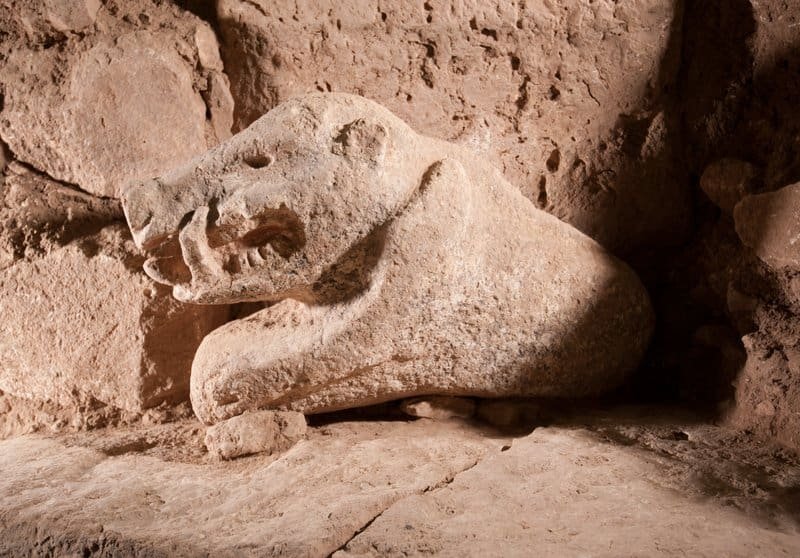 A carved boarA wild boar sculpted almost in the round — one of the animals that recur across the pillars and enclosures.
Common questions
How tall are the Göbekli Tepe pillars?
The central pillars can exceed five metres and weigh several tons; the surrounding ring pillars are smaller.
Are the T-pillars people?
The central ones clearly are — they have arms, hands, belts, and fox-pelt loincloths carved in relief, making them stylized human (or humanlike) figures.
What animals are carved on the pillars?
Foxes, snakes, wild boar, aurochs, cranes, scorpions, spiders, and vultures — mostly wild and dangerous animals. Some, like the predator on Pillar 27, are carved in dramatic high relief.
Sources & further reading4 references
- Schmidt, K. (2012). Göbekli Tepe: A Stone Age Sanctuary in South-Eastern Anatolia. Berlin: ex oriente. The foundational monograph by the site's first excavator.
- Haklay, G. & Gopher, A. (2020). Geometry and Architectural Planning at Göbekli Tepe, Turkey. Cambridge Archaeological Journal 30(2): 343–357.
- Notroff, J., Dietrich, O. & Schmidt, K. (2014). Building Monuments, Creating Communities. Early monumental architecture at Pre-Pottery Neolithic Göbekli Tepe. In J.F. Osborne (ed.), Approaching Monumentality in Archaeology: 83–105. Albany: SUNY Press.
- Clare, L. (2025). Public lectures and interviews on Göbekli Tepe (Göbekli Tepe Project, DAI). Transcribed talks and interviews held in the Taş Tepeler research atlas. Spoken material rather than a peer-reviewed publication; positions may be refined in print.
Full bibliography: the Taş Tepeler reference library →