Short answer
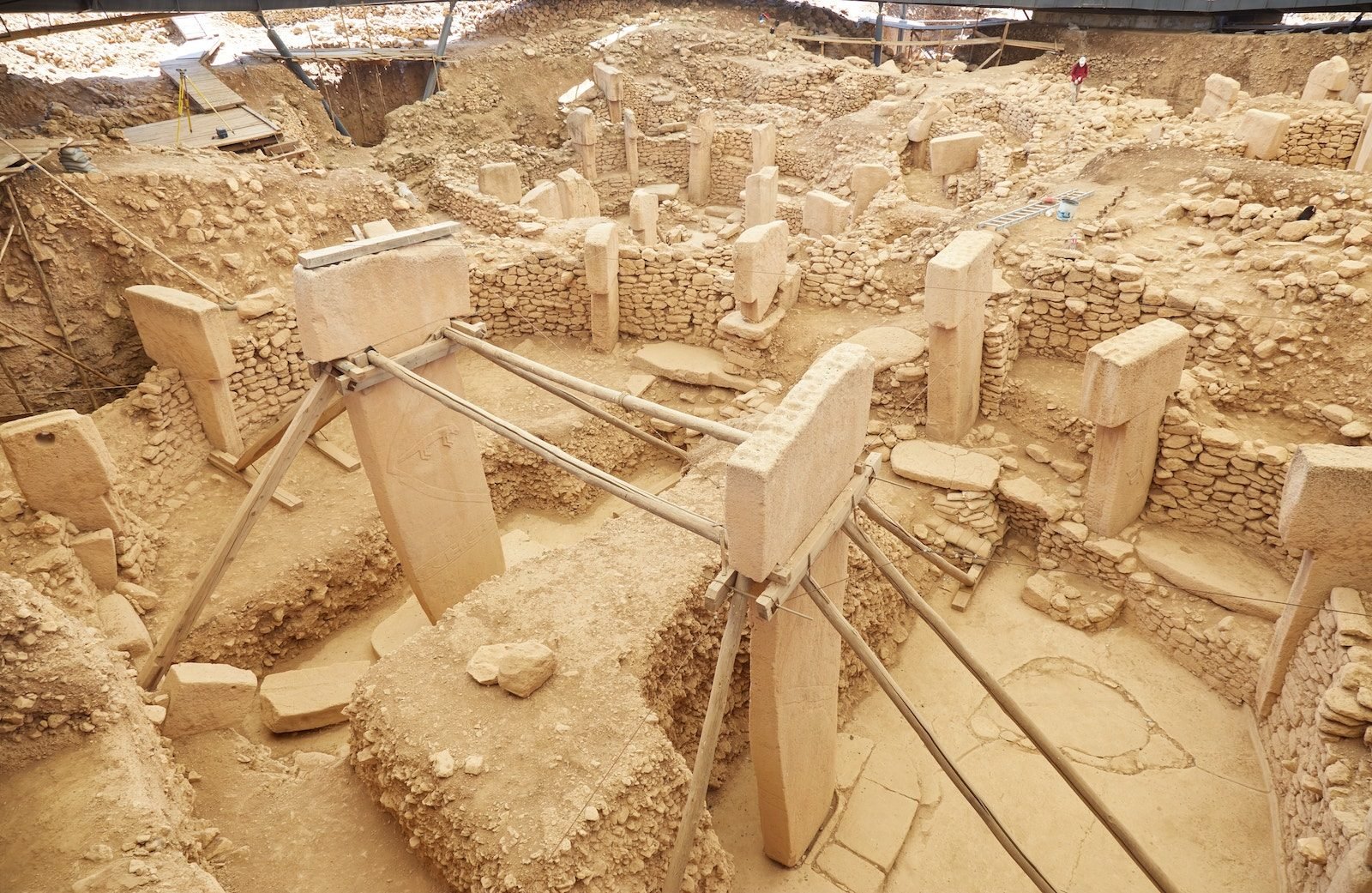
Göbekli Tepe is an 11,000-year-old hilltop sanctuary in southeastern Türkiye, where hunter-gatherers raised rings of giant carved T-shaped pillars — the oldest known monumental architecture on Earth, built before farming, pottery, metal or the wheel.
First mistaken for a low mound called Potbelly Hill, it holds a series of great oval enclosures ringed with stone benches and centred on pairs of towering, human-like pillars. Its date — around 9500 BCE — is what stunned archaeologists: it proved that mobile foragers, not settled farmers, raised the first monuments, forcing a rethink of how civilisation began.
The short version
Göbekli Tepe is a 11,000-year-old site of monumental stone buildings on a limestone ridge near Şanlıurfa in southeastern Türkiye. Its name means “Potbelly Hill” in Turkish, after the rounded mound that hid it for thousands of years.
What makes it extraordinary is its age. The great circular buildings here were raised around 9500 BCE — before farming, before pottery, before metal, writing, or the wheel. They were built by hunter-gatherers, which overturned the long-held assumption that only settled farming societies could organize labor on this scale.
What's actually there
The site is best known for its enclosures: large oval and circular buildings, each ringed by benches and set with T-shaped limestone pillars. The two biggest pillars stand at the center of each building, facing one another. Some reach over five metres tall and weigh several tons.
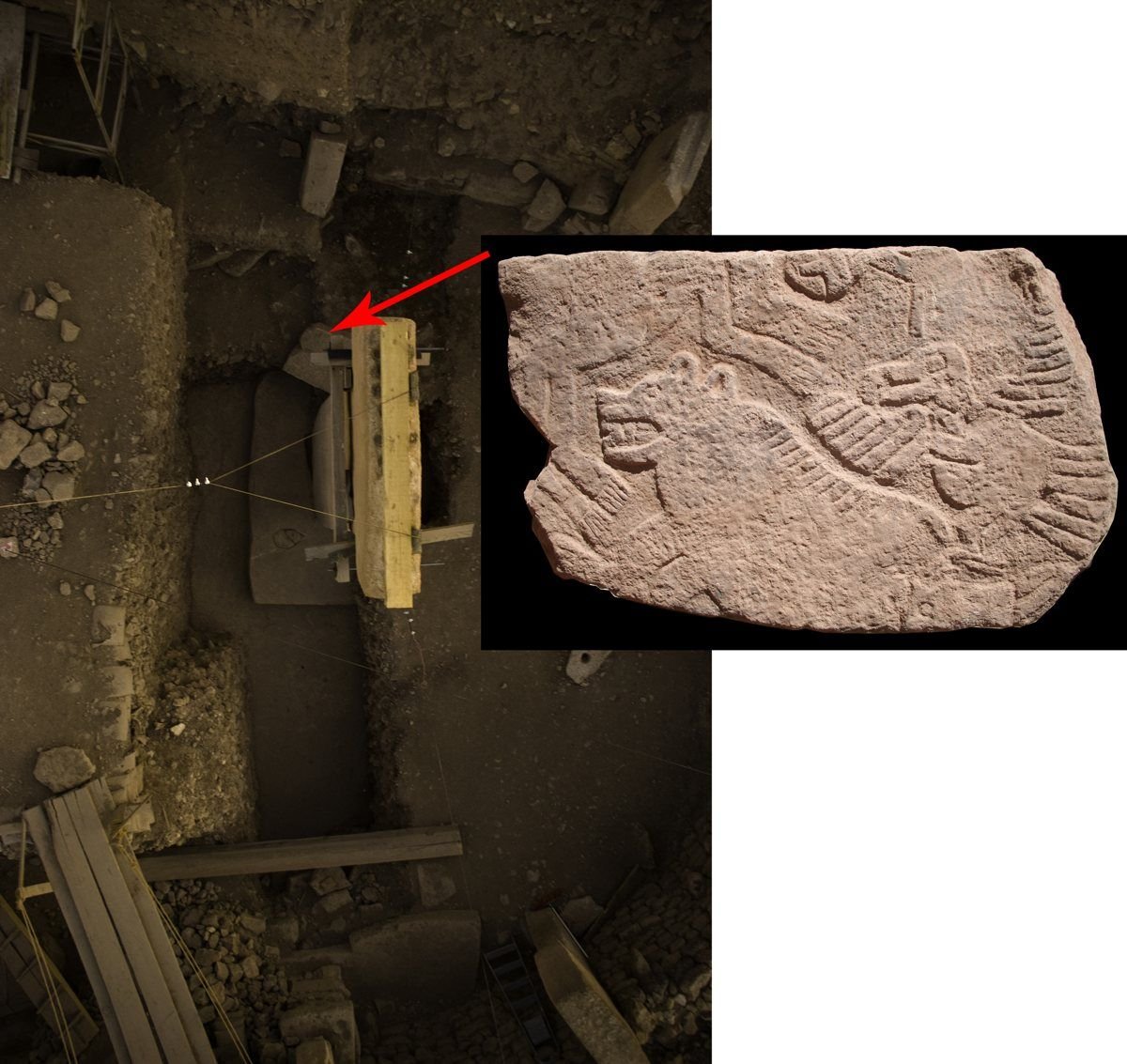
Those central pillars are not blank stones. They are stylized human figures — you can make out arms bent down the sides, hands meeting over the belly, and belts or loincloths carved in relief. Around them, the surfaces crawl with animals: foxes, snakes, wild boar, aurochs, scorpions, spiders, and birds. The site is a gallery of the Neolithic mind, carved before anyone had invented a written word.
Why it changed the story
For most of the twentieth century, archaeologists believed the sequence ran one way: people settled down, farmed, produced a surplus, and only then had the spare time and organization to build temples and monuments. Göbekli Tepe reversed that order. Here the monuments came first, built by mobile foragers who had not yet domesticated a single plant or animal.
That has led many researchers to argue that the desire to gather, build, and mark meaning may have helped drive the shift to farming — not the other way around. The debate is still open, which is part of what keeps the site at the center of Neolithic archaeology.
Hidden in plain sight for thirty years
Here's a twist rarely told: Göbekli Tepe was first noted in 1963, by a joint Istanbul–Chicago survey that saw the broken limestone slabs poking from the mound — and dismissed them as a medieval cemetery. The oldest monument on Earth sat catalogued and ignored for three decades, because no one expected hunter-gatherers to have built anything worth a second look.
It took Klaus Schmidt, returning in 1994, to recognise what the 'gravestones' really were. The lesson is as much about us as about the site: what you can see depends on what you believe is possible. And Göbekli Tepe is not a lone marvel — it is the best-known of the Taş Tepeler, a whole landscape of related sites raised in the same centuries.
Only a fraction has been dug
For all its fame, Göbekli Tepe has barely been touched. Geophysical survey shows the mound hides far more than the handful of excavated enclosures — by the commonly cited estimate, only around a twentieth of the site has been dug — and the current team deliberately leaves most of it in the ground for future methods.
That is worth sitting with. The most important thing we know about the origins of monument-building rests on a small slice of one hill, inside a landscape of a dozen related sites that are only now being explored. Whatever Göbekli Tepe already is, it is also a question that is mostly still unanswered.
The things to see
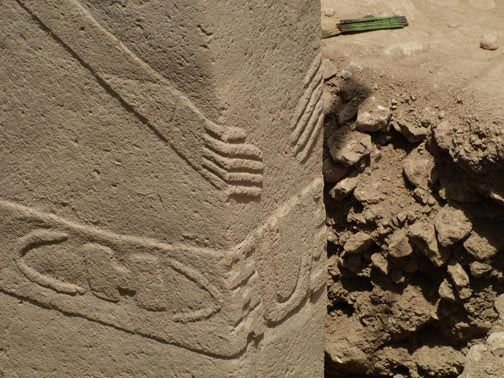 The central pillarsTwo five-metre pillars with carved arms, hands and a belt — bodies, not columns.
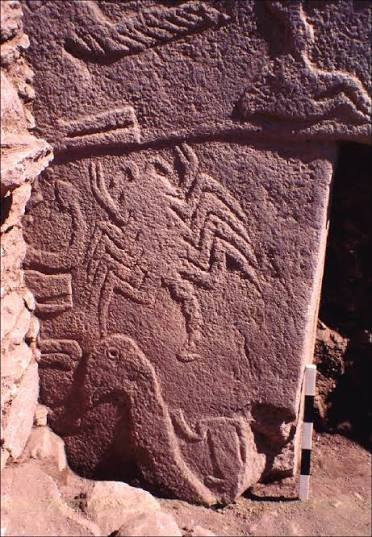 The Vulture StonePillar 43's crowded scene of vultures, a scorpion and a headless man.
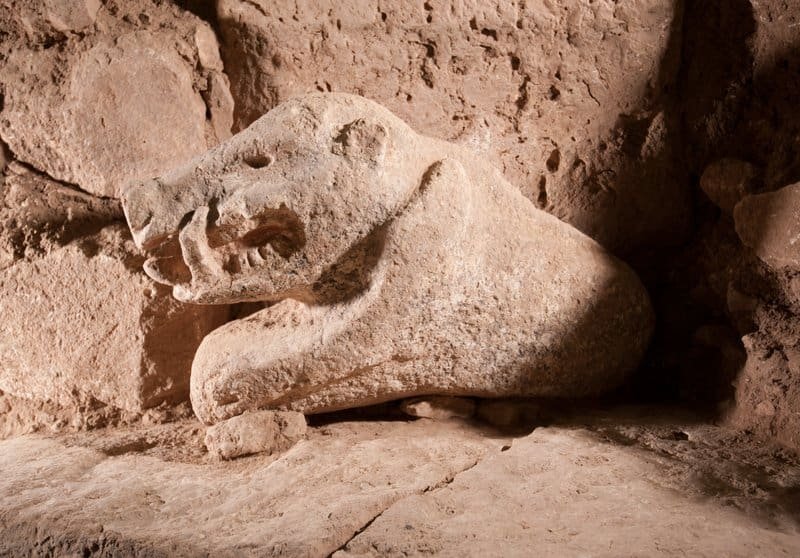 Carved, painted animalsFoxes, boars, snakes and cranes — one boar sculpture still held its red, black and white paint.
 The skull cultHuman skulls carved and drilled — a Neolithic cult of the head.
Common questions
Where is Göbekli Tepe?
On a limestone ridge about 15 kilometres northeast of Şanlıurfa in southeastern Türkiye. It is a UNESCO World Heritage Site and open to visitors.
How old is Göbekli Tepe?
Its monumental round buildings date to roughly 9500 BCE — about 11,500 years old, and around 7,000 years older than Stonehenge or the Egyptian pyramids.
Who built Göbekli Tepe?
Hunter-gatherers, before the adoption of farming, pottery, or metal. It is the strongest evidence we have that monumental building predates settled agriculture.
Sources & further reading5 references
- Schmidt, K. (2012). Göbekli Tepe: A Stone Age Sanctuary in South-Eastern Anatolia. Berlin: ex oriente. The foundational monograph by the site's first excavator.
- Clare, L. (2020). Göbekli Tepe, Turkey. A brief summary of research at a new World Heritage Site (2015–2019). e-Forschungsberichte des Deutschen Archäologischen Instituts 2020(2): 81–88.
- Dietrich, O., Heun, M., Notroff, J., Schmidt, K. & Zarnkow, M. (2012). The role of cult and feasting in the emergence of Neolithic communities. New evidence from Göbekli Tepe, south-eastern Turkey. Antiquity 86(333): 674–695.
- UNESCO World Heritage Centre (2018). Göbekli Tepe (inscription on the World Heritage List). UNESCO. link
- Notroff, J., Dietrich, O. & Schmidt, K. (2014). Building Monuments, Creating Communities. Early monumental architecture at Pre-Pottery Neolithic Göbekli Tepe. In J.F. Osborne (ed.), Approaching Monumentality in Archaeology: 83–105. Albany: SUNY Press.
Full bibliography: the Taş Tepeler reference library →