Short answer
Göbekli Tepe was built by hunter-gatherers — the local Neolithic communities of the Şanlıurfa hills, who lived by hunting wild game and gathering wild plants around 9500 BCE, long before farming, herding, pottery or metal.
They were not a lost civilisation or outsiders but skilled, coordinated foragers who gathered — probably seasonally — to quarry, carve and raise multi-tonne pillars, and to feast together. That people without farms or cities could organise building on this scale is exactly why the site rewrote prehistory.
The short answer: hunter-gatherers
Göbekli Tepe was built by hunter-gatherers — mobile communities in the hills of what is now Şanlıurfa province, in south-eastern Türkiye, who lived by hunting wild animals and gathering wild plants around 9500 BCE. They had no farms, no herds, no pottery and no metal. They were not a lost civilization and not outsiders: they were the local Neolithic people of the region, and Göbekli Tepe is one of several related sites — the Taş Tepeler, or 'Stone Hills' — they left across the same landscape.
That single fact is why the site matters so much. It means people organised the quarrying, carving, transport and raising of multi-ton limestone pillars before the things we once assumed such projects required — villages, agriculture, writing, kings.
How we know they were foragers
This isn't a guess; it rests on what came out of the ground. The animal bones from the monumental levels are overwhelmingly from wild species — gazelle above all, along with wild cattle (aurochs), wild boar, red deer, and birds — with no evidence of domesticated sheep, goat or cattle in that early phase. The plant remains are wild too: wild cereals and other gathered foods, not cultivated crops.
Domestication of plants and animals only appears in the region later. So the people who raised the great enclosures were, by definition, hunter-gatherers — which is precisely what makes the scale of their building so unexpected.
Coming together to build — and to feast
Raising a T-pillar that weighs several tonnes takes far more hands than a single foraging band. The best current reading, argued by Oliver Dietrich and colleagues of the excavation team, is that groups came together from across the region — probably seasonally — to build, and that large communal feasts were part of what drew and rewarded them.
The evidence for feasting is concrete: enormous quantities of wild animal bone, and stone vessels for preparing food and drink on a large scale, including limestone basins with capacities up to around 160 litres. Some researchers have suggested these may even have held fermented liquids. Whether or not that is right, the picture is of many people fed at once — the kind of gathering that both requires and reinforces cooperation.
Skilled hands and a shared visual language
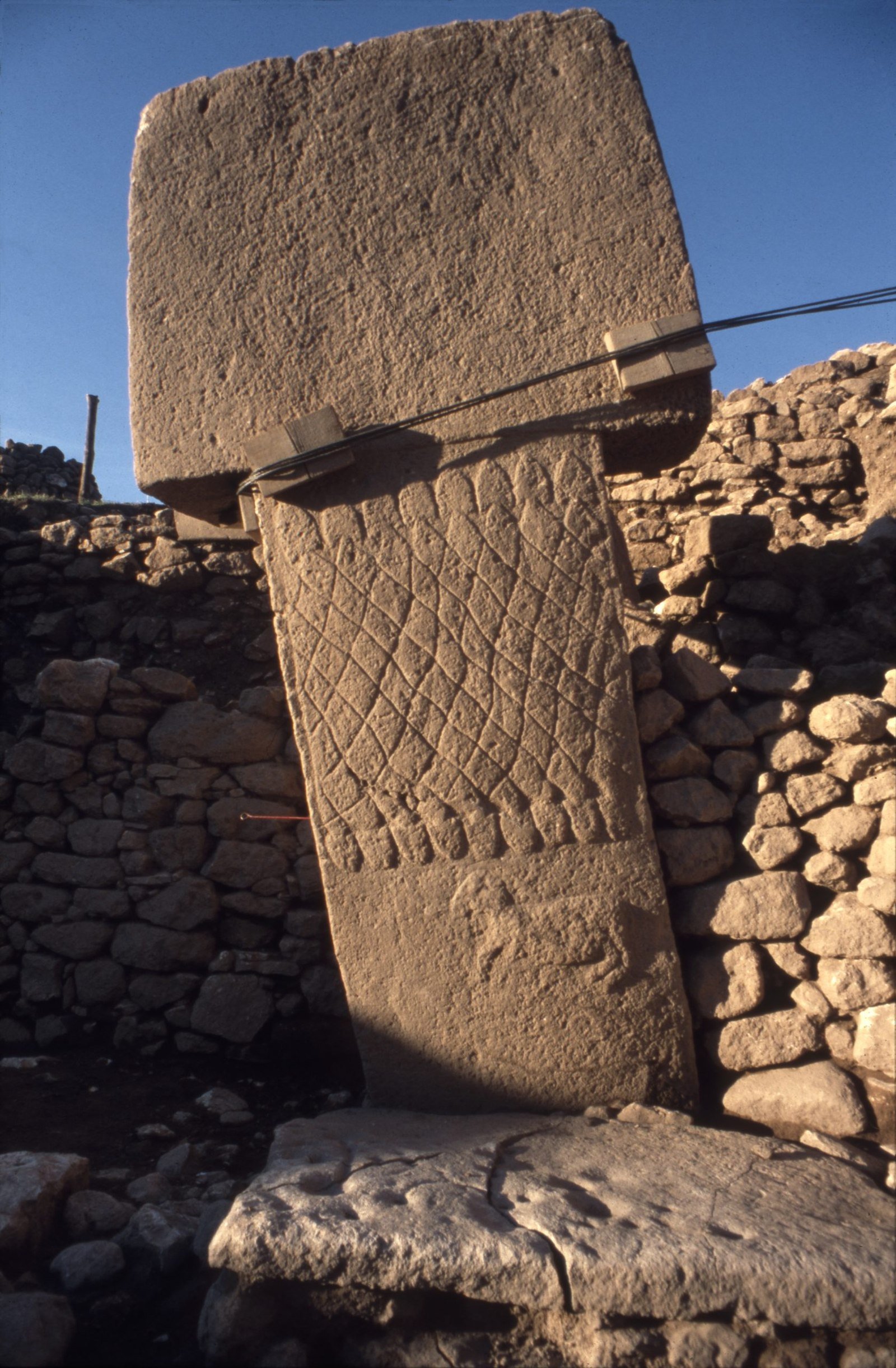
Whoever they were, they were not improvising. The animals are carved with real anatomical observation — you can tell a fox from a boar from a crane — and the human imagery follows a consistent code across different buildings: the T-pillars are stylised human figures, many with arms carved down their sides, hands meeting over the belly, and belts and loincloths. That consistency, repeated from enclosure to enclosure, means these communities shared symbols and almost certainly had people skilled enough to carve them.
In other words, this was a society with specialists, shared beliefs, and the social organisation to pool labour toward a single monumental goal — all without farming.
What we genuinely don't know
Being honest about the limits matters here. We do not know how many people were involved, whether the work was directed by leaders or organised more collectively, or how the labour was mobilised — no cemetery has been found that might show us how this society ranked its dead. We don't know what language they spoke, how they reckoned kinship, or whether the builders were one community or many loosely allied ones.
What we can say is bounded and specific: the builders were local hunter-gatherers, skilled and coordinated, who gathered at the hill over generations. The 'who' beyond that — their names, their politics, their leadership — is exactly what the stones do not record.
Why the answer matters
For a long time it was assumed that monuments came after farming and settled towns — that you needed surplus and hierarchy first. Göbekli Tepe reverses the order. It shows hunter-gatherers capable of monumental, symbolic, cooperative building, and it has fed a serious argument that the impulse to gather and build may have been one of the pressures that pushed people toward settling down in the first place, rather than a product of it.
Common questions
Did farmers build Göbekli Tepe?
No. It was built by hunter-gatherers before farming began in the region — the animal bones and plant remains from that phase are all from wild species. That is what makes it so significant.
How many people did it take to build it?
We don't know a number. Raising multi-ton pillars needed far more hands than a single foraging band, which points to groups gathering from across the region, but the labour force was never counted and no census survives.
Was Göbekli Tepe built by a lost civilization or aliens?
No. It was built by local Neolithic hunter-gatherer communities. The craftsmanship is remarkable but entirely human, and it belongs to the wider Taş Tepeler world of related sites nearby, such as Karahan Tepe and Nevalı Çori.
Sources & further reading4 references
- Dietrich, O., Heun, M., Notroff, J., Schmidt, K. & Zarnkow, M. (2012). The role of cult and feasting in the emergence of Neolithic communities. New evidence from Göbekli Tepe, south-eastern Turkey. Antiquity 86(333): 674–695.
- Schmidt, K. (2012). Göbekli Tepe: A Stone Age Sanctuary in South-Eastern Anatolia. Berlin: ex oriente. The foundational monograph by the site's first excavator.
- Notroff, J., Dietrich, O. & Schmidt, K. (2014). Building Monuments, Creating Communities. Early monumental architecture at Pre-Pottery Neolithic Göbekli Tepe. In J.F. Osborne (ed.), Approaching Monumentality in Archaeology: 83–105. Albany: SUNY Press.
- Clare, L. (2020). Göbekli Tepe, Turkey. A brief summary of research at a new World Heritage Site (2015–2019). e-Forschungsberichte des Deutschen Archäologischen Instituts 2020(2): 81–88.
Full bibliography: the Taş Tepeler reference library →