What's carved on it
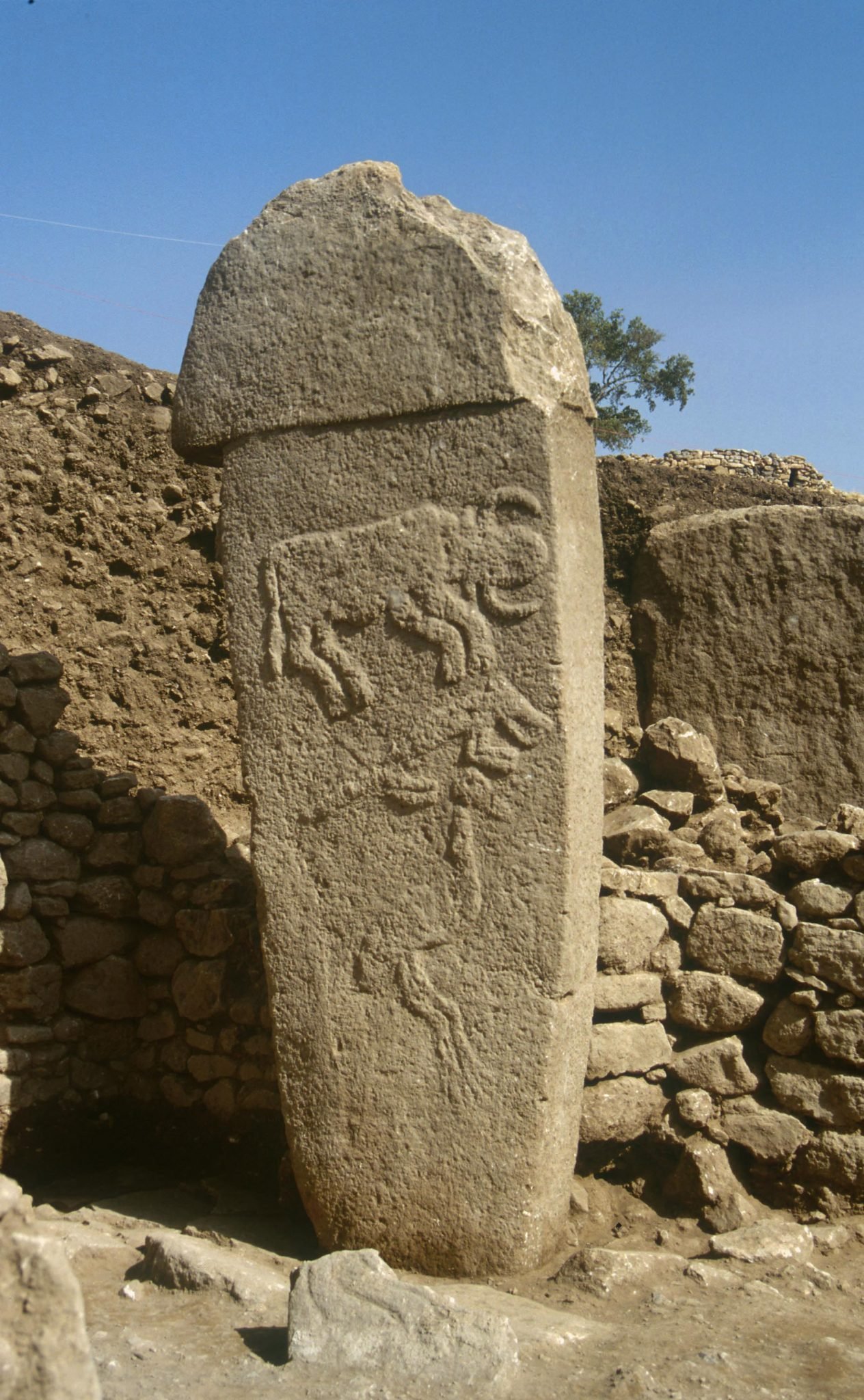
Pillar 2 is the partner of Pillar 1 at the centre of Enclosure A. Its most legible feature is a vertical sequence of three animals, stacked one above another down one side: an aurochs (the wild bull, with great forward-curving horns), a fox, and a crane. The three are read from top to bottom as a deliberate column rather than a scatter.
On the pillar's narrower back side is a bucranium — a frontal bull's head — set between the vertical bands of a stola-like garment, the same clothing convention seen on the other central pillars. As on Pillar 1, the banding marks the whole stone as a stylised human figure that carries the animal imagery on its body.
The crane with human-like legs
The crane on Pillar 2 is one of the reasons this stone matters beyond its own enclosure. Its legs are carved with an oddly human stance — the same peculiarity found on the cranes of Pillar 33 in Enclosure D. Having the trait on two different pillars, in two different buildings, turns a single curiosity into a small pattern: the Göbekli Tepe carvers seem, at least sometimes, to have blurred bird and human deliberately. Peters and Schmidt, who studied the animal imagery, treated cranes as one of the meaningful bird species in the site's repertoire rather than incidental wildlife.
The aurochs–fox–crane column also invites comparison across the site, because the same animals recur in different combinations from pillar to pillar. That repetition is itself the evidence: these were a shared vocabulary of images, arranged and rearranged, not one-off illustrations.
What's established, and what's debated
What is established is unusually clear here, because Pillar 2 is one of the better-preserved central pillars and can be photographed as it stands: the vertical aurochs–fox–crane column, the bucranium set between garment bands on the narrow back, and the pillar's status as one of Enclosure A's two central figures are all securely recorded. The garment banding, read against the explicit arms, hands and belts of Enclosure D's central pillars, makes the human-figure identity well founded rather than speculative.
What is debated is the reading of the images — whether the three-animal column tells a sequence or simply groups charged creatures, and whether the human-legged crane represents a masked person. As with the rest of the site, these questions remain open, and the safest ground is the carving itself, not any single decoding of it.
Where it stands, and what's still unclear
Pillar 2 belongs to Enclosure A, part of Göbekli Tepe's earliest monumental phase in the Pre-Pottery Neolithic A, built in the centuries around 9500 BCE. Enclosure A is one of the more lightly excavated of the four main enclosures and was investigated relatively early, so its full plan and the precise original setting of its central pillars are less firmly established than those of Enclosure D. Any strong claim about how Pillar 2 was arranged, or whether it stands exactly as first placed, should be treated with corresponding caution. The carvings themselves, however — the bull, fox and crane, and the snake-and-ram imagery on its partner Pillar 1 — are what make this central pair one of the clearest windows into Enclosure A's world.
Sources & further reading4 references
- The Tepe Telegrams (Göbekli Tepe Project, DAI) (2017). Enclosure A, a short overview. Deutsches Archäologisches Institut, 5 January 2017. link
- Schmidt, K. (2012). Göbekli Tepe: A Stone Age Sanctuary in South-Eastern Anatolia. Berlin: ex oriente. The foundational monograph by the site's first excavator.
- Peters, J. & Schmidt, K. (2004). Animals in the symbolic world of Pre-Pottery Neolithic Göbekli Tepe, south-eastern Turkey: a preliminary assessment. Anthropozoologica 39(1): 179–218.
- Notroff, J., Dietrich, O. & Schmidt, K. (2014). Building Monuments, Creating Communities. Early monumental architecture at Pre-Pottery Neolithic Göbekli Tepe. In J.F. Osborne (ed.), Approaching Monumentality in Archaeology: 83–105. Albany: SUNY Press.
Full bibliography: the Taş Tepeler reference library →