What's carved on it
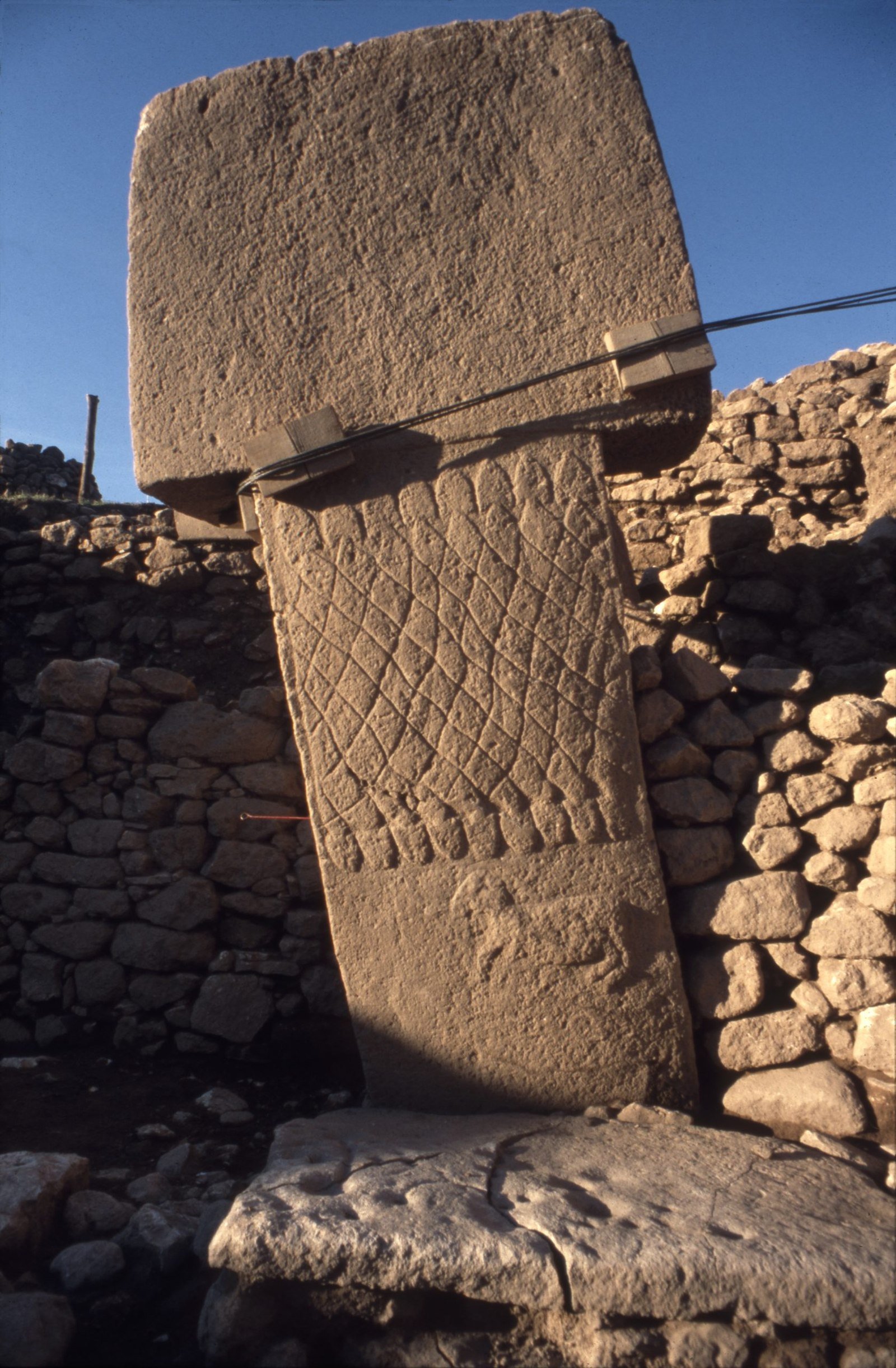
Pillar 1 is one of the two central pillars of Enclosure A — the pair of tall stones that stand at the heart of the enclosure, the largest and most important figures in any Göbekli Tepe building. Its best-known feature is a net-like pattern made of snakes: interwoven serpent bodies forming a dense mesh across the stone, with a ram carved below the netting.
A groove-and-band feature on the front of the pillar carries a further five snakes in bas-relief. On the central pillars this kind of vertical banding is generally read as clothing — a belt or stola-like garment worn by the pillar — which fits the wider understanding that these great central stones are not columns but stylised human figures.
A pillar that is a person
Enclosure A's central pillars belong to the same family as the celebrated central pillars of Enclosure D, where arms, hands, belts and a fox-pelt loincloth make the human reading unmistakable. Pillar 1 is more worn and less fully excavated, but the logic is the same: the snake-band running down its front sits where a garment would fall on a body. So the imagery works on two levels at once — a ram and a woven mass of snakes as subjects, and the whole pillar as a towering clothed figure that carries them.
The snake, more than almost any other creature, dominates Enclosure A. Making Pillar 1's central motif a net of snakes concentrates that theme into a single emblem at the very centre of the building.
What's established, and what's debated
The established part is the carving. The interwoven snake-net, the ram beneath it, and the band of five snakes in low relief down the front are legibly worked into the stone and securely recorded — and Enclosure A as a whole is unusually saturated with serpents, so the snake-net is a concentration of a theme that runs through the building rather than a one-off. That this is one of the enclosure's two central pillars is also firmly established.
The debated part is meaning. Reading the pillar as a clothed human figure rests on analogy with the central pillars of Enclosure D, where arms, hands, a belt and a fox-pelt loincloth make the human identity explicit; Pillar 1 is more worn and does not itself preserve arms or hands, so the human reading, while well supported, is inference rather than something the stone spells out. What the snake-net and ram signified to the people who made them is unknown, and no serious account claims otherwise.
Where it stands, and what's still unclear
Pillar 1 stands in Enclosure A, part of Göbekli Tepe's early monumental architecture in the Pre-Pottery Neolithic A, built in the centuries around 9500 BCE. Enclosure A is among the less fully excavated of the four main enclosures, and it was reached early in the project's history when recording methods were still developing, so its plan and the original arrangement of its pillars are less securely understood than Enclosure D's. What is clear is the imagery itself: the snake-net, the ram, and the banded snakes that mark this stone as one of the two figures around which the whole enclosure was built.
Sources & further reading3 references
- The Tepe Telegrams (Göbekli Tepe Project, DAI) (2017). Enclosure A, a short overview. Deutsches Archäologisches Institut, 5 January 2017. link
- Schmidt, K. (2012). Göbekli Tepe: A Stone Age Sanctuary in South-Eastern Anatolia. Berlin: ex oriente. The foundational monograph by the site's first excavator.
- Peters, J. & Schmidt, K. (2004). Animals in the symbolic world of Pre-Pottery Neolithic Göbekli Tepe, south-eastern Turkey: a preliminary assessment. Anthropozoologica 39(1): 179–218.
Full bibliography: the Taş Tepeler reference library →