What's carved on it
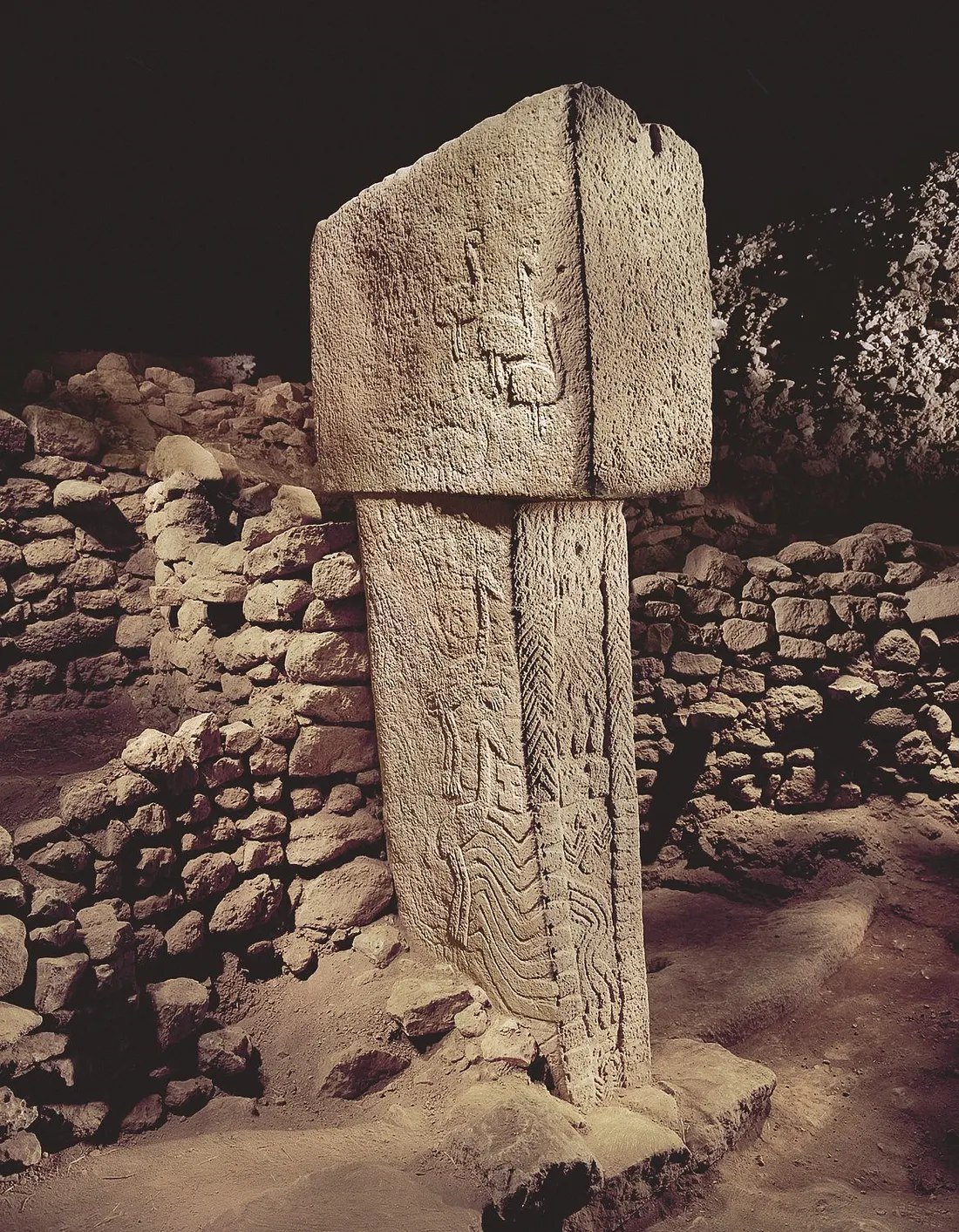
Pillar 33 is one of the wall pillars of Enclosure D, the best-preserved and most completely exposed of Göbekli Tepe's circular buildings. Its surface is more weathered than some of its neighbours, but the composition is still legible, and it is unusual because the two broad sides are carved as a matched pair.
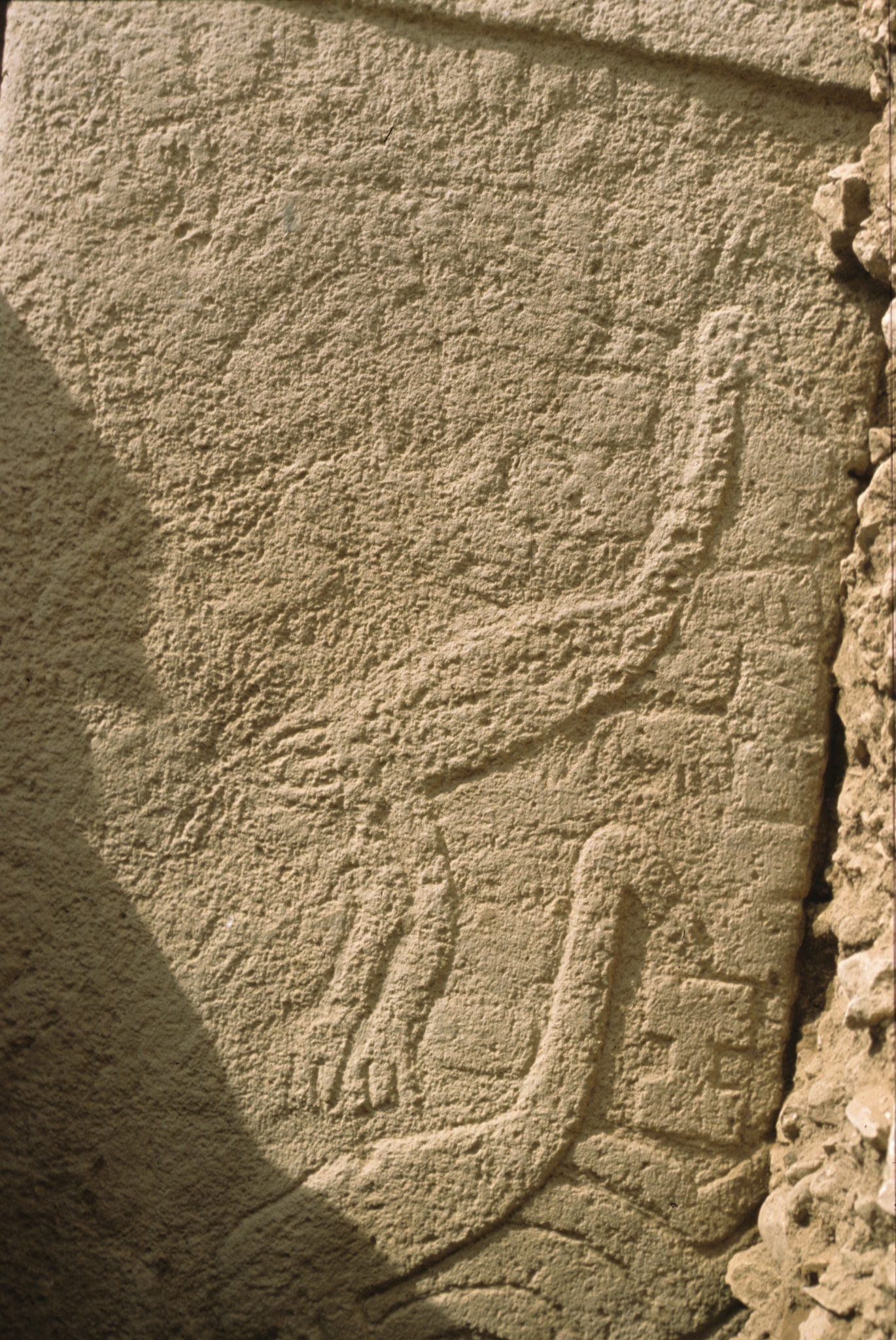
One broad side carries tall cranes, along with duck-like water birds, angular H-shaped signs, and a large bundle of snakes. The opposite broad side shows a fox together with a comparable mass of snakes. In both cases the snakes appear to issue from the animals' bodies — surging from the fox's torso and from the region of the birds' legs — and both bundles then turn the corner onto the front of the pillar, where the snakes' heads come together at the sides.
Two faces that answer each other
What lifts Pillar 33 above a simple animal list is how its two broad sides are composed as a matched pair. Each side carries a large mass of snakes; on one they pour from the region of the birds, on the other from the body of the fox. In both cases the serpents then wrap the corner onto the narrow front, where their heads gather at the sides — so the carving is not confined to flat panels but is worked around the three-dimensional stone as a single continuous field.
That deliberate wrapping is the point. The carvers treated the pillar as a solid object to be read in the round, not as a slab with pictures on its faces. It is one of the clearest cases at Göbekli Tepe of a composition planned across a pillar's whole surface rather than added panel by panel.
Birds with strangely human legs — what's established and what's debated
What is established is the imagery itself: cranes, duck-like water birds, angular H-signs, a fox, and the great bundles of snakes are all legibly carved and securely recorded, on a wall pillar that still stands in its original place in Enclosure D. The cranes belong to a small, much-discussed group of Göbekli Tepe birds whose legs read as oddly human — knees and stance closer to a standing person than to a wading bird — and the same peculiarity appears on Pillar 2 in Enclosure A, which lets the two be compared rather than dismissed as a single quirk.
What is debated is what any of it meant. Peters and Schmidt, cataloguing the animals, treated cranes as a bird the carvers singled out deliberately, and some researchers read the human-legged cranes as people in bird costume — masked dancers rather than wildlife. That reading is plausible but unproven. Pushed much further, some popular writers have read the snakes as meteors and the whole panel as an astronomical scene; those interpretations sit well outside the archaeological mainstream and rest on assumptions the site's excavators reject. The honest limit is that snakes streaming from a fox's belly and cranes on human legs are plainly not naturalistic, and their symbolic rules are lost to us.
Where it stands, and how old it is
Enclosure D belongs to Göbekli Tepe's earliest, Pre-Pottery Neolithic A phase, built in the centuries around 9500 BCE and radiocarbon-dated in known stratigraphic positions — making Pillar 33 and its carvings roughly eleven thousand years old. The pillar remains set in the ring of the enclosure, a few places around from the famous Vulture Stone (Pillar 43), part of the same crowded, death-and-danger imagery that fills this building. Read together, the pillars of Enclosure D show a single visual language repeated and varied around one great room.
Sources & further reading4 references
- Peters, J. & Schmidt, K. (2004). Animals in the symbolic world of Pre-Pottery Neolithic Göbekli Tepe, south-eastern Turkey: a preliminary assessment. Anthropozoologica 39(1): 179–218.
- Schmidt, K. (2012). Göbekli Tepe: A Stone Age Sanctuary in South-Eastern Anatolia. Berlin: ex oriente. The foundational monograph by the site's first excavator.
- Notroff, J., Dietrich, O. & Schmidt, K. (2014). Building Monuments, Creating Communities. Early monumental architecture at Pre-Pottery Neolithic Göbekli Tepe. In J.F. Osborne (ed.), Approaching Monumentality in Archaeology: 83–105. Albany: SUNY Press.
- The Tepe Telegrams (official research blog of the Göbekli Tepe Project, DAI). The Tepe Telegrams. Deutsches Archäologisches Institut. link Accessible, authoritative running commentary from the excavation team.
Full bibliography: the Taş Tepeler reference library →