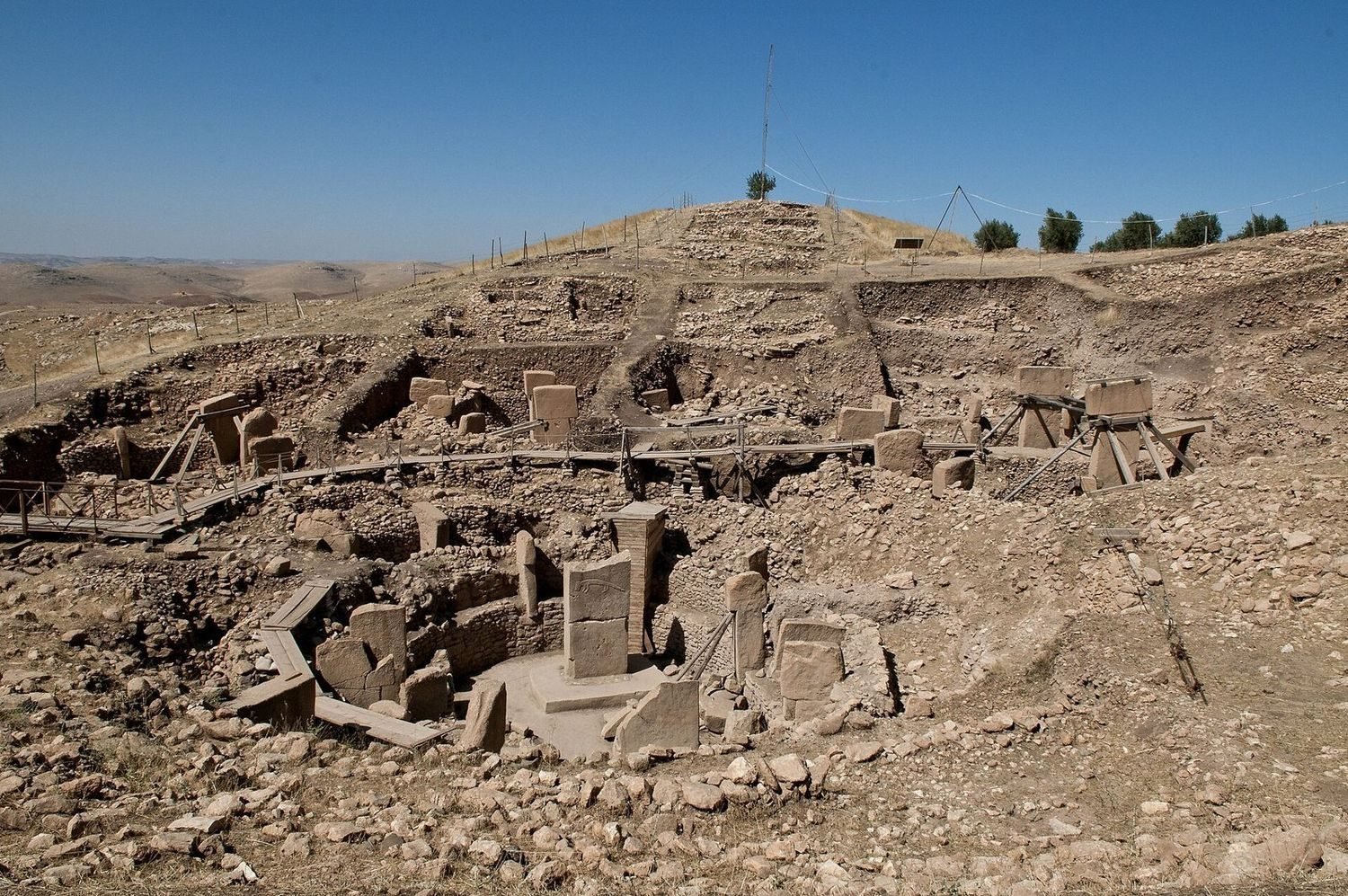
Inside the site
Central Şanlıurfa · Southeastern Türkiye
A Neolithic findspot inside modern Şanlıurfa, near the Balıklıgöl pools — where T-pillar evidence and the famous life-sized statue known as Urfa Man came to light within the living city.
Yeni Mahalle in context
Yeni Mahalle is a Neolithic findspot inside modern Şanlıurfa, near the sacred Balıklıgöl pools — not a remote hill but a spot within the living city. It is best known as the discovery place of the so-called 'Urfa Man' (the Balıklıgöl statue), together with T-pillar evidence that shows the Neolithic world reached right into what is now the urban centre.
That a site of this importance sits beneath a modern neighbourhood is a reminder of how densely the early Neolithic occupied this landscape — and how much of it lies under later towns.
Urfa Man is the reason the findspot is famous. Carved from limestone and standing about 1.8 metres tall, it is one of the oldest known life-size statues of a human being — a standing male figure with obsidian-inlaid eyes, no depicted mouth, and hands brought together at the front of the body.
It belongs to the same Taş Tepeler world of human representation seen at Göbekli Tepe and Karahan Tepe — but where those sites give abstract, T-shaped bodies, Urfa Man is startlingly direct: a whole person, staring back across eleven thousand years. The statue now stands in the Şanlıurfa museum.
Because Yeni Mahalle was investigated as a rescue findspot within a built-up area rather than as an open excavation, the full context of Urfa Man and the associated T-pillar material is less complete than at the great open sites. Its exact relationship to Göbekli Tepe and Karahan Tepe — contemporary, earlier, or later — rests on the statue's style and the limited stratigraphy recovered, and is best treated as broadly, not precisely, placed within the T-pillar horizon.
Inside the site
The wider world
Yeni Mahalle is where the Neolithic surfaces inside modern Şanlıurfa — the findspot of Urfa Man, tying the living city directly into the Taş Tepeler world.
Visit
Small-group and private tours across the Taş Tepeler landscape, led by people who know the ground.
Full bibliography: the Taş Tepeler reference library →
Last reviewed 7 October 2026. Something wrong?