Short answer
Taş Tepeler is a group of about twelve Neolithic sites in the hills of Şanlıurfa, Türkiye — Göbekli Tepe, Karahan Tepe, Sayburç, Sefertepe and others — built and used by the same world of hunter-gatherers between roughly 10,000 and 8,000 BC.
The name means "Stone Hills." It is also the name of the research programme, launched in 2021, that studies the whole cluster together instead of treating Göbekli Tepe as a lone marvel. That shift — from one hill to a landscape — is the single most important thing to understand about the subject.
The Stone Hills
For most people the story begins and ends with one place: Göbekli Tepe, the hill of carved pillars older than the pyramids. That story is true. It is also less than half of what happened here.
Spread across the limestone country around Şanlıurfa is a whole family of sites that share the same deep age, the same T-shaped pillars, the same vocabulary of foxes and snakes and vultures and human heads. Archaeologists gave the group a name that is deliberately plain — Taş Tepeler, the Stone Hills — because the point of the name is the plural. There was never a single sanctuary that scattered bands visited. There was a populated landscape of communities, each building its own version of the same astonishing idea.
The sites usually counted in the cluster are Göbekli Tepe, Karahan Tepe, Sayburç, Sefertepe, Çakmaktepe, Harbetsuvan, Ayanlar Höyük, Gürcütepe, Kurt Tepesi, Söğüt Tarlası, Yoğunburç and Yeni Mahalle — roughly a dozen, with more identified every few years as survey continues. In early 2026 a thirteenth kind of node appeared: Göbekli-style T-pillars surfaced at Samsat, in neighbouring Adıyaman province, the first sign the horizon reaches beyond Şanlıurfa altogether.
One world, many hands
What makes the cluster more than a list is that the sites are clearly related and clearly different. They share a grammar — the T-pillar as a stylised human body, the ring of stone, the animal reliefs, the treatment of the human head — but each community worked that grammar in its own hand.
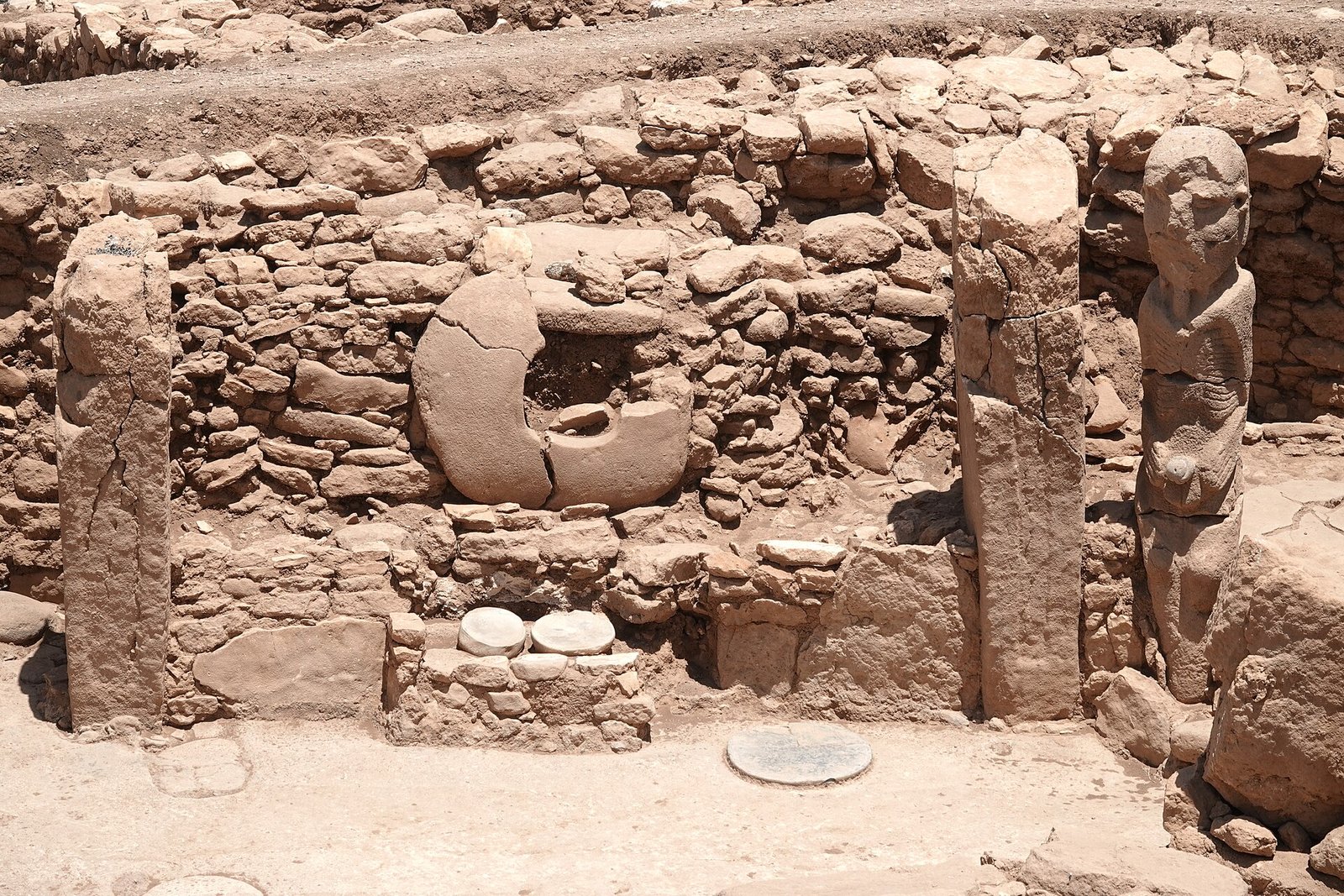
Göbekli Tepe raised great open rings on a hilltop with no spring. Karahan Tepe cut its chambers down into the bedrock, subtractive where Göbekli was additive, and left a room of phallic pillars watched over by a human head growing out of the rock. Sayburç carved a narrative scene onto a bench — a man between two leopards, facing a bull — one of the oldest stories ever set in stone. Sefertepe kept its dead as skulls in a small chamber and its art in beads small enough to hold. Same world; different dialects.
That variety is the discovery. It means these were not identical outposts of one cult but distinct communities in conversation — competing, perhaps, copying each other, certainly aware of each other. The T-pillar was a shared language across a whole region, twelve thousand years ago, before pottery, before farming, before writing.
Why the shift matters
The single-site story carried a particular idea with it: that Göbekli Tepe was a strange one-off, a temple built by wandering hunters who then went home. The landscape story tells something harder and more interesting.
If a dozen communities were building monuments across one region at the same time, then this was not a flash of genius on an empty hill. It was a society — one able to organise labour, feed crowds, hold people together around shared symbols, and do it repeatedly, in place after place, for well over a thousand years. And it was doing all of that before agriculture, which the textbooks long treated as the thing that made settled life and monuments possible. Taş Tepeler puts the monuments first and the farming second. That is why it is quietly rewriting the story of how civilisation began.
The project behind the name
"Taş Tepeler" is also the name of the research programme. It was launched in 2021 by Türkiye's Ministry of Culture and Tourism and is coordinated by the archaeologist Necmi Karul of Istanbul University, pulling the separate excavations into a single, deliberately comparative effort. Rather than dig one hill deeper, the programme asks what the sites reveal together — about the emergence of settled communities and everything that came with them.
It is young, it is active, and it is producing new finds faster than any book can keep up with. A carved human face on a pillar one season, a sealed chamber the next, a village of thirty houses the one after. Much of what you will read here is provisional by design — that is what an open frontier of archaeology looks like.
The dozen Stone Hills
The sites usually grouped as Taş Tepeler, with what each is best known for. Dates are broad Pre-Pottery Neolithic estimates; several are active digs whose phasing is still being published.
Yeni Mahalle, in central Şanlıurfa, is where the Urfa Man statue was found. Şanlıurfa is the city and museum you base yourself in, not a Taş Tepeler site itself.
Seeing the whole landscape
Almost everyone flies in for Göbekli Tepe and leaves having seen one hill. The reward of the region is the opposite: standing at Karahan Tepe with the Tek Tek plateau running to the horizon, then at Sayburç, then in front of the Urfa Man statue in the museum — and feeling the dozen sites resolve into a single world. That is the trip worth taking.
See how a visit works →Common questions
What does Taş Tepeler mean?
It is Turkish for "Stone Hills" (taş = stone, tepeler = hills). It refers both to the cluster of Neolithic sites in Şanlıurfa and to the research programme that studies them together.
How many Taş Tepeler sites are there?
About twelve are usually named, with more identified as survey continues. Göbekli Tepe, Karahan Tepe, Sayburç and Sefertepe are the best known. In 2026 T-pillars of the same type appeared at Samsat in Adıyaman, extending the horizon beyond Şanlıurfa.
Is Taş Tepeler older than Göbekli Tepe?
They are the same world. Göbekli Tepe is the most famous site, but Karahan Tepe may reach back just as far, and the cluster as a whole spans roughly 10,000–8,000 BC. "Older than Göbekli Tepe" usually means "a different part of the same landscape."
Who runs the Taş Tepeler project?
It was launched in 2021 by Türkiye's Ministry of Culture and Tourism and is coordinated by archaeologist Necmi Karul of Istanbul University, bringing the individual excavations into one comparative programme.
Can you visit the Taş Tepeler sites?
Two are set up for visitors — Göbekli Tepe (from a walkway) and Karahan Tepe. The rest are active excavations that are generally not open, though the Şanlıurfa Archaeology Museum holds the finds from across the whole cluster.
Sources & further reading3 references
- Clare, L. (2020). Göbekli Tepe, Turkey. A brief summary of research at a new World Heritage Site (2015–2019). e-Forschungsberichte des Deutschen Archäologischen Instituts 2020(2): 81–88.
- Karul, N. (2021). Buried Buildings at Pre-Pottery Neolithic Karahantepe. Türk Arkeoloji ve Etnografya Dergisi 82: 19–29. link
- Özdoğan, E. (2022). The Sayburç reliefs: a narrative scene from the Neolithic. Antiquity 96(390): 1599–1605. doi:10.15184/aqy.2022.125
Full bibliography: the Taş Tepeler reference library →