Taş Tepeler

Taş Tepeler / Karahan Tepe / The human-faced T-pillar

Object · A T-pillar carrying a carved human face · Karahan Tepe

The human-faced T-pillar

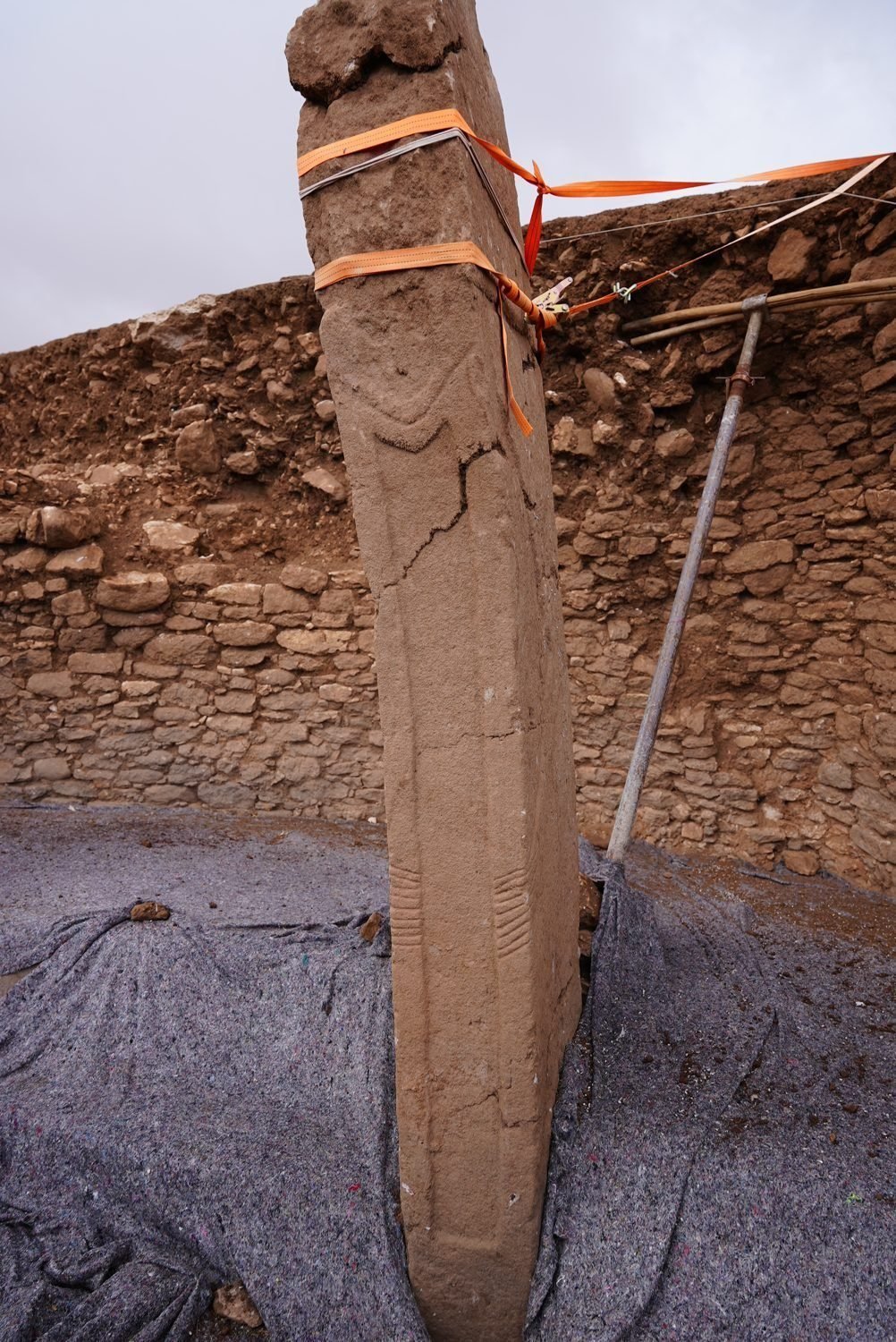
A small T-shaped pillar with a human face carved into it — reported as the first time a face has been found worked directly onto one of the region's signature T-pillars.

A human-featured T-pillar from Karahan Tepe.

Campels, Karahan Tepe - statue en T, CC BY-SA 4.0, via Wikimedia Commons.

A human-featured T-pillar from Karahan Tepe. — Wikimedia Commons

A face on a T-pillar

T-shaped pillars are the defining monument of this Neolithic landscape. For decades they have been read as abstracted human figures — the horizontal top standing for a head, the shaft for a body, with arms and hands sometimes carved in low relief on the sides, but never an actual face. The pillar at the centre of this page changes that picture. It carries a human face worked directly into the stone: a prominent nose, deep-set eyes, and a sharp, angular jaw.

Reporting on the 2025 season put the standing stone at about 135 centimetres tall. It was announced by excavation director Necmi Karul of Istanbul University and covered by outlets including Smithsonian Magazine and The Art Newspaper as the first human face found on a T-pillar at Karahan Tepe.

Found in a sunken house, not a grand enclosure

Just as striking as the face is where it stood. The pillar was not in one of Karahan's monumental chambers but inside a domestic building — a sunken, clay-plastered room built down into the bedrock. Three small T-pillars were set within that room, where they appear to have served a double role: practical supports for the roof, and charged symbols standing inside a lived-in space.

That domestic setting matters. It suggests the T-pillar was not reserved for special ceremonial architecture alone but could also belong to the everyday house — blurring, at least here, the line between the sacred and the domestic that archaeologists often draw.

Why it matters

If a T-pillar could carry a literal human face, it strengthens the long-standing argument that T-pillars are stylised people. Karul framed the find in exactly those terms, describing it as some of the clearest evidence yet that the T-shaped steles stand for human beings. For a symbol that appears across so many sites in the region, a single explicit face is a strong interpretive anchor.

This is recent, fast-moving material. The find was reported during excavation and covered in the press; a full academic publication with secure measurements, context, and phasing is still to come. We present it as reporting-grade: the face and its domestic setting are well attested in the coverage, while precise details may be refined once the season is formally published.

Sources & further reading4 references
  1. Smithsonian Magazine (2025). A human face was carved into this stone pillar in Turkey 11,000 years ago. Smithsonian Magazine, October 2025. Field reporting on the 2025 Karahan Tepe season; awaiting full publication. link
  2. The Art Newspaper (2025). Discovery of 11,000-year-old carved face in Turkey offers new insight into early human expression. The Art Newspaper, 9 October 2025. Field reporting; awaiting full publication. link
  3. Karul, N. (2025). Public lectures and interviews on Karahantepe and the Taş Tepeler project. Transcribed talks and interviews held in the Taş Tepeler research atlas. Spoken material rather than a peer-reviewed publication; positions may be refined in print.
  4. Şanlıurfa Neolithic Research Project — Taş Tepeler (2026). Official project site (Istanbul University / Şanlıurfa Museum). tastepeler.org link

Full bibliography: the Taş Tepeler reference library →

See it for yourself

We run small-group and private tours across the Taş Tepeler landscape.

Plan a visit →

Last reviewed 17 August 2026. Something wrong?