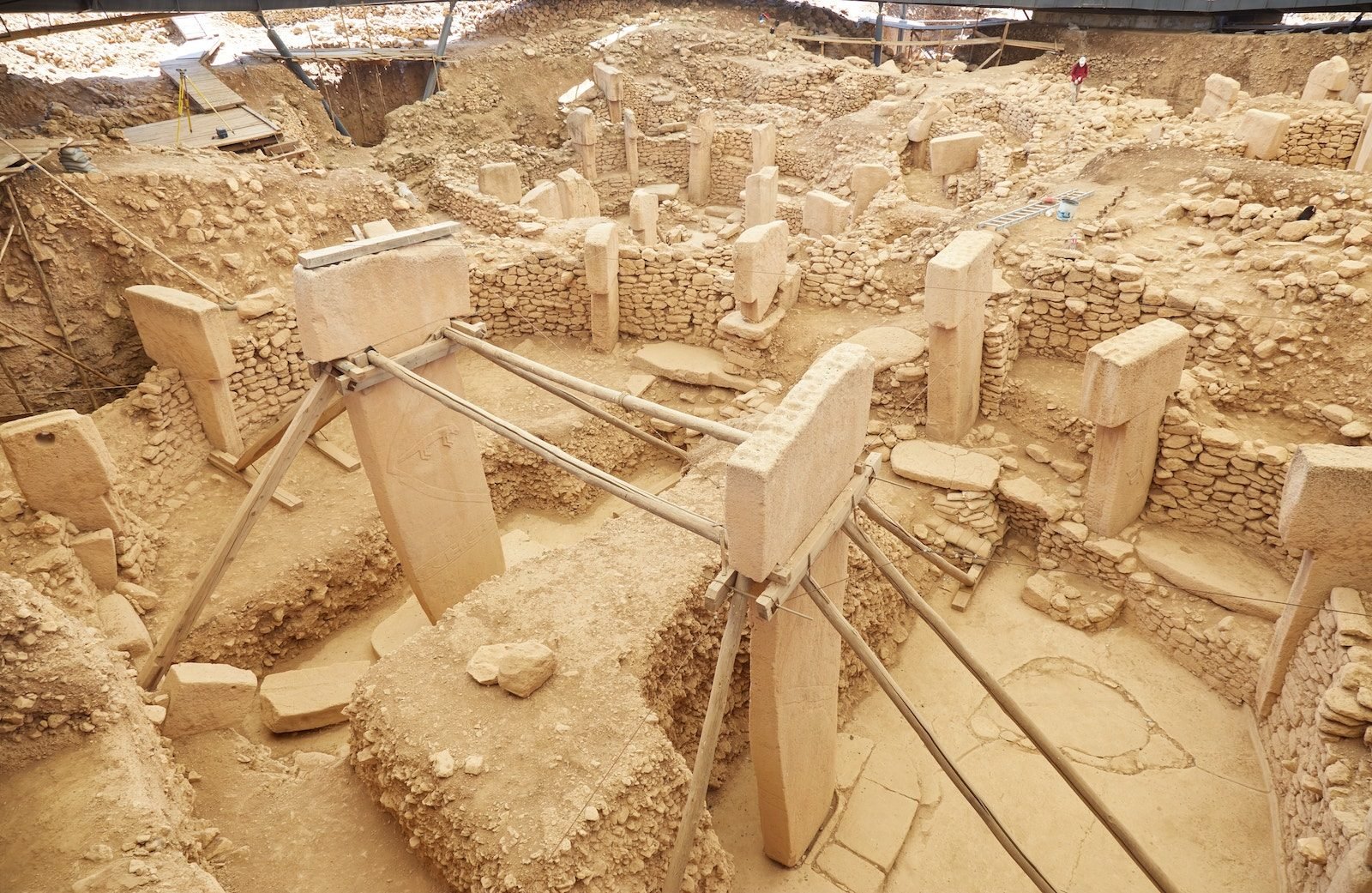
Enclosure D is the most complete and best-preserved of Göbekli Tepe's great round buildings, of the Pre-Pottery Neolithic A. A ring wall and bench enclose the space; smaller T-pillars stand in the wall facing inward; and two much larger pillars — 18 and 31 — stand at the centre, clearly carved as human figures. Its wall carries the site's most famous image, the Vulture Stone (Pillar 43).
A room built around two figures
Everything in Enclosure D points inward. The bench and the ring of wall pillars all face the two great central pillars, which stand parallel at the heart of the space. Those central pillars are not abstract — arms run down their sides to hands meeting over the belly, above a carved belt and, on Pillar 18, a fox-pelt loincloth. They are colossal, faceless people, and the whole building is arranged around them like a gathering around elders.
That arrangement is the key to reading the entire site: the enclosures are not just buildings but congregations of stone beings.
The wall that made the site famous
Set into the wall of Enclosure D is Pillar 43 — the Vulture Stone — with its vulture, scorpion, birds, 'bags,' and headless human figure. It is the single most reproduced image from Göbekli Tepe and the focus of the site's fiercest debates, from death symbolism to the disputed comet theory.
Enclosure D, in other words, is where the monumental architecture and the haunting imagery of Göbekli Tepe come together most completely. It is the room to understand first.
Sources & further reading3 references
- Schmidt, K. (2012). Göbekli Tepe: A Stone Age Sanctuary in South-Eastern Anatolia. Berlin: ex oriente. The foundational monograph by the site's first excavator.
- Notroff, J., Dietrich, O. & Schmidt, K. (2014). Building Monuments, Creating Communities. Early monumental architecture at Pre-Pottery Neolithic Göbekli Tepe. In J.F. Osborne (ed.), Approaching Monumentality in Archaeology: 83–105. Albany: SUNY Press.
- Haklay, G. & Gopher, A. (2020). Geometry and Architectural Planning at Göbekli Tepe, Turkey. Cambridge Archaeological Journal 30(2): 343–357.
Full bibliography: the Taş Tepeler reference library →