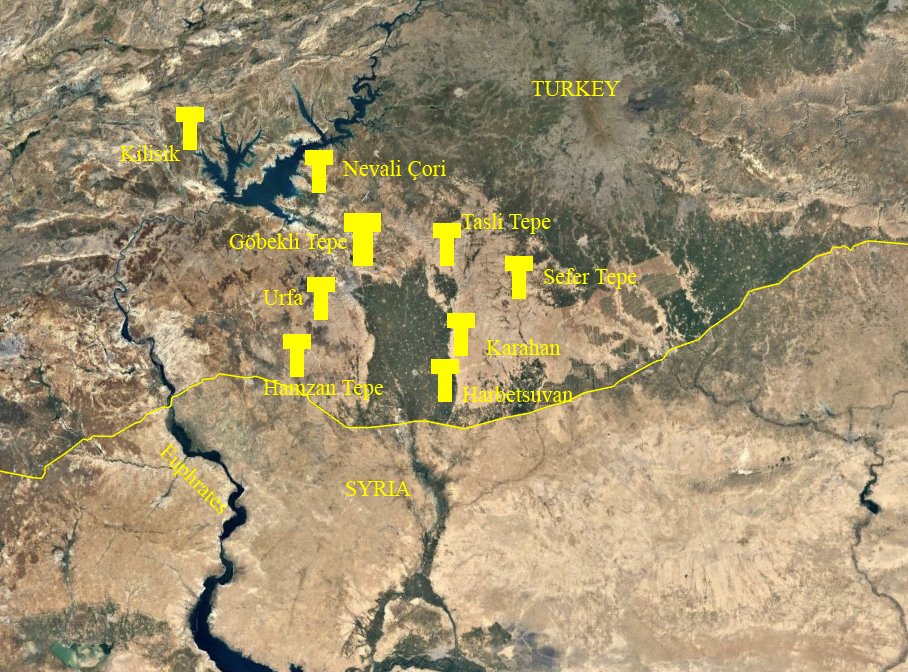
At the heart of Enclosure D stand two T-shaped pillars — Pillars 18 and 31 — taller than everything around them and facing each other. They are carved with arms bending down the sides, hands meeting over the belly, a belt, and a fox-pelt loincloth — the clearest sign that Göbekli Tepe's great stones were meant as human-like figures, not plain supports.
Stone people
From a distance they look like plain T-shaped posts. Up close, the human reading is unmistakable: the long shaft is a body, the wide top is a head seen from the side, and arms run down the flanks to hands that meet over the stomach, the fingers clearly carved. A belt circles the waist, and below it hangs an animal-skin loincloth, shown as a fox pelt.
They are not portraits. There are no faces, no eyes, no mouths. That blankness feels deliberate — these are larger-than-human beings, ancestors or spirits, standing at the centre of the room while the smaller pillars around the wall face inward toward them.
Reading the details
The carving is specific enough to rule out coincidence. The arms bend at the elbow and taper to hands with five long fingers laid across the belly — the pose that, once seen, makes every other T-pillar at the site read as a body. The belt is worked with symbols, and the loincloth beneath it is rendered as an animal skin, identified as a fox pelt.
These are the elements that turn an abstract T-shape into a clothed figure. They appear on both central pillars, set parallel and facing the same way, so the pair reads not as decoration but as two individuals dressed alike and placed at the focus of the building.
Why they matter
The central pillars are the key that unlocks the whole site. Once you see that they are human figures, every other T-pillar at Göbekli Tepe reads differently — as a stylised human form rather than a plain post, and the enclosure as a space built around those figures.
That two such figures could be quarried, carved, and raised — five and a half metres of limestone each — by people without metal tools, draft animals, or the wheel is its own kind of statement about the society that made them.
What's established, and what's debated
What is established is the anthropomorphism itself: the arms, hands, belt and loincloth are unambiguously carved, and they make the identity of the central pillars as human-like figures one of the few things about Göbekli Tepe's imagery that is not seriously disputed. Their size, their central placement, and their Pre-Pottery Neolithic A date are all secure.
What is debated is who or what they represent — ancestors, deities, mythical beings, or idealised humans — and why they were left faceless. Those are open interpretive questions, and no reading of them should be presented as settled fact.
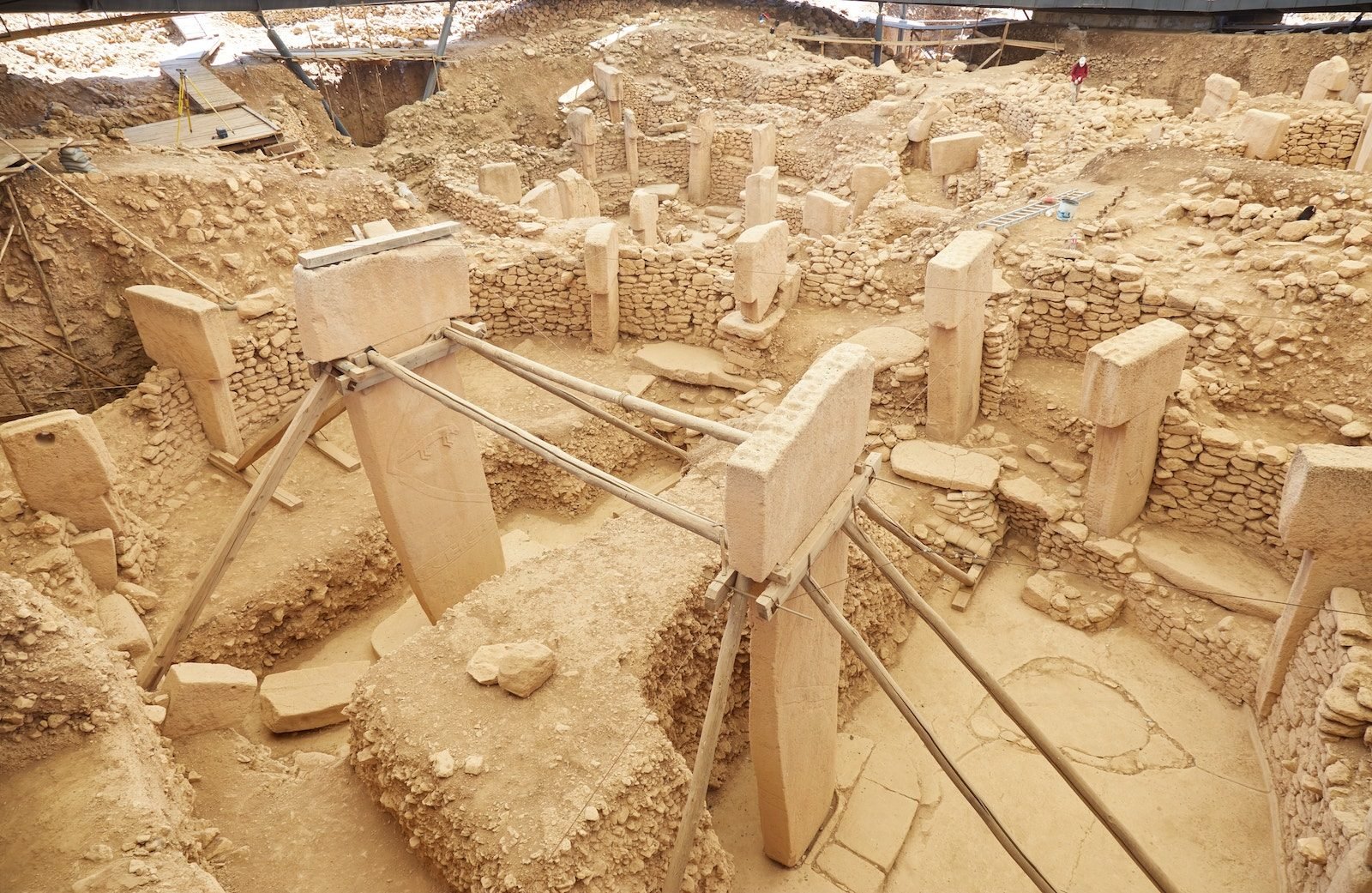
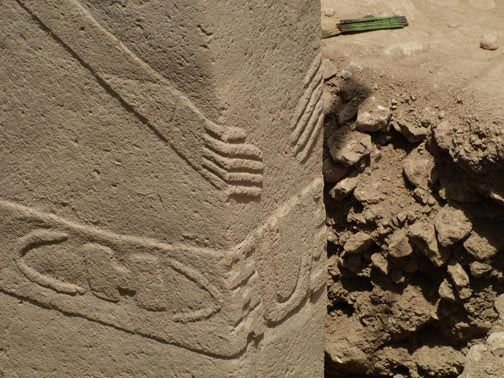
The central pillars of Enclosure D, Göbekli Tepe. Photo: DAI, Göbekli Tepe Project.
German Archaeological Institute, Göbekli Tepe Project, Enclosure D, Göbekli Tepe, Copyright: DAI — used with permission, via .
Sources & further reading3 references
- Schmidt, K. (2012). Göbekli Tepe: A Stone Age Sanctuary in South-Eastern Anatolia. Berlin: ex oriente. The foundational monograph by the site's first excavator.
- Notroff, J., Dietrich, O. & Schmidt, K. (2014). Building Monuments, Creating Communities. Early monumental architecture at Pre-Pottery Neolithic Göbekli Tepe. In J.F. Osborne (ed.), Approaching Monumentality in Archaeology: 83–105. Albany: SUNY Press.
- Haklay, G. & Gopher, A. (2020). Geometry and Architectural Planning at Göbekli Tepe, Turkey. Cambridge Archaeological Journal 30(2): 343–357.
Full bibliography: the Taş Tepeler reference library →