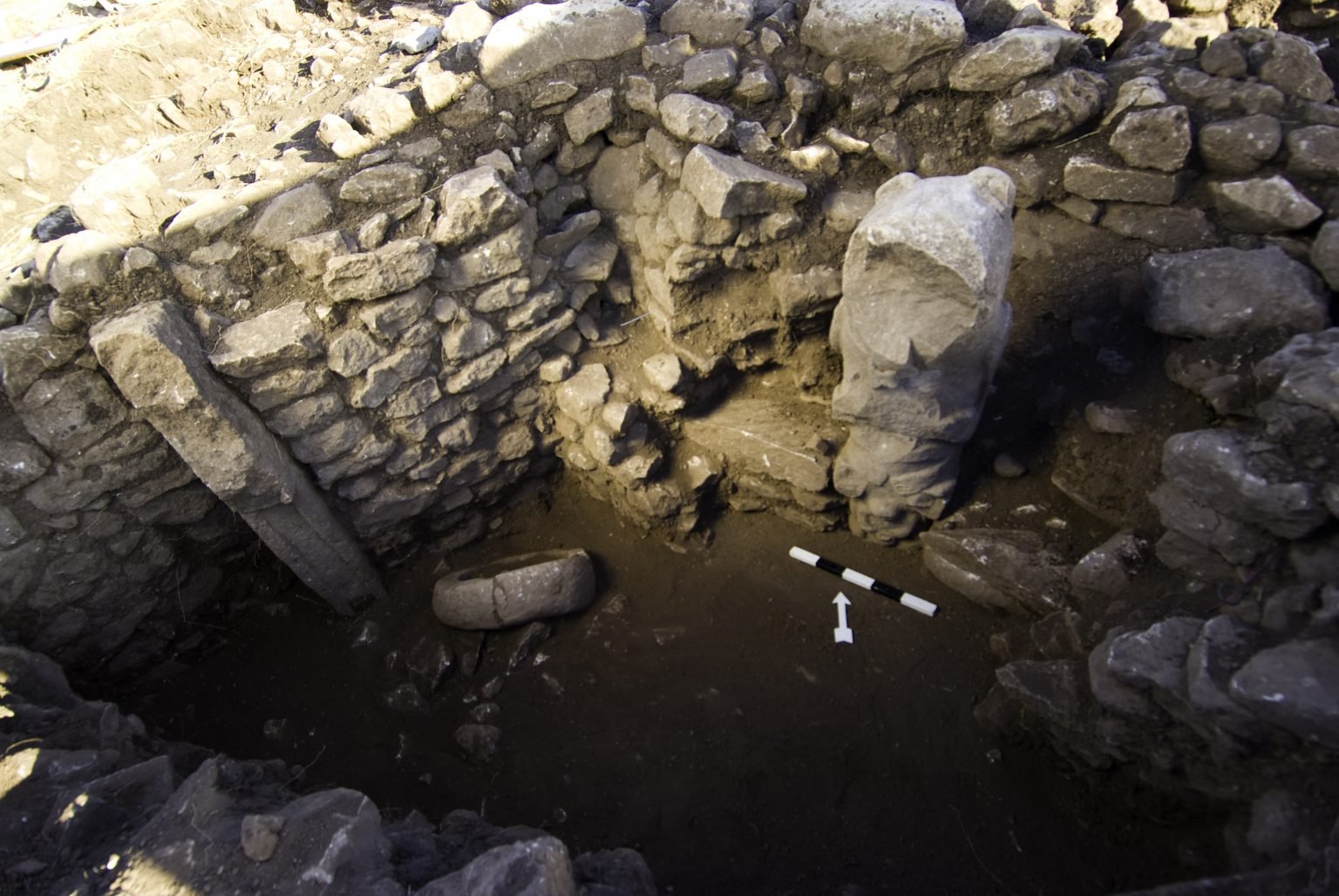
A limestone pole about 1.9 metres tall, carved so that several beings stand one above another: a predatory animal at the top, human figures below it, and snakes worked into the stone. It reads, unmistakably, as a totem-like sculpture — one of the earliest known anywhere, though it was carved long before anything we usually call a totem.
The sculpture stacks its figures vertically. A large predator occupies the top, its upper part now damaged; beneath it a human head emerges, and below that a second human figure whose arms are visible; snakes are also carved on the stone. It was not found standing in a monument but reused as building material in a later structure, which is how it survived.
Stacking beings vertically is a way of saying they belong together — a lineage, a story, or a hierarchy of power between animal and human. We read this stone as a claim about relationship: that people here saw themselves as bound into the animal world, held above and below by it, rather than standing apart from it.
That is interpretation. The figures are worn, the top is broken, and their exact roles are genuinely debated — read it as a suggestive reading of a damaged object, not a settled account.
Found reused, not standing
The totem pole did not come to light standing at the centre of a monument. It was recovered in 2010 from the northwestern part of the mound, built into a later Pre-Pottery Neolithic B structure — reused as ordinary building material long after it was first carved. That is why the sculpture is damaged at the top and survives at all: it was repurposed rather than left standing to weather away.
Reuse like this is common at Göbekli Tepe, where older carved stones were often incorporated into newer walls and fills. It complicates the object's story in a useful way: we have the sculpture, but not the setting it was made for, so its original placement and role can only be guessed at from the stone itself.
A form that outlived the site
The idea of carving figures one on top of another was not unique to this stone. The closest parallel is a similar stacked sculpture from nearby *Nevalı Çori*, a related Pre-Pottery Neolithic site, and the same impulse to compose beings vertically echoes down the millennia into the totems recorded across the world. Göbekli Tepe's version is among the oldest known examples of the form.
That deep antiquity is the real significance. Long before the ethnographic totem poles of much later cultures — and with no possible connection to them — hunter-gatherers in southeastern Anatolia were already stacking animal and human figures into a single vertical statement. The resemblance is a case of independent human imagination reaching for the same device, not of influence or descent.
What's established, and what's debated
What is established is the object: a tall limestone sculpture with vertically stacked figures — a predator, human figures and snakes — recovered in 2010 and reused as building material in a later structure. Its height, its find context and its close resemblance to the Nevalı Çori sculpture are securely recorded.
What is debated is almost everything about its meaning. The upper figure's species (a bear or a big cat), the identities and relationships of the human figures, and whether the composition depicts a birth, an ancestral lineage, or a hierarchy of powers are all proposals rather than proven readings — not least because the sculpture is damaged at the top and was found out of its original setting. The safest description is the one above: stacked beings, deliberately composed, meaning unknown.
Sources & further reading3 references
- Schmidt, K. (2012). Göbekli Tepe: A Stone Age Sanctuary in South-Eastern Anatolia. Berlin: ex oriente. The foundational monograph by the site's first excavator.
- Notroff, J., Dietrich, O. & Schmidt, K. (2014). Building Monuments, Creating Communities. Early monumental architecture at Pre-Pottery Neolithic Göbekli Tepe. In J.F. Osborne (ed.), Approaching Monumentality in Archaeology: 83–105. Albany: SUNY Press.
- The Tepe Telegrams (official research blog of the Göbekli Tepe Project, DAI). The Tepe Telegrams. Deutsches Archäologisches Institut. link Accessible, authoritative running commentary from the excavation team.
Full bibliography: the Taş Tepeler reference library →