Short answer
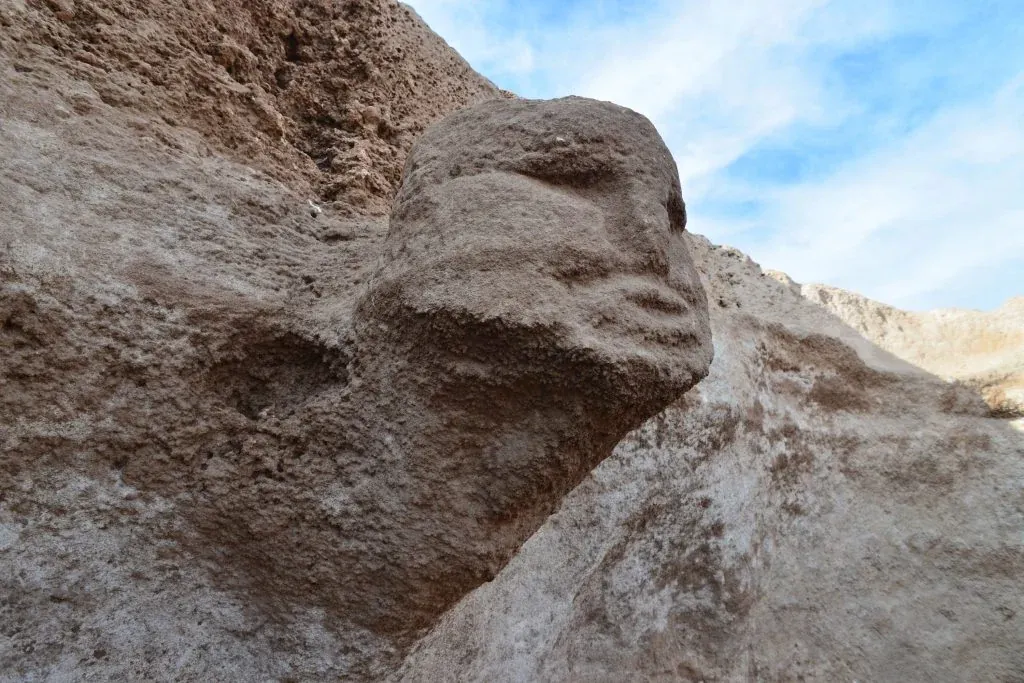
The Karahan Tepe carved head is a life-size human face cut from the living bedrock wall of Structure AB, leaning out into the chamber and turned toward the entrance so that anyone descending is met by its gaze.
It was not carved elsewhere and set in place — it is part of the room, its neck running back into the rock. It belongs to a deep Neolithic preoccupation with the human head, seen right across the Taş Tepeler sites. Whether it is an ancestor, a guardian or a witness is interpretation, not established fact.
The face in the wall
The Karahan Tepe carved head is a human face shaped from the living bedrock wall of Structure AB. It leans out into the room and turns toward the entrance stairs, so that as a visitor descends, a face is already looking at them. It is not a statue carried in and set down — it is the room, come alive.
Set at about the level of the pillar tops, and roughly life-size, the head reads as a presence looking out over the chamber. The neck runs back into the rock, so the face emerges from the wall rather than resting on a body.
Carved, not placed
The head was made the way the whole chamber was made — by subtraction. Instead of sculpting a head elsewhere and mounting it, the makers cut the surrounding rock away and left the face standing proud of the wall. There is no join, no socket, no separate block.
That method is unforgiving. Stone removed cannot be put back, so the position, scale and angle of the head had to be judged before serious cutting began. Somebody stood at that wall and worked as if the face were already inside it, waiting to be uncovered.
Positioned to be met
The placement is the point, and it is easy to miss. You climb down into a sunken chamber, and before you have taken in the room, the room has taken you in. You are seen first.
That is a strikingly theatrical idea — architecture designed to receive a person, to make arrival feel like being met, watched, or judged by a presence that belongs to the place. Whatever ceremonies happened here, the head turned every entrance into an encounter rather than a view.
Part of a world of heads
The head belongs to a deep regional preoccupation. Across Taş Tepeler the human head was treated as the most charged part of a person — carved, separated, collected and kept. At Göbekli Tepe, real human skulls were modified and grooved in what researchers have described as a skull cult.
Karahan Tepe does the opposite and the same thing at once: instead of keeping a real skull, its builders carved a permanent head that could never be lost. It rhymes, too, with Göbekli Tepe's headless figure on the Vulture Stone — a world that carved living heads out of some walls and headless bodies onto others was thinking hard, and consistently, about the head as the seat of the person.
What is settled, and what is not
Settled: the head is genuine, carved from the bedrock of Structure AB, roughly life-size, and deliberately oriented toward the entrance. That much is architecture, and it is not in doubt.
Debated: who or what it represents. Ancestor, deity, guardian, a specific remembered person, a being with no modern name — all have been suggested, none demonstrated. No inscription or myth survives to decide it. The honest position is that we can read the staging with confidence and the meaning only as interpretation.
The image that made Karahan Tepe famous
More than any other find, this face is what carried Karahan Tepe onto front pages after excavation began in 2019 under Necmi Karul of Istanbul University. A human head emerging from raw bedrock travels in a way that ground plans and radiocarbon tables never do.
It earns the attention. It is one of the most arresting things the Neolithic world left behind — and, unlike a carving in a museum case, it is still exactly where its makers left it, watching the same doorway it was cut to watch eleven thousand years ago.
Common questions
What is the Karahan Tepe carved head?
A roughly life-size human face carved from the bedrock wall of Structure AB, turned toward the entrance so it meets anyone descending into the chamber.
Was it carved separately and put in place?
No. It was made by cutting the surrounding rock away, so the face emerges directly from the wall — its neck runs back into the bedrock, with no join or socket.
What does the head represent?
Unknown. Ancestor, guardian, deity or a specific person have all been suggested, but no inscription or myth survives to decide it. The placement is clear; the meaning is interpretation.
How does it relate to the Göbekli Tepe skull cult?
It belongs to the same regional focus on the human head. Where Göbekli Tepe modified real skulls, Karahan Tepe carved a permanent head that could never be lost.
Can you see the carved head if you visit?
Yes — it is one of the reasons people make the trip. It remains in Structure AB where it was carved, rather than in a museum.
Sources & further reading3 references
- Karul, N. (2021). Buried Buildings at Pre-Pottery Neolithic Karahantepe. Türk Arkeoloji ve Etnografya Dergisi 82: 19–29. link
- Gresky, J., Haelm, J. & Clare, L. (2017). Modified human crania from Göbekli Tepe provide evidence for a new form of Neolithic skull cult. Science Advances 3(6): e1700564. doi:10.1126/sciadv.1700564
- Clare, L. (2020). Göbekli Tepe, Turkey. A brief summary of research at a new World Heritage Site (2015–2019). e-Forschungsberichte des Deutschen Archäologischen Instituts 2020(2): 81–88.
Full bibliography: the Taş Tepeler reference library →