Short answer
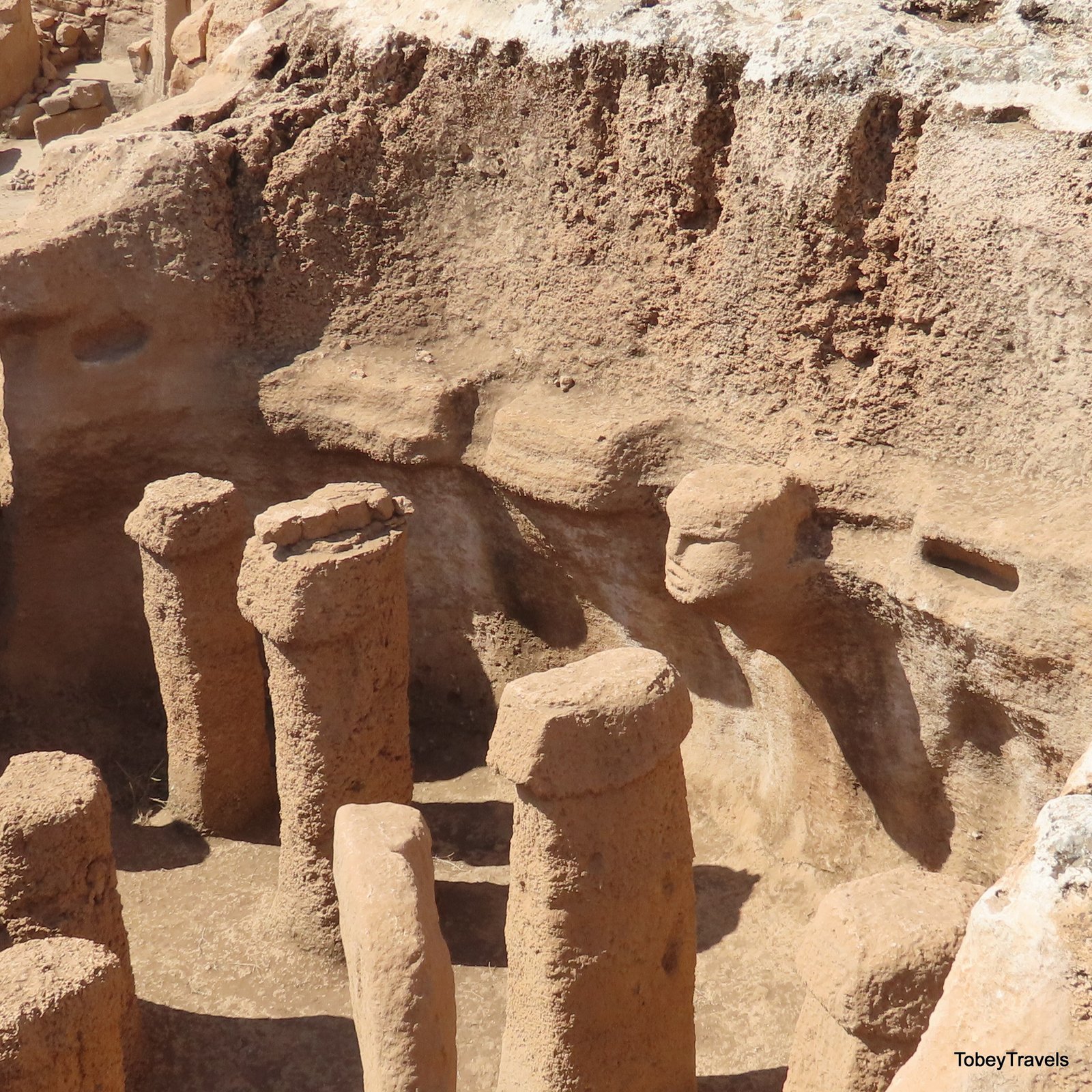
Structure AB is Karahan Tepe's most famous space — a chamber carved down into the bedrock, with ten pillars left standing from the living rock, a human head watching from the wall, and a porthole and channel linking it to the room next door.
It was made by subtraction — cutting rock away rather than building it up — so the whole plan had to be resolved before the first serious cut. It is the parent feature behind Karahan Tepe's three signature details: the phallic pillars, the carved head, and the channel. What it was actually used for is still unknown.
Architecture by subtraction
Almost every famous ancient structure is additive: material is quarried, moved and assembled. Göbekli Tepe's pillars were cut from a quarry, transported and raised into position.
Structure AB at Karahan Tepe works the opposite way. The chamber was cut down into the bedrock, and its pillars were never carried anywhere. They are the rock that was left behind when everything around them was removed.
This is a fundamentally different and less forgiving process. Additive building tolerates error — a misplaced block can be lifted and reset. Subtractive carving does not. Stone removed cannot be replaced. Every pillar, every surface and the entire plan had to be resolved before the first serious cut.
The pillars
The chamber contains a series of pillars rising directly from the floor — commonly reported as about eleven — arranged around the space.
They are not T-shaped like Göbekli Tepe's. They are shafts, widely described as phallic in form, standing upright from the bedrock floor.
That difference matters. Karahan Tepe is unmistakably part of the same regional tradition, and yet its central room does something the tradition's most famous site does not. These communities shared a vocabulary and used it differently.
The head
Set into the wall of the chamber is a human head carved from the living rock. It is not a sculpture placed in the room; it is part of the room.
The head leans out from the wall into the space and turns toward the entrance. Anyone descending into the chamber is met by it — which appears to be the point. Its position does the work.
The neck extends back into the rock, so the head emerges from the wall rather than sitting on a body. Whatever it represents — an ancestor, a being, a guardian, a participant — it was designed to be encountered rather than viewed.
The porthole and the channel
A round porthole, cut through the rock, links Structure AB to the adjacent room (often labelled AD), and a channel, also carved into the bedrock, runs between the two spaces.
Something was intended to move between the rooms. Liquid poured as part of a ritual is the most discussed reading; drainage of rainwater from a sunken rock-cut room is the more prosaic and entirely plausible one, and the two are not mutually exclusive. Descriptions of it as a 'blood channel' are not supported by evidence.
The relevant point for the architecture is that porthole and channel, like everything else here, had to be planned before cutting. They were integral, not remedial.
Going down into it
The chamber is entered by descending. That is a deliberate architectural choice with predictable effects on a person: the horizon disappears, sound changes, light narrows, and the ordinary world is replaced by an enclosed one.
Sunken and semi-subterranean spaces recur across this region's special buildings. Whatever these rooms were for, going down was part of it.
Combined with the head positioned to meet arrivals, the room reads as designed around the experience of entering it — a sequence rather than a container.
Settled, and still open
Settled: the chamber is real, carved by subtraction, holding a cluster of bedrock pillars, a head cut from the wall, and a porthole and channel to the next room. Its architecture is legible and secure.
Open: what it was used for — initiation, ceremony, gathering, or functions with no modern equivalent are all proposed, none demonstrated. What the pillars and head represent. How the structure relates in time to Göbekli Tepe's enclosures. And whether its fill is deliberate closure or accumulated collapse. Karahan Tepe has been excavated only since 2019; Structure AB is clear as architecture and largely unresolved as purpose.
Common questions
What is Structure AB at Karahan Tepe?
A chamber cut down into the bedrock containing pillars left standing from the rock itself, a human head carved into the wall, and a porthole and channel connecting it to the adjacent structure.
How many pillars are in the chamber?
Commonly reported as about eleven, rising directly from the bedrock floor. They are shafts widely described as phallic in form, rather than the T-shape familiar from Göbekli Tepe.
How was it built?
By subtraction. The chamber and its pillars were made by cutting away the surrounding bedrock rather than by assembling quarried material — a process that allows no corrections, so the whole plan had to be resolved in advance.
What is the carved head?
A human head carved from the living rock of the chamber wall, leaning out into the room and turned toward the entrance, so that anyone descending is met by it.
How is it different from Göbekli Tepe?
Göbekli Tepe's pillars were quarried, moved and raised, and are T-shaped. Karahan Tepe's were left standing as the rock around them was removed, and are shafts rather than T-forms.
What was the channel for?
Unknown. Deliberate pouring of liquid and rainwater drainage are both plausible and not mutually exclusive. Descriptions of it as a blood channel are not supported by evidence.
Sources & further reading4 references
- Karul, N. (2021). Buried Buildings at Pre-Pottery Neolithic Karahantepe. Türk Arkeoloji ve Etnografya Dergisi 82: 19–29. link
- Karul, N. (2025). Public lectures and interviews on Karahantepe and the Taş Tepeler project. Transcribed talks and interviews held in the Taş Tepeler research atlas. Spoken material rather than a peer-reviewed publication; positions may be refined in print.
- Clare, L. (2020). Göbekli Tepe, Turkey. A brief summary of research at a new World Heritage Site (2015–2019). e-Forschungsberichte des Deutschen Archäologischen Instituts 2020(2): 81–88.
- The Tepe Telegrams (official research blog of the Göbekli Tepe Project, DAI). The Tepe Telegrams. Deutsches Archäologisches Institut. link Accessible, authoritative running commentary from the excavation team.
Full bibliography: the Taş Tepeler reference library →