Short answer
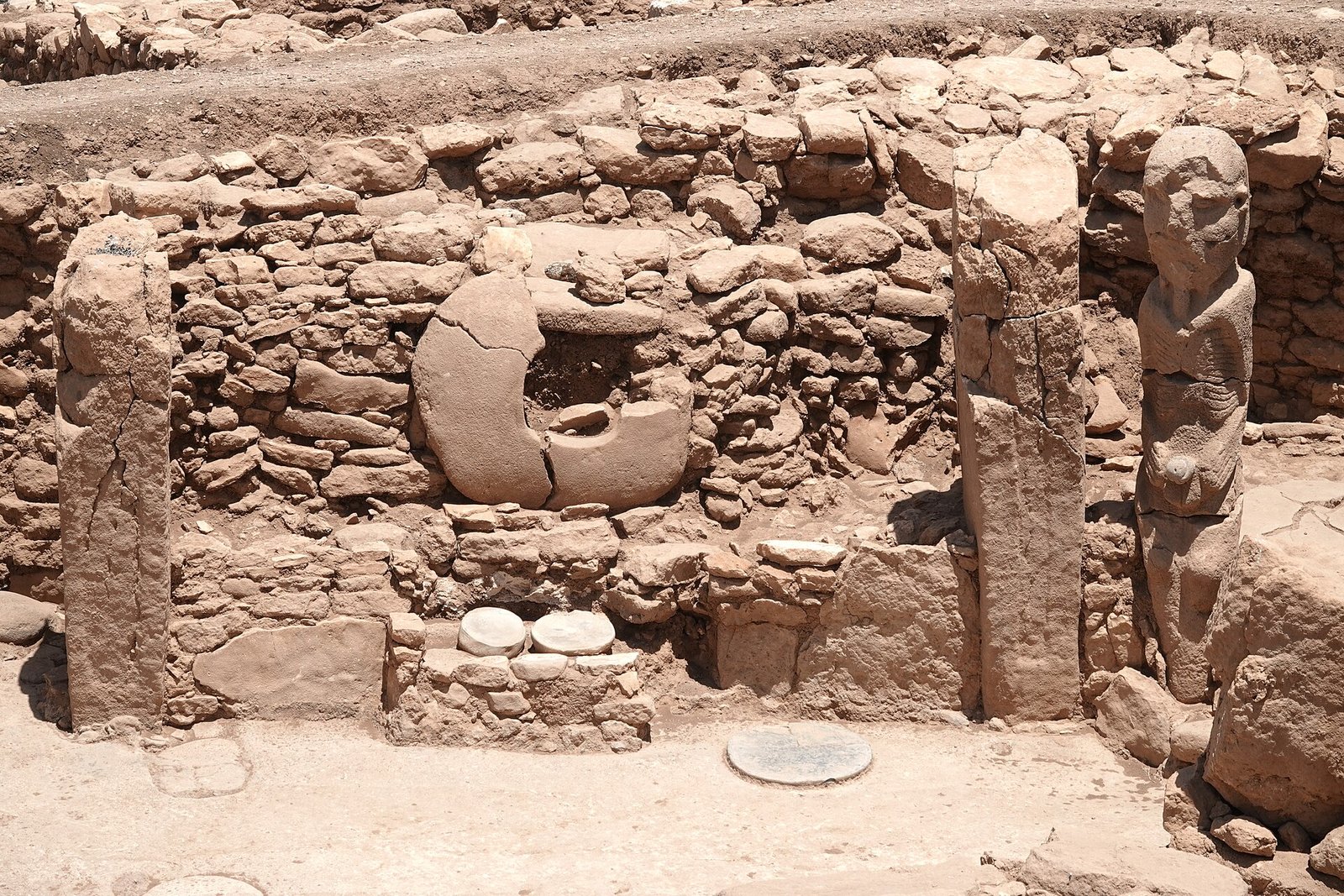
Nobody knows for certain — a channel deliberately cut into the bedrock links Karahan Tepe's pillared chamber to the room beside it, so something was meant to move through it, but what has never been established.
The most-discussed reading is liquid poured as part of a ritual; the more prosaic and equally plausible one is drainage of rainwater from a sunken rock-cut room, and the two need not exclude each other. Popular 'blood channel' descriptions have no evidence behind them. Because an open stone cut keeps no residue, the case rests on context, not contents.
What it actually is
Karahan Tepe's best-known space is a chamber cut down into the bedrock, with pillars left standing from the living rock and a human head carved into the wall.
Connecting that chamber to the adjacent structure is a channel carved into the bedrock. It is a deliberate cut — not a crack, not erosion — running between two spaces that were themselves carved rather than built.
That is the secure part. A channel is a thing for moving something from one place to another, and this one was made on purpose, in stone, at considerable effort.
The candidate explanations
Liquid, poured deliberately. The most discussed reading. A channel connecting a ritual space to an adjacent room suggests something poured in one and received in the other — water, blood, or another substance. This is the interpretation that most naturally fits a chamber already loaded with imagery.
Drainage. Considerably less romantic and entirely plausible. A room cut down into bedrock, open to the sky or partially roofed, will collect rainwater. A channel is exactly what you would cut to get it out. Karahan Tepe sits on limestone heights where water management was a real concern, and Göbekli Tepe has produced evidence for channels, cisterns and rainwater harvesting.
Both. These are not exclusive. A practical drainage cut can acquire ritual use, and a channel made for libation still drains. The distinction may be one we impose.
Why it is hard to settle
Because a stone channel does not preserve what passed through it. Unlike a vessel, which can retain residue, an open cut in bedrock exposed for millennia offers little to analyse.
Residue analysis would be the obvious route, and it is not clear that any is recoverable. Without it, the argument rests on context — the chamber's imagery, its architecture, the channel's gradient and where each end sits — rather than on direct evidence of contents.
This is a general feature of the site. Karahan Tepe's architecture is legible; its purposes are not.
Where the caution is warranted
Popular accounts sometimes describe the channel confidently as a blood channel used for sacrifice. There is no evidence for that. No sacrificial deposits, no residue analysis, nothing establishing what moved through it.
The phrase is compelling and it circulates because it is compelling, not because it is supported. It is a good example of how a plain description — 'a channel connecting two rooms' — acquires content it was never given by the excavation.
The accurate statement is narrower and more honest: a deliberately carved channel connects the pillared chamber to the neighbouring structure, something was intended to pass along it, and what that was is unknown.
Why it matters anyway
Because it belongs to a larger and genuinely interesting pattern at Karahan Tepe: this is subtractive architecture. The chamber, the pillars, the head and the channel were all made by removing rock rather than by assembling it.
Building by removal is unforgiving. There is no correcting a mistake, no adding material back. Every element — including the channel — had to be planned before cutting began.
So whatever the channel carried, it was part of the design from the start. It was not added when someone noticed a problem. Somebody stood on that bedrock before any of it existed and decided that a passage between these two spaces was necessary.
Common questions
What is the Karahan Tepe channel?
A channel deliberately carved into the bedrock connecting the pillared rock-cut chamber to the adjacent structure.
Was it used for blood or sacrifice?
There is no evidence for that. No sacrificial deposits or residue analysis support it. The 'blood channel' description circulates because it is striking, not because it is established.
Could it just be drainage?
Yes, and that is a serious possibility. A chamber cut into bedrock collects rainwater, and the region shows evidence of water management including channels and cisterns. Drainage and ritual use are also not mutually exclusive.
Why can't archaeologists tell what it carried?
An open channel cut in bedrock and exposed for millennia retains little analysable residue, unlike a vessel. The argument has to rest on architectural context instead.
Why is the channel significant?
Because Karahan Tepe's architecture is subtractive — carved by removing rock, which allows no corrections. The channel had to be planned before cutting began, so it was integral to the design rather than a later addition.
Sources & further reading4 references
- Karul, N. (2021). Buried Buildings at Pre-Pottery Neolithic Karahantepe. Türk Arkeoloji ve Etnografya Dergisi 82: 19–29. link
- Karul, N. (2025). Public lectures and interviews on Karahantepe and the Taş Tepeler project. Transcribed talks and interviews held in the Taş Tepeler research atlas. Spoken material rather than a peer-reviewed publication; positions may be refined in print.
- Clare, L. (2020). Göbekli Tepe, Turkey. A brief summary of research at a new World Heritage Site (2015–2019). e-Forschungsberichte des Deutschen Archäologischen Instituts 2020(2): 81–88.
- The Tepe Telegrams (official research blog of the Göbekli Tepe Project, DAI). The Tepe Telegrams. Deutsches Archäologisches Institut. link Accessible, authoritative running commentary from the excavation team.
Full bibliography: the Taş Tepeler reference library →