Short answer
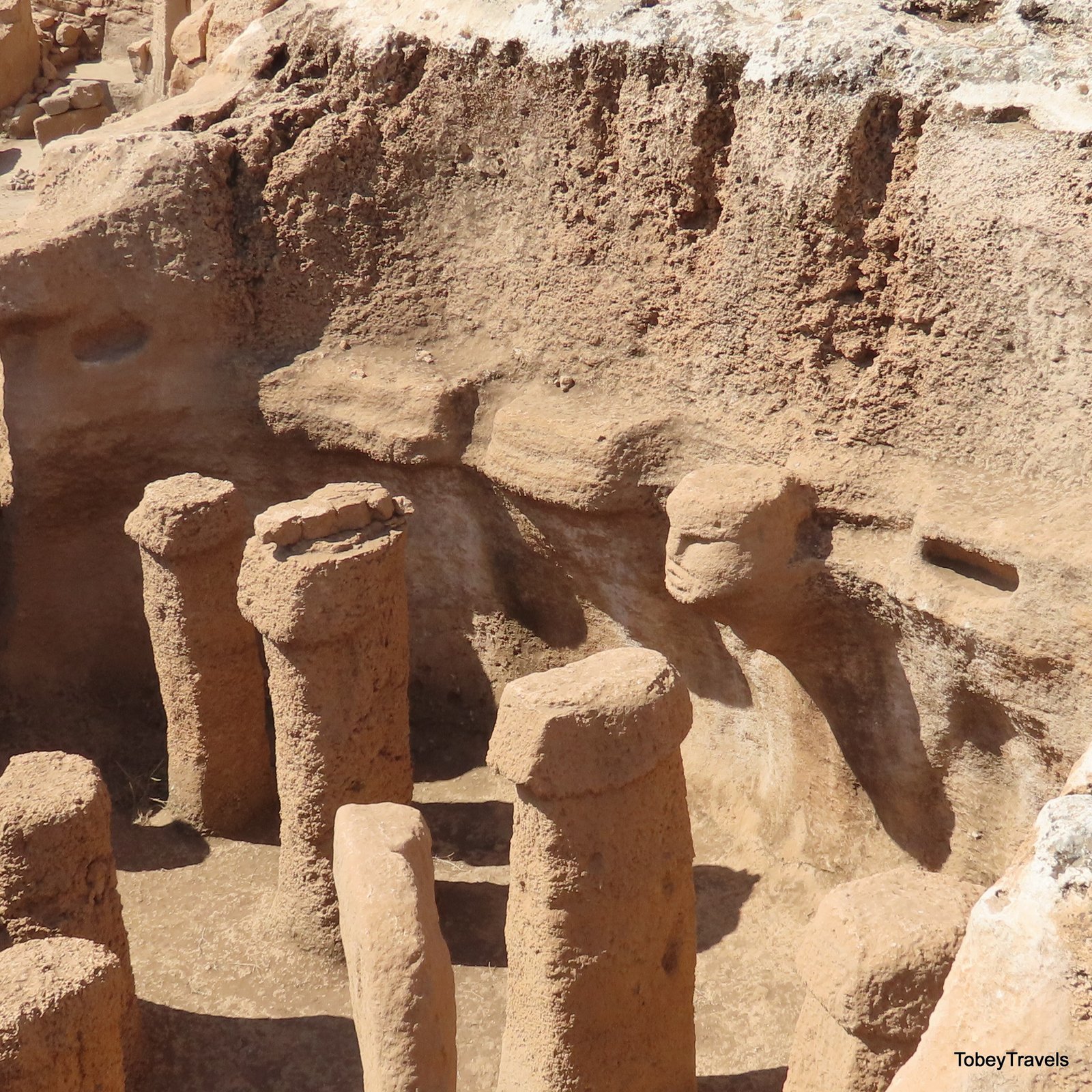
The Karahan Tepe phallus pillars are a cluster of about eleven tall, rounded pillars — widely described as phallic — rising straight from the bedrock floor of a rock-cut chamber, watched over by a human head carved from the wall.
Unlike Göbekli Tepe's T-pillars, they were not quarried and raised but left standing as the rock around them was cut away. Readings around fertility, ancestry, potency or creation are plausible interpretations, not proven meanings — no text survives to tell us. The deliberate pairing of many bodily pillars with one presiding face is, so far, unique in the known Neolithic record.
The room of pillars
Karahan Tepe's most talked-about feature is a room carved down into the bedrock, from whose floor rise a cluster of tall, rounded pillars — commonly reported as about eleven, and widely described as phallic in form. They stand together in the enclosed space like a gathering of figures, all cut from the living rock rather than built up from separate stones.
The room is entered by descending, and everything about it — the shaping of the pillars, the enclosed bedrock walls, the sunken approach — points to ritual rather than everyday use.
Not T-pillars
This is where Karahan Tepe parts company with its famous neighbour. Göbekli Tepe's uprights are T-shaped, quarried, moved and raised into sockets. Karahan Tepe's were never carried anywhere: they are the rock that was left standing when everything around them was cut away.
So the two sites share a symbolic world without sharing its execution. Karahan Tepe is unmistakably part of the same regional tradition, and yet its central room does something the tradition's most famous site never does. These were communities using a shared vocabulary in their own way — which is more interesting than mere copying.
The watching head and the porthole
The detail that makes the room unforgettable is a human head and neck carved from the wall, projecting into the space so the face looks out over the pillars. Set at about the level of the pillar tops, it reads as a presence — a witness, a guardian, or a participant in whatever happened here.
A porthole — a round opening cut through the rock — links the chamber to the adjacent room, and a channel runs between the two. Whatever the pillars were for, they sat inside a designed sequence of spaces, not a single sealed box.
What it might mean
The bodily imagery has drawn interpretations around fertility, potency, ancestry, masculinity and creation. As with all Neolithic symbolism, certainty is not possible: no text survives to tell us what the makers intended, and confident single-word explanations tend to say more about us than about them.
What can be said is narrower and firmer. The room was a deliberate, dramatic stage for belief, and its combination of many bodily pillars with one presiding face is, so far, unique in the known record.
A room built as a body
What unsettles visitors is how bodily the chamber is. Phallic pillars rise directly from the bedrock floor; overhead, a human head watches from the wall. The room reads less like architecture with decoration and more like a space made from the human body itself — potency, presence and a presiding gaze, all in one sunken chamber.
We should be honest about the limits: nothing here is labelled, and the phallic reading, though widely shared, is still a reading. But the deliberate pairing — many pillars, one head, a hidden room reached by going down — is clearly not random. It is a staged, bodily world, and it is unlike anything at Göbekli Tepe.
Settled and debated
Settled: the pillars are real, carved from bedrock, standing in a rock-cut chamber of Structure AB, with a carved head set into the wall above them. Their form is widely described as phallic.
Debated: what they meant, whether 'phallic' is the makers' intention or our projection, and how the room relates in time to Göbekli Tepe. Karahan Tepe has only been excavated since 2019, so the picture is still being worked out.
Common questions
What are the Karahan Tepe phallus pillars?
A cluster of about eleven tall, rounded pillars — widely described as phallic — rising from the bedrock floor of a rock-cut chamber in Structure AB, watched over by a carved human head.
How are they different from Göbekli Tepe's pillars?
Göbekli Tepe's are T-shaped, quarried and raised. Karahan Tepe's were left standing as the surrounding rock was cut away, and are shafts rather than T-forms.
What do the phallus pillars mean?
Often linked to fertility, potency, ancestry or creation, but their precise meaning is unknown. What is clear is that the room was a deliberate ritual space.
How many phallus pillars are there?
Commonly reported as about eleven, though counts vary with how the pillars are defined. They rise directly from the bedrock floor.
Sources & further reading3 references
- Karul, N. (2021). Buried Buildings at Pre-Pottery Neolithic Karahantepe. Türk Arkeoloji ve Etnografya Dergisi 82: 19–29. link
- Clare, L. (2020). Göbekli Tepe, Turkey. A brief summary of research at a new World Heritage Site (2015–2019). e-Forschungsberichte des Deutschen Archäologischen Instituts 2020(2): 81–88.
- The Tepe Telegrams (official research blog of the Göbekli Tepe Project, DAI). The Tepe Telegrams. Deutsches Archäologisches Institut. link Accessible, authoritative running commentary from the excavation team.
Full bibliography: the Taş Tepeler reference library →