Göbekli Tepe · Şanlıurfa, Türkiye · The "Fox Pillar Building"
Enclosure B
PPNA · Layer III · 10th millennium BCE · roughly circular · ~8 ring pillars · central Pillars 9 & 10 (both a fox)
A compact round enclosure whose two central pillars both carry the fox, and whose floor — a hard, polished lime "terrazzo" with a stone bowl set into it — is among the best preserved anywhere at Göbekli Tepe.
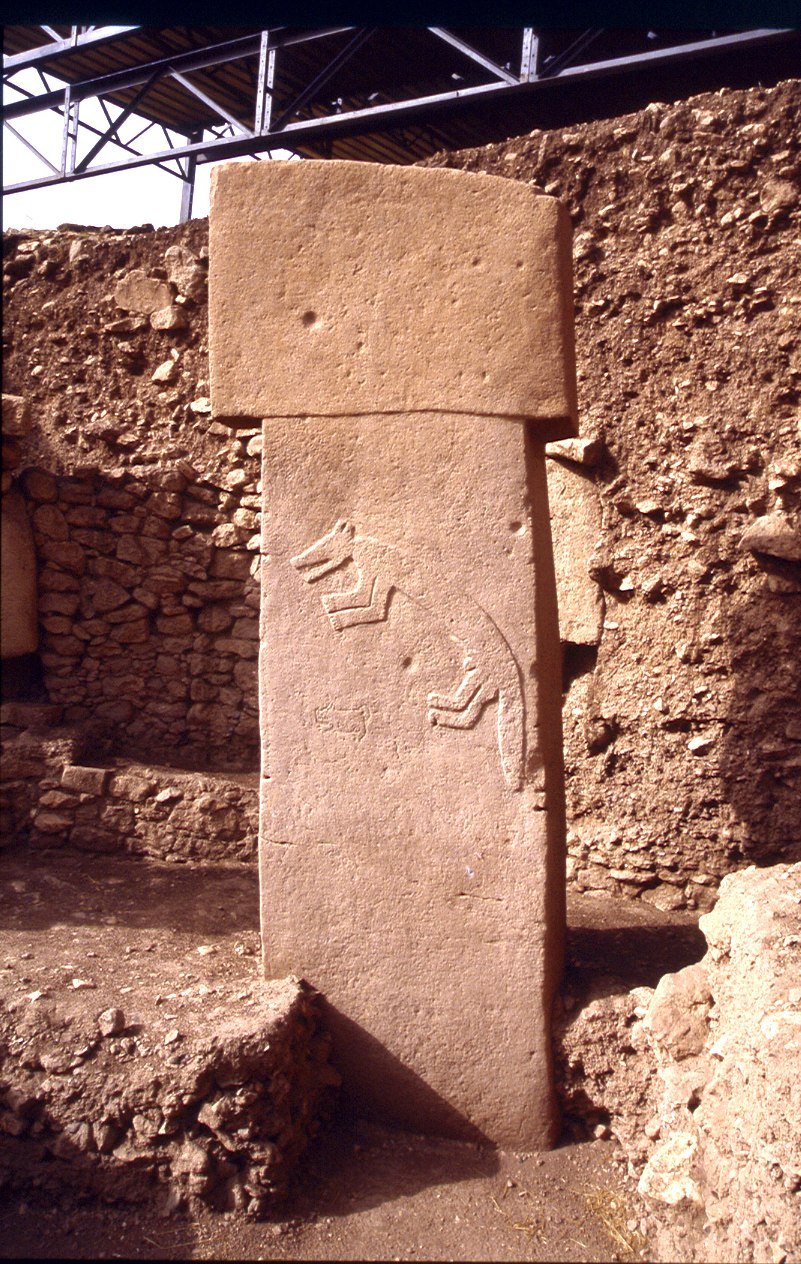
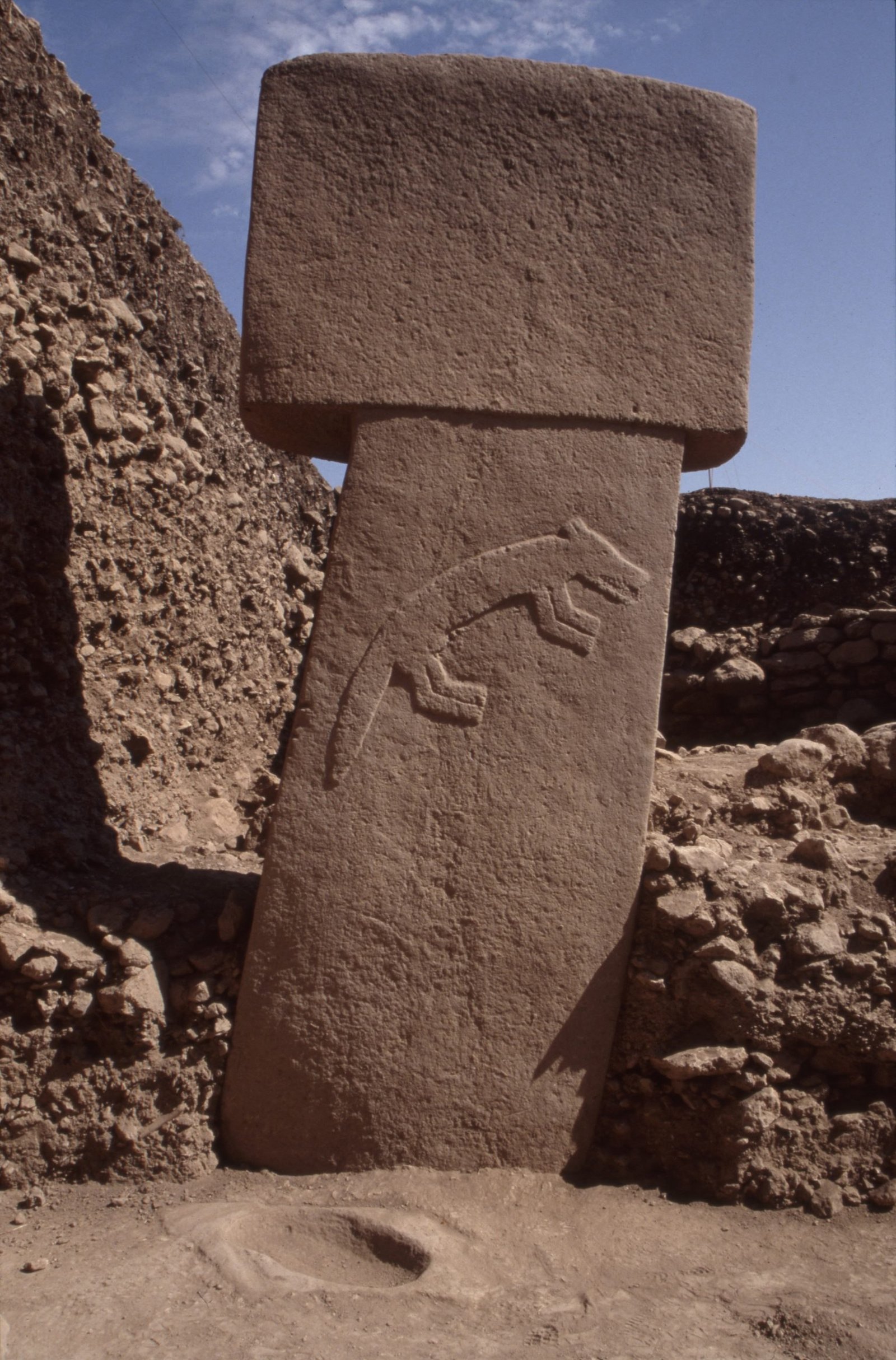
A central pillar of Enclosure B — Pillar 10 — carrying a fox in low relief on its shaft. Both central stones of the enclosure carry the same animal. Photo: DAI, Göbekli Tepe Project.
A pillar, not the building as a whole: no aerial photograph of Enclosure B exists under the protective roof. See the excavation plan under Architecture.
01
Quick facts
Enclosure B is smaller and more compact than C and D, but it preserves one thing they largely do not: a made floor. Its distinguishing marks are the twin foxes at the centre and that polished terrazzo surface.
Period
PPNA — 10th millennium BCE (Layer III)
Built from
around 9500 BCE
Plan
roughly circular ring
Ring pillars
about eight (incl. 6, 7, 8, 14, 15, 16, 34)
Central pillars
two — Pillars 9 & 10, both carrying a fox
Floor
polished burnt-lime terrazzo
Feature
a stone bowl and channel set in the floor by Pillar 9
The fox on both central pillars, the ~eight ring pillars and the terrazzo floor with its bowl and channel are reported by the excavation team (DAI, "Enclosure B — a short overview"). The purpose of the bowl-and-channel is not settled; readings about pouring liquids are interpretation laid on top of the recorded features.
02
The architecture
Enclosure B follows the same basic scheme as the other great buildings — two central pillars inside a ring wall set with about eight more, each turned to face the centre, with a bench along the inner face. It is smaller and tighter than C and D. What sets it apart is underfoot: instead of the plain bedrock floors of the other enclosures, the space between the central pillars was finished with a hard, polished lime terrazzo.
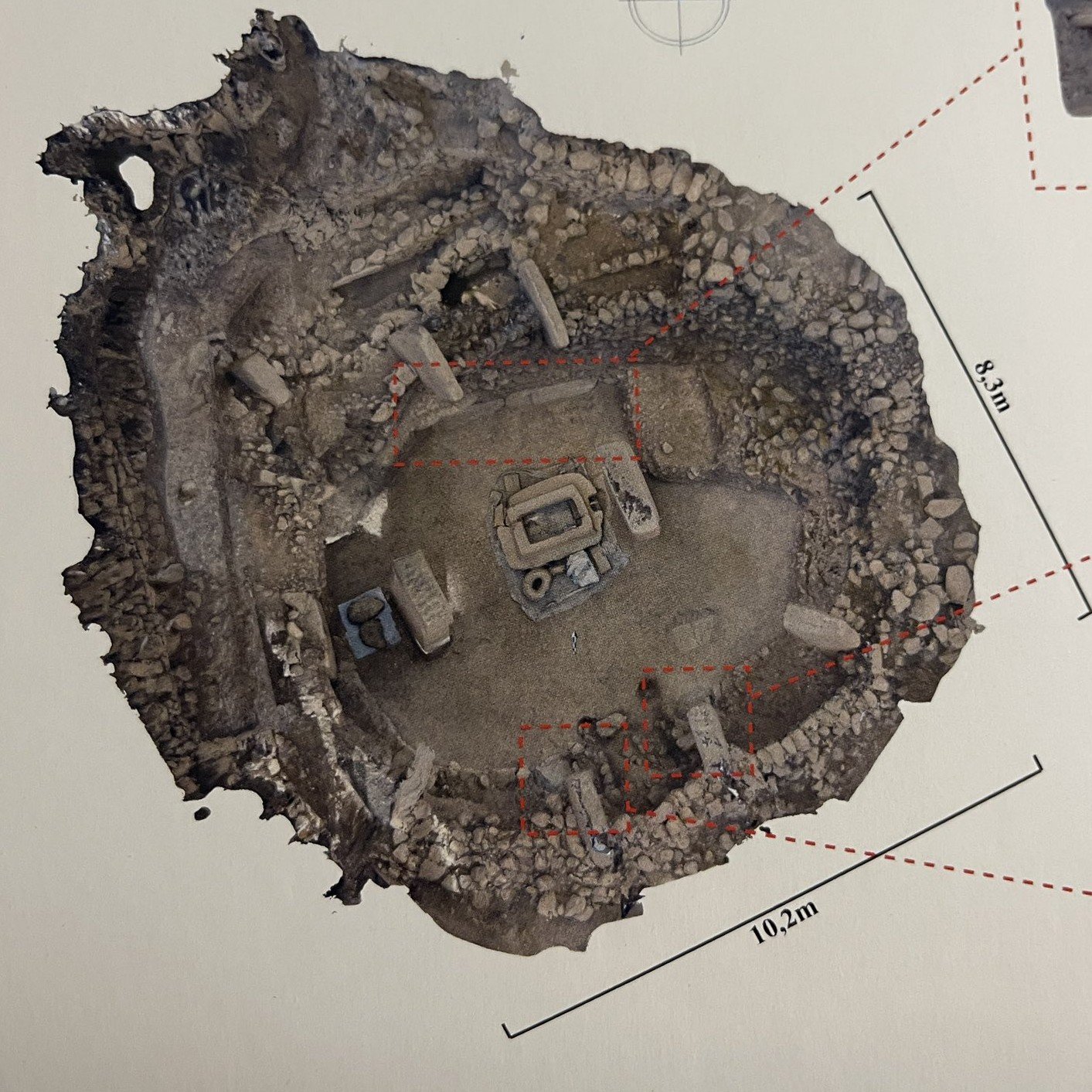
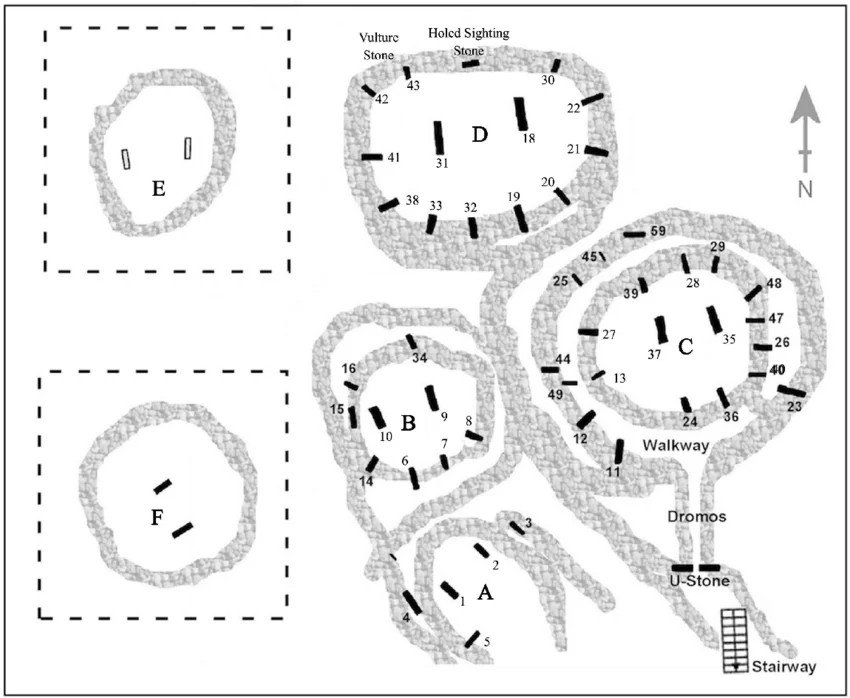
A vertical photogrammetry model of Enclosure B (Building B, Area L9-66) seen from directly overhead — the oval measures about 10.2 × 8.3 m, with the ring-wall T-pillars around the two central pillars and the porthole/terrazzo features at the centre. Image: Benny Waszk, DAI, Göbekli Tepe Project, 2024.Enclosure B in the wider site plan — the smaller circle at centre-left, its central pair (9 & 10) inside a ring of numbered T-pillars (6, 7, 8, 14, 15, 16, 34). Plan: after the Göbekli Tepe Project (DAI).
Key to the building — Central pillars 9 & 10 the two central stones — both carry a fox, distinctive to this enclosure. Ring / wall pillars the surrounding T-pillars — on the plan, Pillars 6, 7, 8, 14, 15, 16 and 34; Pillars 6 and 7 are shown below. Floor a polished burnt-lime terrazzo, with a stone bowl and channel set in front of Pillar 9. Porthole stone a richly carved porthole slab recorded in the deep sounding north of the enclosure.
The plan above is the architecture visual for B: no photograph shows its ring from above, because the site's protective roof rules out aerial photography.
03
The pillars, up close
Where Enclosure D mixes many creatures and C leans on the boar, B pairs its centre around the fox — and the fox recurs on its wall pillars too.
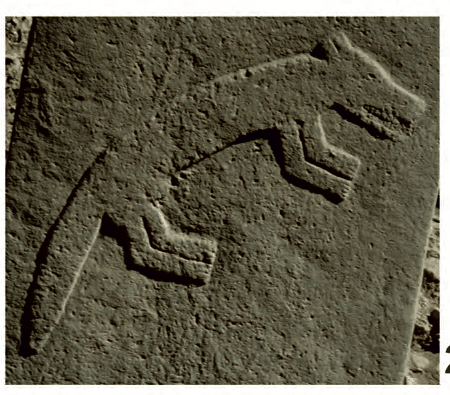
Both central stones carry a fox. Having the same animal on both central pillars is distinctive to Enclosure B — a per-enclosure emphasis, where D mixes creatures and C leans on the boar.
The fox on central Pillar 9, in low relief — the motif shared by both of the enclosure's central stones. Photo: DAI, Göbekli Tepe Project.
One of the clearest T-pillars at the site — its full T-head intact — carrying a fox worked in relief along the shaft, another turn on the enclosure's fox theme.
Pillar 7 — a well-preserved T-pillar carrying a fox in relief. Photo: DAI, Göbekli Tepe Project.
Ring wall · P6
Pillar 6 — no page yet
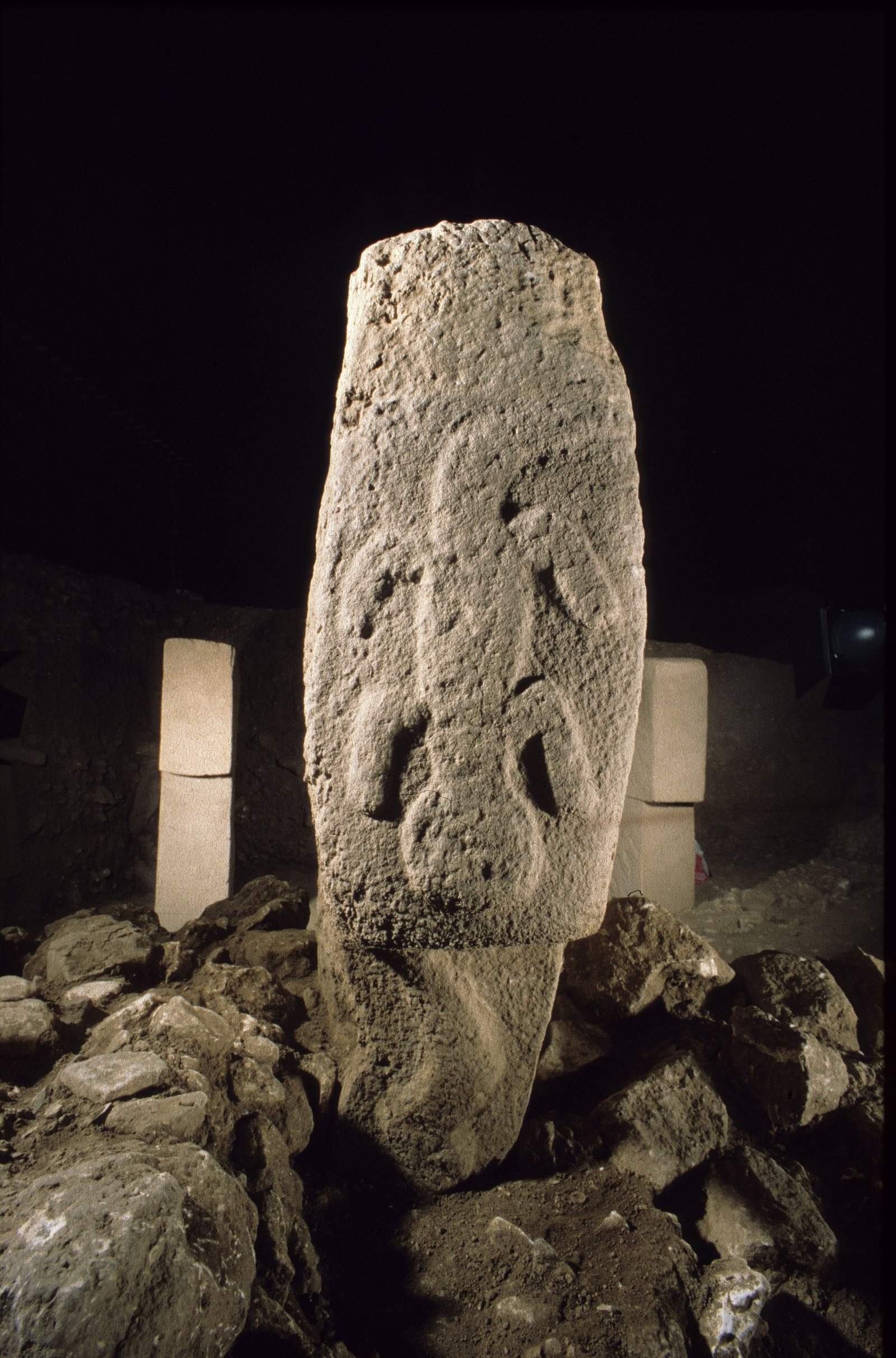
A ring-wall pillar of Enclosure B, its carved shaft caught in raking light at night, with other pillars of the ring standing behind it.
Pillar 6 in the ring wall, night-lit among its neighbours. Photo: DAI, Göbekli Tepe Project.
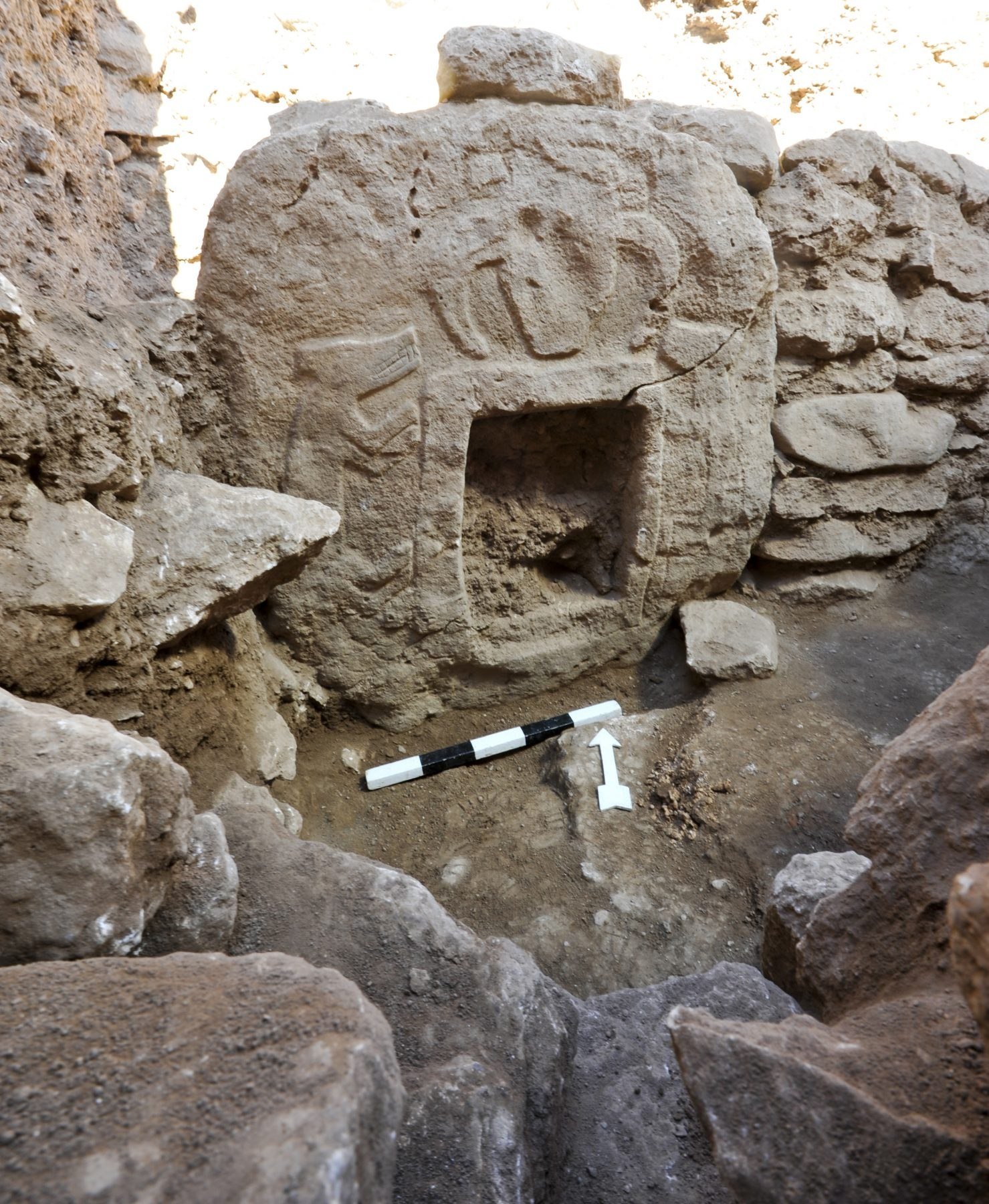
A richly decorated porthole stone recorded in situ in the deep sounding north of Enclosure B, its square opening framed by relief. Porthole slabs of this threshold type recur across the site; the exact original setting of this one is unresolved.
The porthole stone in situ, its square opening framed by relief, in the sounding north of the enclosure. Photo: DAI, Göbekli Tepe Project.Full page →
04
The terrazzo floor
Between the central pillars, excavators exposed a terrazzo floor — a polished surface of burnt lime, laboriously made and smoothed, quite different from the plain bedrock floors of the other enclosures. Set into it, in front of Pillar 9, was a stone bowl with a small channel running toward it. The features are real and carefully recorded; what they were for is not settled. It is tempting to read a bowl and channel in a made floor as evidence of pouring liquids, but the excavation record describes them without settling their purpose — any story about libations or feasting is interpretation laid on top of them.
No archive photograph — an honest gap
There is no verified archive photograph of Enclosure B's terrazzo bowl-and-channel in this collection, so it is described here in words rather than shown. A real find photograph should be sourced before one is printed; a drawn reconstruction is deliberately not used in its place.
05
The finds & carved stones
The central fox pair, the terrazzo floor feature and the porthole stone, gathered as one catalogue. Where a full object page exists, it is linked from the card; where no real photograph exists, an honest text card is shown instead of a drawing.
Centre · P9 & P10
The fox pair — Pillars 9 & 10
The two central stones of Enclosure B, each carrying a fox — the same animal on both central pillars, distinctive to this building. Where D mixes many creatures and C leans on the boar, B pairs its centre around the fox.
A richly decorated porthole slab recorded in situ in the deep sounding north of Enclosure B, its square opening framed by relief. Porthole slabs of this threshold type recur across the site; the exact original setting of this one is best read as part of the building's history rather than a securely placed doorway.
No verified archive photograph of the terrazzo bowl-and-channel is in this collection — described in words, not shown as a drawing.
Floor · Feature
The terrazzo bowl and channel
A stone bowl with a small channel running toward it, set into the polished burnt-lime terrazzo floor in front of Pillar 9. The features are carefully recorded; their purpose is unsettled, and readings about pouring liquids are interpretation, not fact.
Two cards use real archive photographs; the terrazzo bowl-and-channel has no verified photograph and is shown as an honest text card. Full object pages exist for the fox pair, the terrazzo feature and the porthole stone.
06
What might it have meant?
What we know
Secure — attested by the architecture and the finds.
Two central T-pillars (9 & 10), both carrying a fox, inside a ring of about eight wall pillars.
The fox recurs on the wall pillars too (e.g. Pillar 7) — a per-enclosure animal emphasis.
A polished burnt-lime terrazzo floor, unusual at the site, with a stone bowl and channel set in front of Pillar 9.
A richly carved porthole stone recorded in the sounding north of the enclosure.
Possible interpretations
Readings, not facts.
The fox as B's emblem — the fox is common across Göbekli Tepe, but in B it takes the central place on both principal stones; whether that carried a specific meaning, or reflects one community's choices, is unknown.
A bowl for what? — a bowl and channel in a made floor invites a reading of pouring liquids, but the record does not settle their purpose; any libation or feasting story is laid on top of the features.
An open question. The fox emphasis and the terrazzo bowl are securely recorded; what they meant to the people who made them is not, and should be read as interpretation.
07
Sources
The Tepe Telegrams (DAI) 2017. "Enclosure B, a short overview." Deutsches Archäologisches Institut, 3 February 2017. (Fox on both central pillars; ~eight ring pillars; the terrazzo floor with bowl and channel.)
Schmidt, K. 2012. Göbekli Tepe: A Stone Age Sanctuary in South-Eastern Anatolia. Berlin: ex oriente.
Dietrich, O. et al. 2012. "The role of cult and feasting in the emergence of Neolithic communities. New evidence from Göbekli Tepe." Antiquity 86(333): 674–695.
Notroff, J., O. Dietrich & K. Schmidt 2014. "Building Monuments, Creating Communities…," in J. Osborne (ed.) Approaching Monumentality in Archaeology. SUNY Press, 83–105.
Peters, J. & K. Schmidt 2004. "Animals in the symbolic world of Pre-Pottery Neolithic Göbekli Tepe…" Anthropozoologica 39(1): 179–218.
08
Related structures
The finds and carved stones of Enclosure B are catalogued above under The finds & carved stones. Below are the neighbouring buildings and ways to visit.
To visit — Göbekli Tepe lies northeast of Şanlıurfa, Türkiye; Enclosure B stands beneath the main protective shelter alongside the other great rings. Finds from the site are conserved at the Şanlıurfa Archaeology Museum.