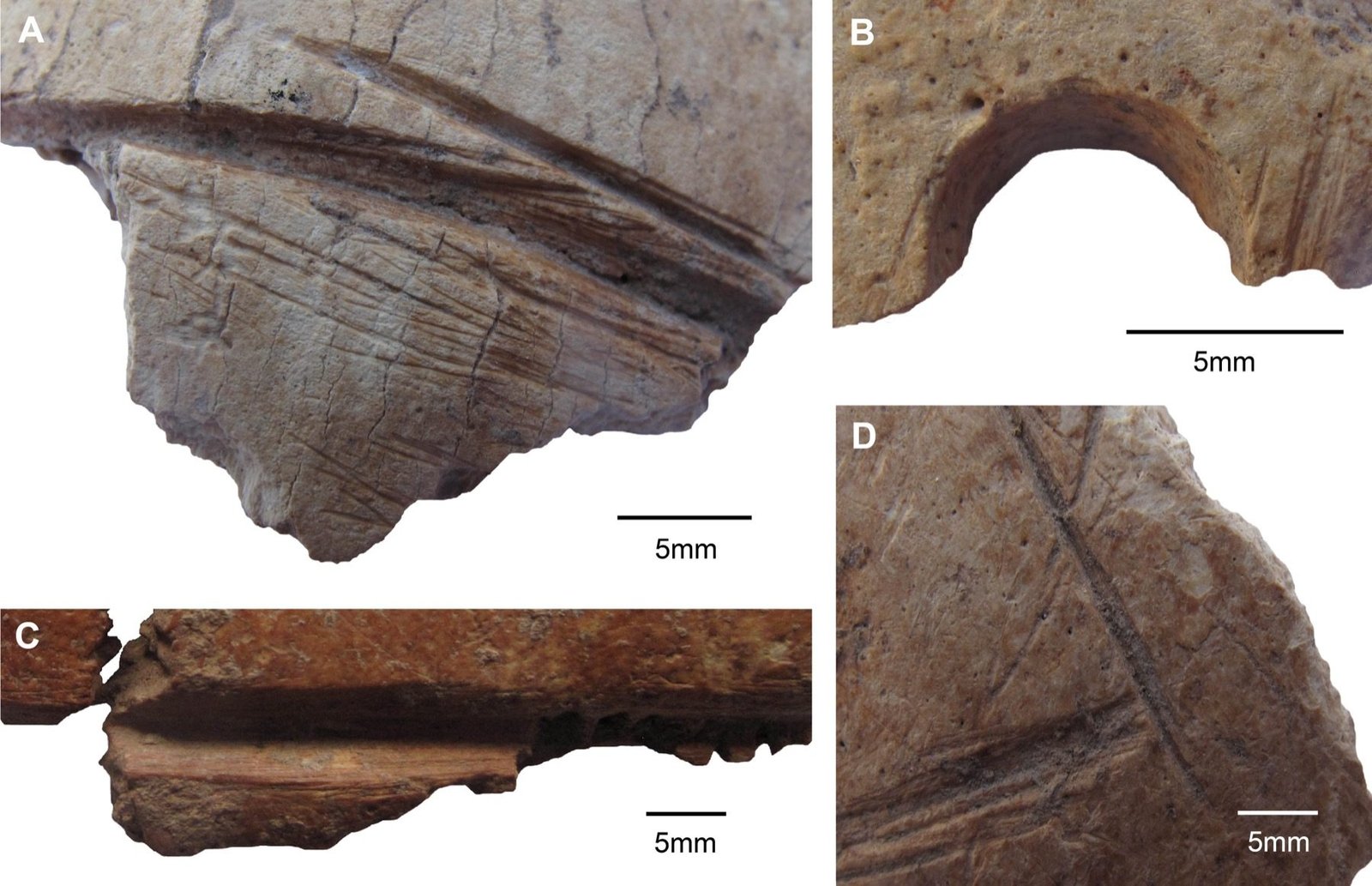
Göbekli Tepe has produced no cemetery and no laid-out graves. Instead, human bone appears broken and scattered through the fill of the buildings, and several skull fragments carry deliberate carved modifications. Together they suggest a treatment of the dead built not around burial but around the head.
A world without graves
The absence is the first clue. In the great enclosures there are no formal burials — no bodies laid to rest. What turns up instead are fragments: pieces of human skull and other bone mixed through the rubble that fills the buildings. Whatever these people did with their dead, it was not simple interment.
That points to a treatment of the dead focused on parts, and above all on the head — the part that, across this whole world, seems to have carried the person.
Three skull fragments from Göbekli Tepe carry deliberate, deep carved grooves; one also has a drilled perforation. The cut-marks are intentional and patterned, not incidental butchery.
The excavators' reading is that these skulls were modified to be handled — decorated, perhaps suspended and displayed. They named it a new form of Neolithic 'skull cult.' It is one of the best-evidenced windows we have into how these people treated their dead.
It also connects straight to the art: the headless figure on the Vulture Stone, the carved heads at Karahan Tepe. A single preoccupation — the human head as the seat of the person — runs through the bone and the stone alike.
Sources & further reading3 references
- Gresky, J., Haelm, J. & Clare, L. (2017). Modified human crania from Göbekli Tepe provide evidence for a new form of Neolithic skull cult. Science Advances 3(6): e1700564. doi:10.1126/sciadv.1700564
- Notroff, J., Dietrich, O. & Schmidt, K. (2014). Building Monuments, Creating Communities. Early monumental architecture at Pre-Pottery Neolithic Göbekli Tepe. In J.F. Osborne (ed.), Approaching Monumentality in Archaeology: 83–105. Albany: SUNY Press.
- Schmidt, K. (2012). Göbekli Tepe: A Stone Age Sanctuary in South-Eastern Anatolia. Berlin: ex oriente. The foundational monograph by the site's first excavator.
Full bibliography: the Taş Tepeler reference library →