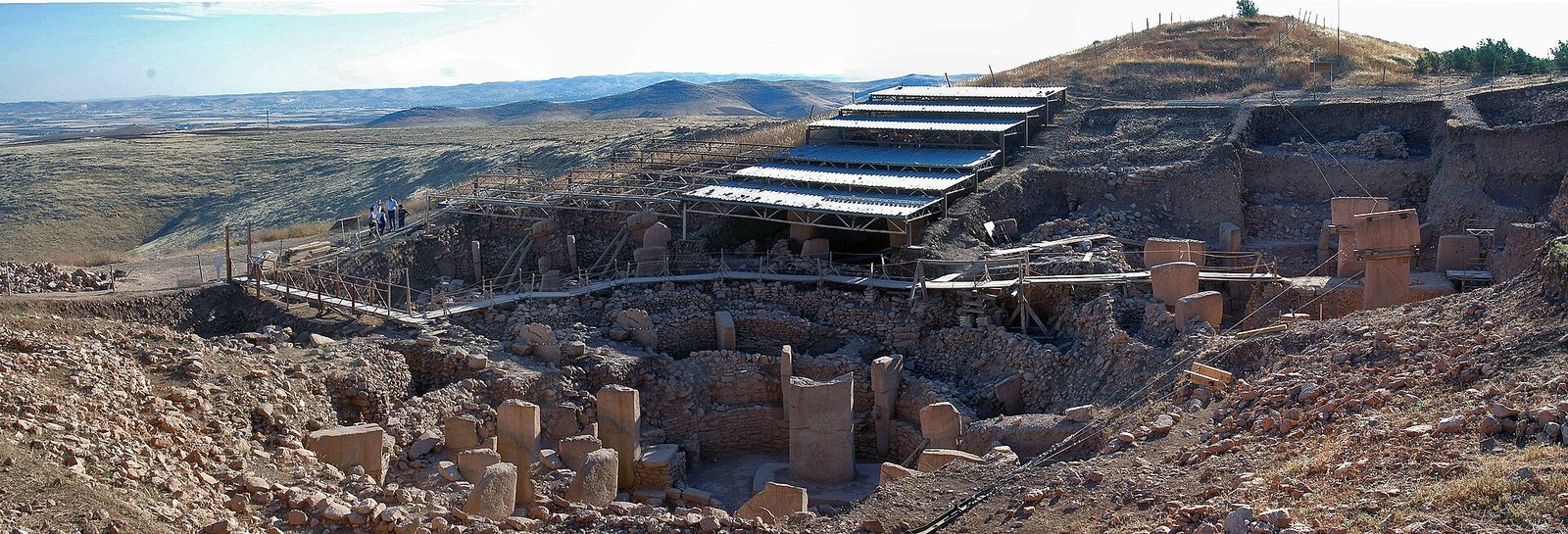
The pillars were quarried, shaped, moved, and raised by hunter-gatherers using stone tools alone. The proof is still in the ground: half-finished pillars lying in the bedrock where they cracked or were abandoned — including one that would have stood about seven metres tall.
The limestone was cut on site, from quarries a short distance from the enclosures. Workers freed each pillar by hammering channels around it with harder stones, then levered it loose. The largest raised pillars weigh on the order of ten tonnes; the unfinished 7-metre giant would have been far heavier. There is no evidence of metal tools, the wheel, or draft animals at this date.
Moving ten tonnes of stone without machines is not a lone genius at work — it is organisation. We read the site as evidence that these hunter-gatherers could gather a large workforce, feed it, and hold it together long enough to finish monuments. That social feat may matter more than the stones themselves.
How many people, and for how long, is estimated, not counted.
Fed by the hunt
A crowd that size has to eat. Huge numbers of wild animal bones — gazelle and aurochs above all — and tens of thousands of grinding stones point to feeding on a large scale, perhaps at gatherings or feasts. The work and the feast look like two halves of the same event.
- Pillars quarried on site with stone tools — no metal.
- Unfinished pillars still lie in the bedrock, including a ~7 m giant.
- Largest raised pillars weigh roughly ten tonnes.
- No wheel and no draft animals at this date.
- Building implies a large, organised, well-fed workforce.
Sources & further reading5 references
- Schmidt, K. (2012). Göbekli Tepe: A Stone Age Sanctuary in South-Eastern Anatolia. Berlin: ex oriente. The foundational monograph by the site's first excavator.
- Clare, L. (2020). Göbekli Tepe, Turkey. A brief summary of research at a new World Heritage Site (2015–2019). e-Forschungsberichte des Deutschen Archäologischen Instituts 2020(2): 81–88.
- Notroff, J., Dietrich, O. & Schmidt, K. (2014). Building Monuments, Creating Communities. Early monumental architecture at Pre-Pottery Neolithic Göbekli Tepe. In J.F. Osborne (ed.), Approaching Monumentality in Archaeology: 83–105. Albany: SUNY Press.
- The Tepe Telegrams (official research blog of the Göbekli Tepe Project, DAI). The Tepe Telegrams. Deutsches Archäologisches Institut. link Accessible, authoritative running commentary from the excavation team.
- Peters, J. & Schmidt, K. (2004). Animals in the symbolic world of Pre-Pottery Neolithic Göbekli Tepe, south-eastern Turkey: a preliminary assessment. Anthropozoologica 39(1): 179–218.
Full bibliography: the Taş Tepeler reference library →