Short answer
Göbekli Tepe was built as a gathering place — somewhere scattered hunter-gatherer communities came together to build, feast and enact shared beliefs, not to live in or to defend.
The architecture reads as assembly rather than housing: benched rooms centred on towering human-like pillars, no ordinary houses in the earliest phase, and huge quantities of wild-animal bone from large communal meals. What the builders actually believed — which spirits or ancestors the animals and pillars stood for — is beyond recovery.
The short answer: to gather
No one can read the minds of people who left no writing, but the strongest evidence points one way: Göbekli Tepe was a gathering place — somewhere scattered hunter-gatherer communities came together to build, to feast, and to enact shared beliefs. It was not a village and not a fortress. It was a place people travelled to, again and again over centuries, for something that mattered to them collectively.
What the architecture is telling us
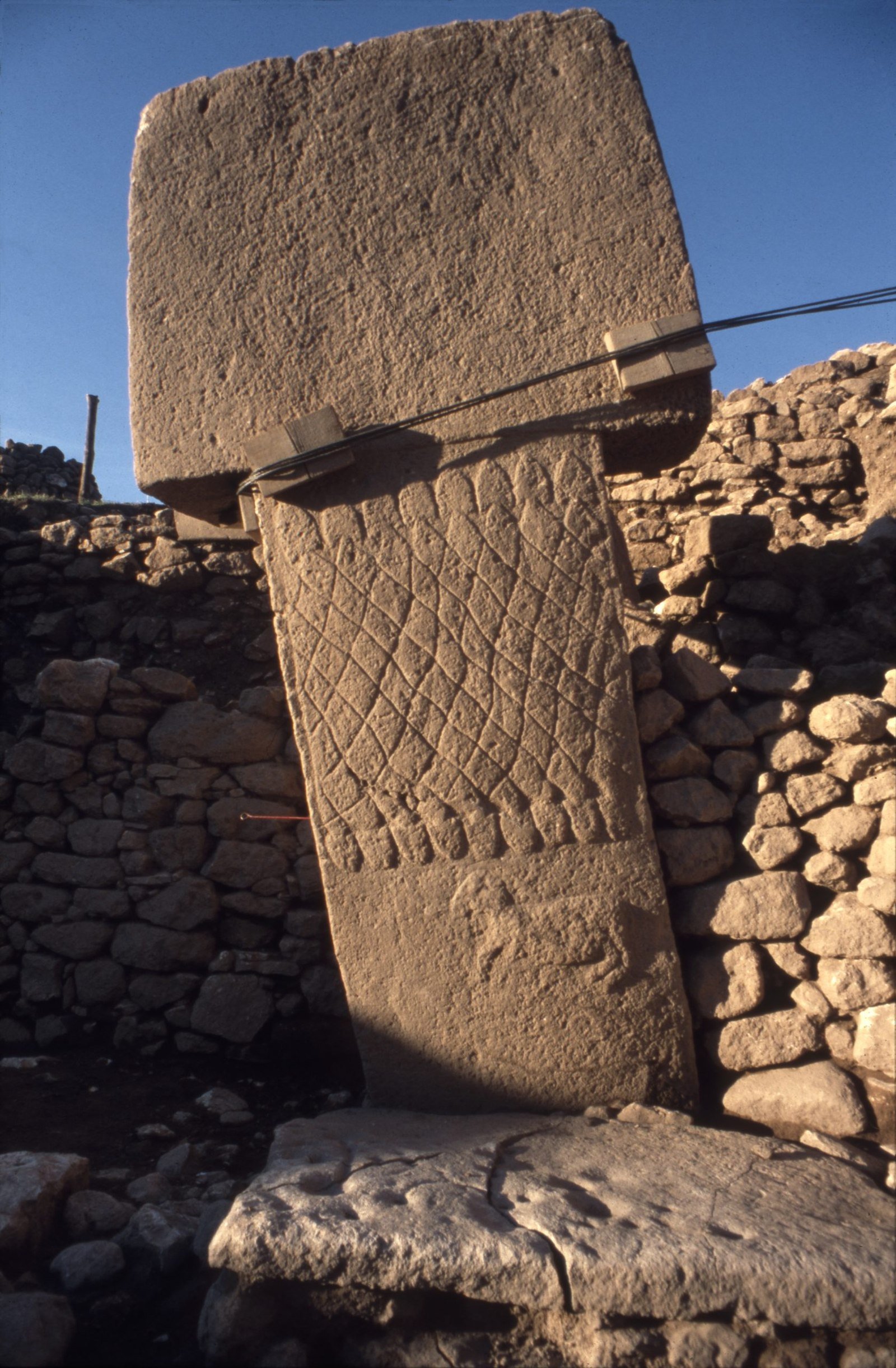
The buildings themselves make the 'gathering' reading hard to avoid. The great enclosures are round or oval rooms, ringed by walls with stone benches built along them — as if to seat people. In the centre of each stand two tall T-pillars, facing each other and often taller than the ring around them, like two figures presiding over the room. And crucially, from the earliest monumental phase there are no ordinary houses on the hill.
Put together — seating, a focal pair of figures, no domestic life — this is the architecture of assembly, not of everyday living. People came here to do something together in these rooms, then left.
Feasting on a large scale
The other strong signal is food. The monumental levels produced very large quantities of wild animal bone — especially gazelle — consistent with meals far bigger than a single band would eat. Alongside them are stone vessels and basins for processing food and drink in bulk, some holding on the order of 160 litres. Oliver Dietrich and colleagues have argued this points to communal feasting, possibly including fermented drinks, as a central activity. Bringing many people together, feeding them, and raising monuments in the process may have been the whole point.
Belief carved in stone
The carvings are not idle decoration. The same creatures recur — foxes, snakes, vultures, boar, scorpions — chosen deliberately, and overwhelmingly they are dangerous or wild animals rather than the gazelle people actually ate. The T-pillars are abstract human beings, larger than life. Many researchers read the enclosures as ritual spaces bound up with the community's picture of the world, its ancestors and its dead. Fragments of human skull, some deliberately cut and incised, suggest that how the dead were treated was part of what happened here — a belief system we can glimpse but not fully read.
Which interpretation is right?
The excavators' framing has shifted over time, and that shift is worth knowing. The first excavator, Klaus Schmidt, emphasised Göbekli Tepe as a purely ritual 'mountain sanctuary' — a place of cult with no one living there. More recent work by the DAI team (Lee Clare, Oliver Dietrich, Jens Notroff and others) has softened that: they now find some evidence of domestic activity and water management in later phases, and prefer to describe it as a monumental gathering place where the sacred and the social were not separate. The two readings are less opposed than they sound — both agree the site was built for people to come together around shared belief.
What almost everyone rejects is the popular shorthand of a 'temple' in the modern sense of a dedicated religious building staffed by priests. The word imports institutions that did not yet exist.
What remains uncertain
We cannot say what they believed — which spirits, ancestors or forces the animals and pillars stood for. We don't know whether the feasts were annual, tied to hunting seasons, or occasional. And we don't know whether one belief system held across all the enclosures or whether each building meant something slightly different. The 'why' is answered at the level of behaviour (gathering, feasting, ritual) far better than at the level of specific meaning.
Purpose, not significance
That is the answer to why it was built: to gather, to feast, and to hold shared belief in a fixed place, returned to over centuries. It is worth keeping that question separate from a second one it is often confused with — why the site matters to us.
Why Göbekli Tepe is historically important — how it upended the assumption that farming had to come before monuments — is a different question with a different answer, taken up on its own page (see 'Why is Göbekli Tepe important?' in Explore next). This page is about what the builders were doing; that one is about what it means for the story of civilisation.
The feasting argument, and the complication
One of the most durable explanations for Göbekli Tepe is feasting. Dietrich and colleagues argued in 2012 that large-scale food and drink consumption was central to how communities were gathered and rewarded for the enormous labour of raising the enclosures — including the possibility of fermented beverages prepared in the site's big limestone vessels.
It is an attractive model because it supplies a mechanism. Nobody moves a five-tonne pillar for an abstraction; people do it for an occasion, with food at the end of it.
The complication is where the evidence comes from. Much of the case rests on the fill inside the buildings — animal bone and debris interpreted as the residue of feasts. But the same fill is now read differently by the current excavation: Lee Clare has attributed a good deal of it to slope collapse and displaced midden material moving downhill, possibly mixed with some deliberate backfill.
So the question becomes awkward in a specific way: is this deposit the remains of a feast, an ordinary midden that slid into the building, or a mixture that cannot be separated? Feasting almost certainly happened. Whether a given layer of bone proves it is a much narrower claim, and one that is currently unsettled.
Common questions
Was Göbekli Tepe a temple?
It's often called the world's first temple, but archaeologists prefer 'monumental gathering and ritual place.' It clearly mattered spiritually, but 'temple' imports later ideas of dedicated religious buildings and priesthoods that did not yet exist.
Did people live at Göbekli Tepe?
Not in the earliest monumental phase — there are no ordinary houses from that time. Later phases show some domestic activity, but the great enclosures read as places people gathered at rather than lived in.
Why did they carve dangerous animals instead of the ones they ate?
It's one of the site's real puzzles. The carvings favour foxes, snakes, vultures and boar over the gazelle that dominate the bones — a sign the imagery was symbolic, not a menu, though what it symbolised is still debated.
Sources & further reading5 references
- Dietrich, O., Heun, M., Notroff, J., Schmidt, K. & Zarnkow, M. (2012). The role of cult and feasting in the emergence of Neolithic communities. New evidence from Göbekli Tepe, south-eastern Turkey. Antiquity 86(333): 674–695.
- Notroff, J., Dietrich, O. & Schmidt, K. (2014). Building Monuments, Creating Communities. Early monumental architecture at Pre-Pottery Neolithic Göbekli Tepe. In J.F. Osborne (ed.), Approaching Monumentality in Archaeology: 83–105. Albany: SUNY Press.
- Schmidt, K. (2012). Göbekli Tepe: A Stone Age Sanctuary in South-Eastern Anatolia. Berlin: ex oriente. The foundational monograph by the site's first excavator.
- Clare, L. (2020). Göbekli Tepe, Turkey. A brief summary of research at a new World Heritage Site (2015–2019). e-Forschungsberichte des Deutschen Archäologischen Instituts 2020(2): 81–88.
- Clare, L. (2025). Public lectures and interviews on Göbekli Tepe (Göbekli Tepe Project, DAI). Transcribed talks and interviews held in the Taş Tepeler research atlas. Spoken material rather than a peer-reviewed publication; positions may be refined in print.
Full bibliography: the Taş Tepeler reference library →