Short answer
Göbekli Tepe matters because it arrived in the wrong order — monumental architecture built by hunter-gatherers around 9500 BCE, before farming, pottery, cities or writing, which forced archaeology to rethink how complex society began.
Its carved T-pillars are also the earliest monumental images of the human form of their kind, and the site reframed a whole region, launching the twelve-site Taş Tepeler research programme. It is not evidence of a lost civilisation — the toolkit is entirely Neolithic — and it became a UNESCO World Heritage Site in 2018.
The order was wrong
For most of the twentieth century the sequence looked settled. Agriculture produces surplus; surplus produces settled populations; settled populations produce hierarchy, specialists and organised religion; and only then do you get monumental construction, because only then is there anyone able to command that much labour.
Göbekli Tepe does not fit. Its monumental enclosures were raised in the Pre-Pottery Neolithic A, from around 9500 BCE, by people who were not farmers. There is no domesticated wheat, no herded flock, no pottery, no metal, no writing, no evidence of kings.
Multi-tonne carved limestone pillars were quarried, moved, raised and arranged by hunter-gatherers. That single fact is why the site is famous, and it is not an exaggeration by the excavators — it is the finding.
What it did to the standard model
The most quoted response is Klaus Schmidt's inversion: rather than agriculture creating the conditions for temples, the need to gather and feed large numbers of people for collective ritual work may have driven the intensification of plant use that became agriculture.
That formulation is debated and should not be treated as established. But the underlying disruption survives the debate. Whatever the causal direction, complex collective undertakings preceded farming in this region, and any account of the Neolithic has to accommodate that.
It also shifted the question from what did they have to what were they able to organise. These communities had no obvious mechanism to compel labour. They built anyway.
The imagery is the other half
Göbekli Tepe would be significant as engineering alone. What makes it extraordinary is that the pillars are carved.
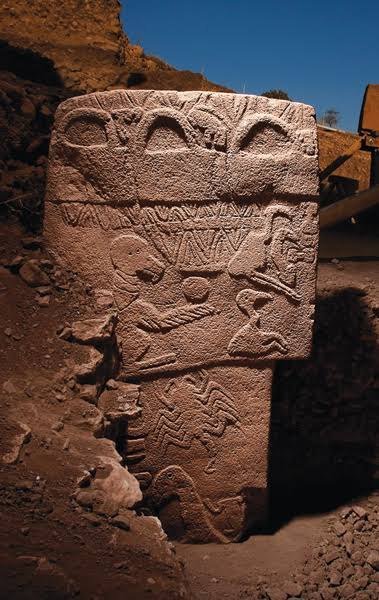
Foxes, boars, snakes, vultures, cranes, scorpions, spiders, aurochs — rendered with real observational precision, and arranged in ways that look deliberate rather than decorative. Pillar 43, the Vulture Stone, carries a dense composition including a headless human figure.
The T-pillars themselves appear to be bodies: arms bent along the sides, hands meeting at the front, belts and loincloths carved in relief, with a flat blank slab where a head would be. These are the earliest monumental depictions of the human form of this kind, and they are faceless.
Lee Clare has argued the animals should not be read as wildlife observation but as narrative — figures from stories a Neolithic viewer would have recognised. If so, the pillars preserve fragments of a mythology roughly eleven and a half thousand years old.
It is older than almost everything you would compare it to
The comparisons are what make the date land. Göbekli Tepe predates Stonehenge by roughly six thousand years, and the Giza pyramids by around seven thousand.
It is older than pottery, older than the wheel, older than writing, older than metal tools, older than domesticated animals and older than cities.
The gap between Göbekli Tepe and the pyramids is substantially larger than the gap between the pyramids and today.
What it is not
It is not evidence of a lost advanced civilisation, and the excavators are direct about this. The toolkit is Neolithic throughout — flint and obsidian, no metal, no machinery. The achievement is organisational, not technological.
It was not built by aliens, Atlanteans, or survivors of a vanished global culture. Those claims require ignoring the excavated evidence rather than engaging with it.
And it may not be a 'temple' in the sense the word usually carries. Necmi Karul prefers 'special building' for structures of this kind — communal, distinct from houses, but not demonstrably devoted to worship of gods. Recent work has also found domestic structures on the mound itself, which weakens the older picture of an unpopulated sanctuary visited only for ceremony.
The honest version is more interesting than the mythology: not a lost civilisation, but ordinary Neolithic people doing something nobody expected them to be capable of.
Why it still matters now
Because it is roughly 5% excavated. Geophysical survey indicates far more remains buried, and the current excavation is deliberately leaving most of it for future methods.
Because it reframed a region rather than a site. Göbekli Tepe led to Karahan Tepe, Sayburç, Sefertepe and the rest — twelve active excavations that did not exist as a research programme before.
And because it made the origins of religion, monumentality and social complexity into empirical questions with dirt attached, rather than purely theoretical ones. It became a UNESCO World Heritage Site in 2018.
Common questions
Why is Göbekli Tepe so important?
Because monumental architecture appears there before farming, pottery, metal, writing or cities. Multi-tonne carved pillars were raised by hunter-gatherers around 9500 BCE, which contradicts the long-standing assumption that agriculture had to come first.
How much older is it than Stonehenge?
Roughly six thousand years older than Stonehenge, and around seven thousand years older than the Giza pyramids.
Did Göbekli Tepe cause agriculture?
Klaus Schmidt proposed that gathering and feeding people for collective ritual work may have driven the intensification of plant use that became farming. It is a debated hypothesis, not an established finding.
Is Göbekli Tepe a temple?
Disputed. Necmi Karul prefers 'special building' for structures of this type — communal and distinct from houses, but not demonstrably devoted to worship. Domestic structures have also been found on the mound.
How much of Göbekli Tepe has been excavated?
Only a small fraction — commonly cited as around 5%. Geophysical survey shows much more remains buried, and the current project deliberately leaves most of it for future methods.
Was Göbekli Tepe built by a lost civilization?
No. The excavated toolkit is Neolithic throughout — flint and obsidian, no metal or machinery. The achievement is organisational rather than technological.
Sources & further reading5 references
- Schmidt, K. (2012). Göbekli Tepe: A Stone Age Sanctuary in South-Eastern Anatolia. Berlin: ex oriente. The foundational monograph by the site's first excavator.
- Clare, L. (2020). Göbekli Tepe, Turkey. A brief summary of research at a new World Heritage Site (2015–2019). e-Forschungsberichte des Deutschen Archäologischen Instituts 2020(2): 81–88.
- Dietrich, O., Heun, M., Notroff, J., Schmidt, K. & Zarnkow, M. (2012). The role of cult and feasting in the emergence of Neolithic communities. New evidence from Göbekli Tepe, south-eastern Turkey. Antiquity 86(333): 674–695.
- UNESCO World Heritage Centre (2018). Göbekli Tepe (inscription on the World Heritage List). UNESCO. link
- Notroff, J., Dietrich, O. & Schmidt, K. (2014). Building Monuments, Creating Communities. Early monumental architecture at Pre-Pottery Neolithic Göbekli Tepe. In J.F. Osborne (ed.), Approaching Monumentality in Archaeology: 83–105. Albany: SUNY Press.
Full bibliography: the Taş Tepeler reference library →