Short answer
Sefertepe matters for its intense focus on the human head: carved faces, a tiny double-faced bead, and a ‘skull room’ where human skulls were gathered — one of the most concentrated expressions of the region’s skull symbolism.
The skull room
Excavation has documented 43 skulls in two chambers as of the 2025 season — 31 recorded in the original skull room, with a further 12 recovered in 2025. Twenty-one were grouped together in a chamber, in what was described as a deliberate, ritual-style arrangement, associated with the bones of an infant. One further skull stood alone, facing east.
Later reporting from the excavation gives other figures, including a layer containing 31 skulls and skull fragments. Each figure is a snapshot of a continuing excavation rather than a competing claim.
What is not in question is the shape of what was found: human heads brought together into one space, on purpose, with an infant's remains among them.
Why that is significant beyond Sefertepe
The treatment of human heads is one of the defining preoccupations of the early Neolithic Near East, but the evidence is usually scattered — a modified fragment here, a separated skull there.
Göbekli Tepe produced skull fragments with cut marks and a drilled perforation implying suspension. Jericho produced skulls plastered into faces. These are individually remarkable but come from dispersed contexts.
Sefertepe is different because the evidence is concentrated in one room. A group of skulls, deposited together, in a definable space. That gives archaeologists something the other sites largely do not: a single context in which the practice can be studied as an arrangement rather than as isolated finds.
Architecture at a junction
Sefertepe was reported by Bahattin Çelik in Neo-Lithics in 2006, as one of the Şanlıurfa T-pillar sites that showed the tradition extended well beyond Göbekli Tepe.
It has T-shaped pillars along with a group of quadrangular buildings — rectangular plans, in a region best known for round ones.
Field notes describe the architecture as blending traits associated with the Tigris region and the Euphrates region. If that holds under fuller publication, Sefertepe sits at a junction between two architectural traditions rather than inside one, which would make it a useful place to study how ideas moved across this landscape.
The other material
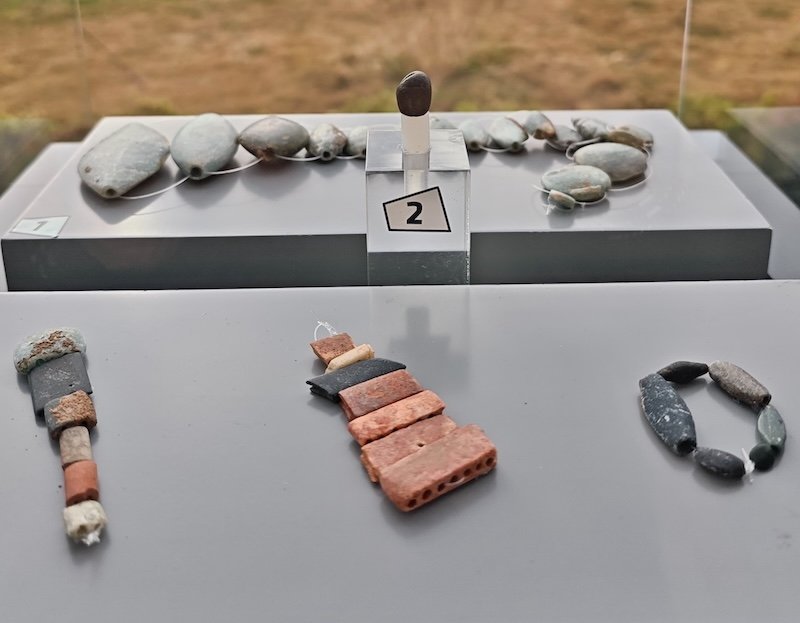
Sefertepe has produced paired human face reliefs and a dual-faced anthropomorphic bead — a small object with a face on each side.
It has also produced a young wild boar incised on the back of a grinding stone: an image on a working tool rather than on architecture, which is a useful reminder that symbolic life was not confined to special buildings.
Taken together with the skull room, the site's signature is clear. Sefertepe is where the Taş Tepeler concern with faces, heads and the dead is most densely represented.
What is still unresolved
The skull counts, and how the different reported figures relate to one another and to distinct contexts.
Whether the arrangement in the chamber has internal structure — orientation, grouping, sequence of deposition.
Who the individuals were: age, sex, and whether they show the cut marks and perforations documented at Göbekli Tepe.
The significance of the infant bones, which is currently the most affecting detail and the least explained.
And whether the Tigris–Euphrates architectural reading survives publication.
Sefertepe is an active excavation. This is a site whose most important account has not been written yet.
Common questions
Why is Sefertepe important?
Because of its skull room — a chamber where human skulls were deliberately gathered together with the bones of an infant. It concentrates in one context a practice that is usually found scattered across sites.
How many skulls were found at Sefertepe?
Onsite notes from August 2024 record 22: twenty-one grouped in a chamber with infant bones, and one standing alone facing east. The documented skull-room total later reached 31, and the 2025 season added 12 more across a second chamber — 43 in all.
Does Sefertepe have T-pillars?
Yes, along with quadrangular buildings. It was reported by Bahattin Çelik in 2006 as one of the Şanlıurfa T-pillar sites that showed the tradition extended beyond Göbekli Tepe.
What else has been found at Sefertepe?
Paired human face reliefs, a dual-faced anthropomorphic bead, and a young wild boar incised on the back of a grinding stone.
Can you visit Sefertepe?
It is a working excavation rather than a developed visitor site. Access varies by season and permission.
Sources & further reading5 references
- Çelik, B. (2006). Sefer Tepe: A New Pre-Pottery Neolithic Site in Southeastern Turkey. Neo-Lithics 1/06: 23–25.
- Onsite notes from archaeologists working at Sefertepe (2024). Field observations recorded at the site, end of August 2024. Unpublished field notes held by Taş Tepeler (tastepeler.net). First-hand site notes, not a peer-reviewed publication. Figures may be superseded by the excavation's own reporting.
- Gresky, J., Haelm, J. & Clare, L. (2017). Modified human crania from Göbekli Tepe provide evidence for a new form of Neolithic skull cult. Science Advances 3(6): e1700564. doi:10.1126/sciadv.1700564
- Clare, L. (2020). Göbekli Tepe, Turkey. A brief summary of research at a new World Heritage Site (2015–2019). e-Forschungsberichte des Deutschen Archäologischen Instituts 2020(2): 81–88.
- Çelik, B.. Differences and similarities between the settlements in Şanlıurfa region where 'T' shaped pillars are discovered. Comparative survey of the Şanlıurfa T-pillar sites. Consulted via open repository copy; full bibliographic details not verified.
Full bibliography: the Taş Tepeler reference library →