Short answer
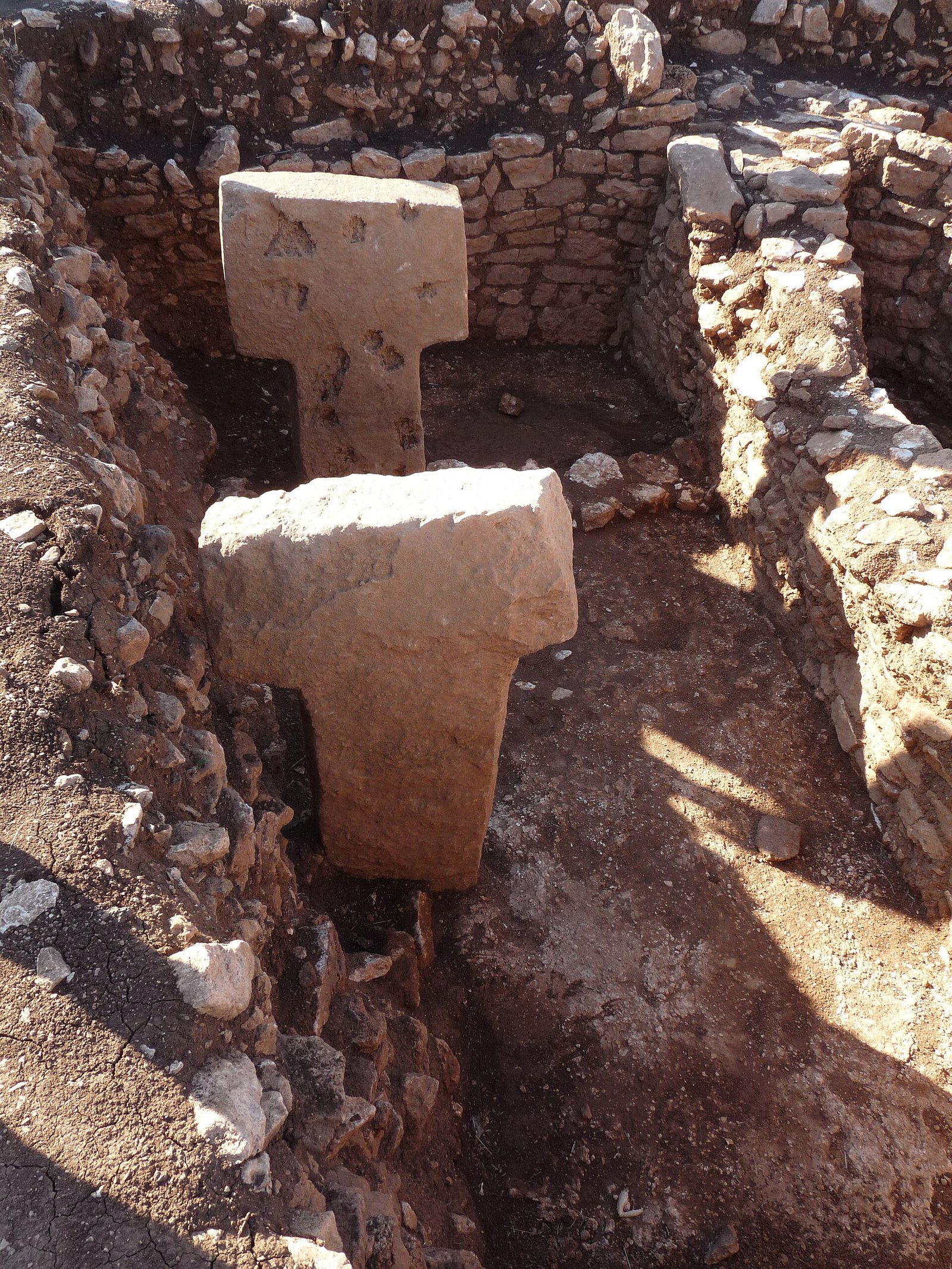
Sefertepe's pillars are a set of ten upright stones — three T-shaped and seven quadrangular — combining the region's signature T-pillar with plain rectangular pillars, including one T-pillar carved with geometric decoration on its east-facing side.
The T-pillar is the shared signature of the Taş Tepeler world, a stylised standing figure in stone. What makes Sefertepe distinctive is that it pairs the T-form with quadrangular pillars and rectangular buildings — a different architectural habit from the great round enclosures at Göbekli Tepe.
Ten pillars, of two kinds
The excavations have reported ten pillars at Sefertepe: three T-shaped and seven quadrangular. That ratio is worth pausing on. The T-pillar is the regional signature — the thing that first marked Sefertepe out as belonging to the Taş Tepeler group — but here it is outnumbered by plain rectangular pillars.
One space was cleared right down to the floor around a T-shaped pillar, which is how the best-documented example came to light. The others are known in less detail, and counts at an active excavation should be expected to move.
What a T-pillar is
A T-shaped pillar is not just a column. Across this region the form reads as a stylised human body: the broad horizontal top is a head, the shaft is a torso, and on the clearest examples elsewhere arms bend down the sides and hands meet at the front. They are standing figures rendered in stone.
That is why the T-pillar is treated as the shared vocabulary of the Taş Tepeler world. Finding it at Sefertepe places the site inside that tradition — the same idea of the stone person, repeated across the hills of Şanlıurfa.
The decorated pillar
The T-pillar cleared to the floor carries decoration on its east-facing side, on both the upper and lower parts of the shaft — geometric forms worked in relief and incision.
Decorated pillars are the exception rather than the rule at most Taş Tepeler sites, where many stones are plain. This makes Sefertepe's example one of the better-documented decorated pillars outside the two flagship sites, Göbekli Tepe and Karahan Tepe.
The decoration is geometric rather than figurative — no animals or human features on this shaft — which is itself a data point about how ornament varied from site to site.
Why the mix matters
The combination of T-pillars with quadrangular pillars and rectangular buildings is a different architectural habit from Göbekli Tepe's great circular enclosures. It sits closer to the rectilinear building tradition seen elsewhere in the region.
Field notes describe Sefertepe's architecture as blending traits associated with the Tigris and Euphrates regions. If that holds under publication, the pillars are part of the evidence that the site sits at a junction between two traditions rather than inside one — using the shared signature form within a locally distinct kind of building.
So the pillars do two things at once: they tie Sefertepe to the wider network, and they show that network being worked in a local hand.
What is established, and what is not
Secure: Sefertepe has T-shaped pillars, which is what first identified it as a Taş Tepeler site when Bahattin Çelik reported it in 2006, and it has quadrangular pillars alongside them, with at least one decorated T-pillar documented.
Not yet settled: the full count and arrangement of the pillars, how they relate to the site's buildings and to the skull chamber, and the exact reading of the architecture as a Tigris–Euphrates blend. Much of this rests on season reports rather than final publication, so the numbers and the interpretation may both change.
Common questions
How many pillars are at Sefertepe?
Ten have been reported: three T-shaped and seven quadrangular. Counts may change as excavation continues.
What is a T-shaped pillar?
An upright stone whose broad horizontal top and vertical shaft render a stylised human body — the signature form of the Taş Tepeler world, found across the Şanlıurfa sites.
Are any of the Sefertepe pillars carved?
Yes. One T-pillar carries geometric decoration in relief and incision on its east-facing side, on both the upper and lower shaft. The decoration is geometric rather than figurative.
How are Sefertepe's pillars different from Göbekli Tepe's?
Sefertepe pairs its T-pillars with quadrangular pillars and rectangular buildings, a different habit from Göbekli Tepe's great round enclosures — part of why its architecture is read as sitting between regional traditions.
Is the pillar evidence fully published?
No. Sefertepe is thinly published, dug systematically only since 2021, so pillar counts and their interpretation come largely from season reports and should be expected to move.
Sources & further reading4 references
- Çelik, B. (2006). Sefer Tepe: A New Pre-Pottery Neolithic Site in Southeastern Turkey. Neo-Lithics 1/06: 23–25.
- Çelik, B.. Differences and similarities between the settlements in Şanlıurfa region where 'T' shaped pillars are discovered. Comparative survey of the Şanlıurfa T-pillar sites. Consulted via open repository copy; full bibliographic details not verified.
- Clare, L. (2020). Göbekli Tepe, Turkey. A brief summary of research at a new World Heritage Site (2015–2019). e-Forschungsberichte des Deutschen Archäologischen Instituts 2020(2): 81–88.
- The Tepe Telegrams (official research blog of the Göbekli Tepe Project, DAI). The Tepe Telegrams. Deutsches Archäologisches Institut. link Accessible, authoritative running commentary from the excavation team.
Full bibliography: the Taş Tepeler reference library →