Short answer
Sefertepe is one of the Taş Tepeler sites — a Pre-Pottery Neolithic community at the eastern edge of the Şanlıurfa cluster, sharing the group's T-shaped pillars, carved human imagery and preoccupation with the human head, and excavated within the same Turkish-led programme.
It belongs to Taş Tepeler both geographically — roughly 50 km from Göbekli Tepe and 20 km from Karahan Tepe — and culturally, through a shared vocabulary of stone. But it is not a copy: its quadrangular buildings and its concentrated skull chamber give it a distinct role in the network the programme was set up to study.
The same world, the eastern edge
Taş Tepeler — 'the Stone Hills' — is a cluster of around a dozen Pre-Pottery Neolithic sites across Şanlıurfa province, studied together as one connected landscape rather than as a scatter of separate marvels. Sefertepe is one of them.
It sits toward the eastern edge of that cluster, about 72 km east of Şanlıurfa, roughly 50 km from Göbekli Tepe and 20 km from Karahan Tepe. That is far enough out to sit at the margin of the group and close enough to belong squarely to it — within a landscape people could cross on foot.
It was first reported as a T-pillar site by Bahattin Çelik in 2006, one of the finds that showed the tradition extended well beyond Göbekli Tepe. Systematic excavation began only in 2021, inside the Taş Tepeler programme.
What it shares with the network
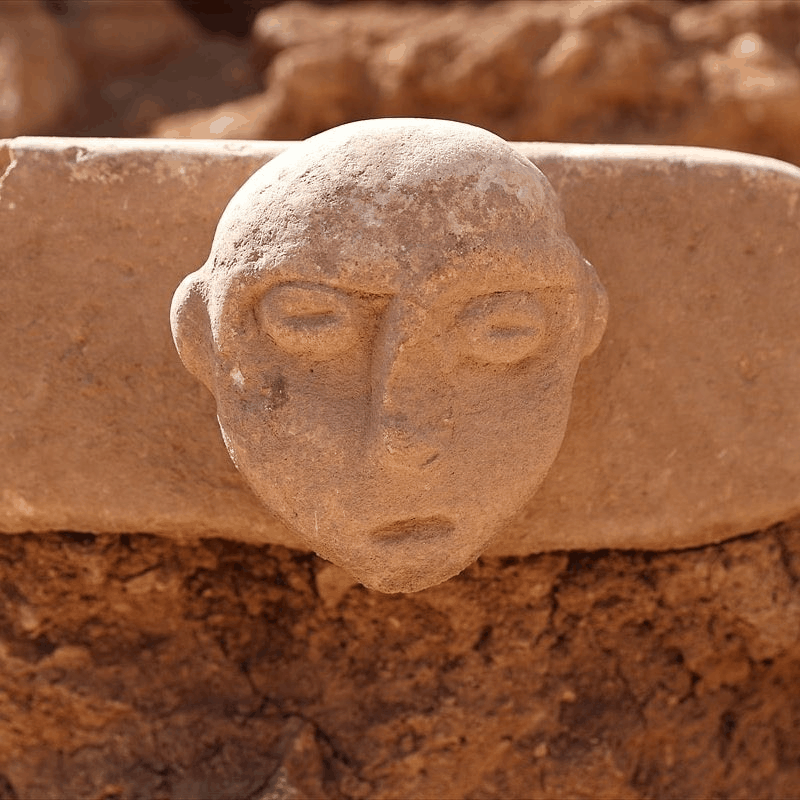
Sefertepe carries the core Taş Tepeler vocabulary. It has T-shaped pillars, the regional signature — a stylised standing figure in stone. It has carved human faces, tying it to the region's central artistic subject. And it has an intense focus on the human head, expressed most dramatically in its skull chamber.
These are exactly the features that recur across the group — T-pillars, special buildings distinct from houses, animal and human imagery, and a concern with heads and the dead. Sharing them is what makes Sefertepe part of the network rather than an isolated site.
What it does differently
Grouping the sites together should not flatten them, and Sefertepe is a good example of why. Alongside its T-pillars it has a set of quadrangular buildings — rectangular plans, in a region best known for round enclosures.
Field notes describe its architecture as blending traits associated with the Tigris and Euphrates regions. If that holds under publication, Sefertepe would sit at a junction between two traditions rather than inside one — a useful place to watch ideas move across the landscape.
And where the treatment of human heads is usually found scattered across other sites — a modified fragment here, a separated skull there — at Sefertepe it is concentrated in one room, as an arrangement. That gives the network something it otherwise lacks: a single, dense context in which the practice can be studied.
Why the programme studies them together
For decades the story was told through one hill, Göbekli Tepe, treated as a lone wonder. The Taş Tepeler programme — launched in 2021 and coordinated by Necmi Karul — was built on the opposite premise: that the region is a connected society of communities in conversation, and that the sites reveal more together than apart.
Sefertepe is part of the evidence for that shift. A community with the shared grammar but its own architecture and its own way of handling the dead is precisely what turns 'a famous temple' into 'a populated landscape.' Its value is comparative — it shows what the shared idea looked like somewhere else.
Established, and still open
What is secure: Sefertepe is a genuine Taş Tepeler site, with T-pillars, carved faces and a skull chamber, dug within the programme.
What is not yet settled: it is one of the thinly published members of the group. Its internal chronology, full plan, and the Tigris–Euphrates architectural reading all rest largely on season reports rather than final publication. As one of the less-excavated sites, its exact place in the network may grow and shift as work continues — which is itself a fair description of what an active research frontier looks like.
Common questions
How does Sefertepe connect to Taş Tepeler?
It is one of the Taş Tepeler sites — a Pre-Pottery Neolithic community at the eastern edge of the Şanlıurfa cluster that shares the group's T-pillars, carved human faces and focus on the head, and is excavated within the same programme.
How far is Sefertepe from Göbekli Tepe and Karahan Tepe?
Roughly 50 km from Göbekli Tepe and about 20 km from Karahan Tepe, at the eastern edge of the cluster — within a landscape people could cross on foot.
What does Sefertepe add to the network?
Quadrangular buildings alongside its T-pillars, a possible junction between Tigris- and Euphrates-region architectural traditions, and a skull chamber that concentrates in one room a practice usually found scattered across sites.
Is Sefertepe well studied?
Not yet. It is one of the thinly published Taş Tepeler sites, systematically excavated only since 2021, so much of what is known comes from annual season reports rather than final publication.
Sources & further reading5 references
- Çelik, B. (2006). Sefer Tepe: A New Pre-Pottery Neolithic Site in Southeastern Turkey. Neo-Lithics 1/06: 23–25.
- Çelik, B.. Differences and similarities between the settlements in Şanlıurfa region where 'T' shaped pillars are discovered. Comparative survey of the Şanlıurfa T-pillar sites. Consulted via open repository copy; full bibliographic details not verified.
- Clare, L. (2020). Göbekli Tepe, Turkey. A brief summary of research at a new World Heritage Site (2015–2019). e-Forschungsberichte des Deutschen Archäologischen Instituts 2020(2): 81–88.
- Karul, N. (2021). Buried Buildings at Pre-Pottery Neolithic Karahantepe. Türk Arkeoloji ve Etnografya Dergisi 82: 19–29. link
- The Tepe Telegrams (official research blog of the Göbekli Tepe Project, DAI). The Tepe Telegrams. Deutsches Archäologisches Institut. link Accessible, authoritative running commentary from the excavation team.
Full bibliography: the Taş Tepeler reference library →