Short answer
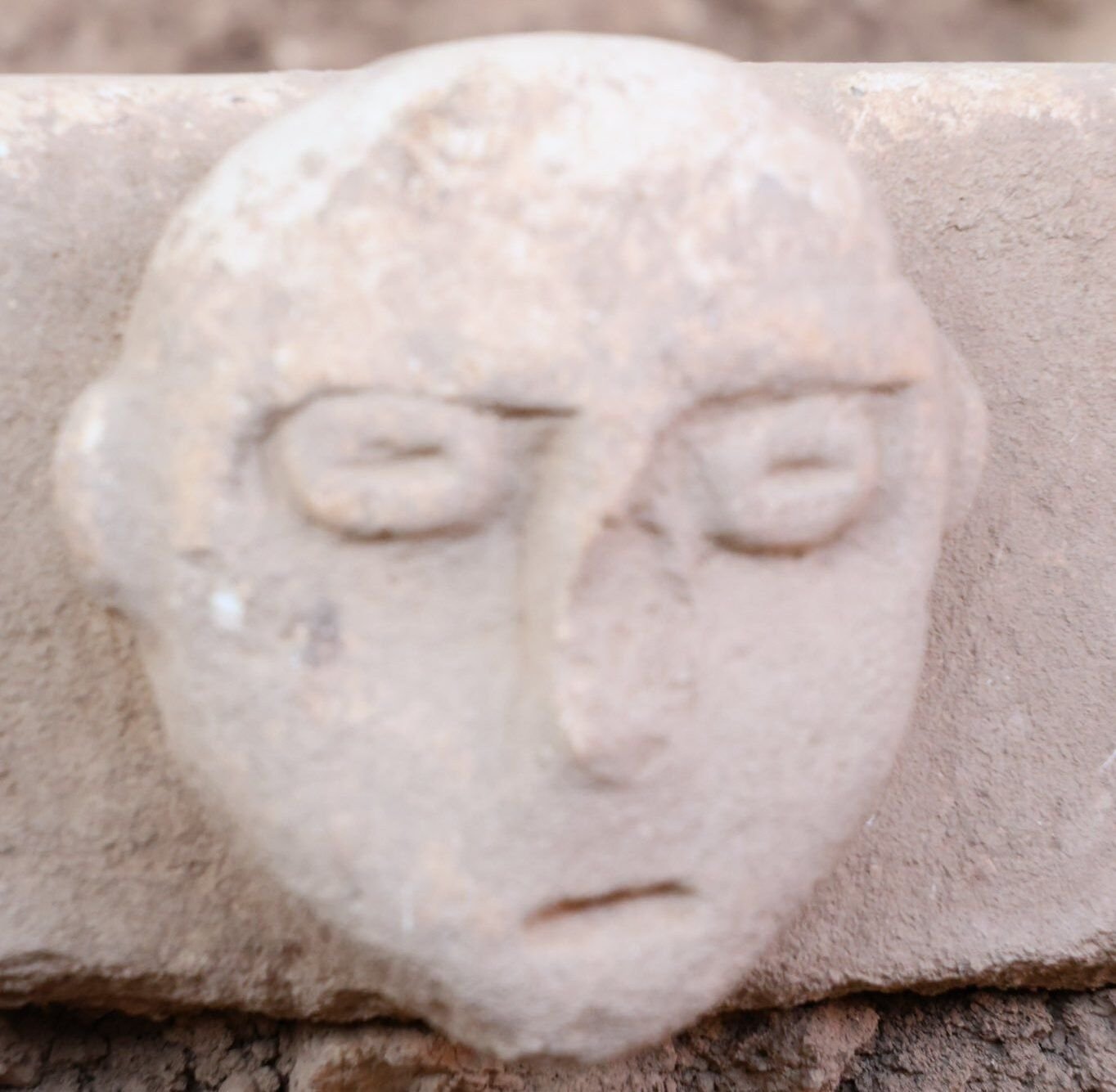
The Sefertepe human faces are relief carvings of the human face worked into the site's stonework — including a group cut into the front of four limestone blocks forming a platform, and a tiny double-faced bead carrying a face on each side.
Reported from recent seasons, the platform faces are carved in a mix of high and low relief, with two of them oriented toward the north in what looks like a ceremonial setting. Their proportions are described as stylistically distinct from the carved heads at Göbekli Tepe, Karahan Tepe and Sayburç — a local hand rather than a copied template.
Faces on a stone platform
The most substantial face find was reported in 2025: reliefs cut into the front surfaces of four limestone blocks set together as a platform, in what the excavation describes as a ceremonial setting rather than an ordinary building.
Two of the faces are oriented toward the north. Orientation is one of the few things an arrangement like this can tell you directly, and it was recorded — though what north meant to the people who set the blocks is not something the stones can answer.
The carving technique varies: one face is worked in high relief, standing proud of the block, and another in low relief, barely raised from the surface. That range within a single group is itself worth noting — these were not stamped from one mould but cut as individual images.
A local style, not a copy
The point emphasised in the reporting is that the Sefertepe faces are stylistically distinct. Their proportions do not simply repeat the conventions known from Göbekli Tepe's pillar-figures, Karahan Tepe's carved head, or the figures at Sayburç.
If that reading holds under fuller publication, it matters for the whole region. It would mean the human image was being handled differently at different sites within one cultural landscape — a shared subject worked in local hands, rather than a single template copied from hill to hill.
That is a more interesting picture than uniformity. It suggests communities that recognised each other's imagery and still made their own version of it.
The face made portable
Alongside the monumental faces, Sefertepe has produced a small black serpentinite bead carved with a human face on each side — a dual-faced, anthropomorphic bead.
This is the quiet headline. The human face, which elsewhere in this world is fixed to walls and pillars and blocks, here becomes tiny, double-sided and portable — something to be carried, strung or worn.
It collapses the distance between the great carved heads and the individual person. The same image that watches from a platform could also sit against someone's skin. The Taş Tepeler concern with the face ran from the giant to the handheld.
Part of a regional obsession with the head
The faces do not sit on their own. They belong to a site where the human head recurs at every scale — the carved reliefs, the double-faced bead, and, most strikingly, the skull room, where the heads of real people were gathered together.
Across Taş Tepeler the head was treated as the most charged part of a person: carved, collected, modelled and kept. Göbekli Tepe modified real skulls; Karahan Tepe carved a head from the living rock; Jericho, further south and later, plastered skulls into faces.
Sefertepe's faces are one thread of that preoccupation — the represented head — running alongside the site's treatment of the actual head in the skull chamber.
What is established, and what is not
What is reasonably secure: Sefertepe has produced carved human faces, in more than one form, and a double-faced bead. These place it firmly inside the region's tradition of human imagery.
What is not yet settled: most of the detail comes from annual season reporting rather than final, peer-reviewed publication. The count of faces, the exact character of the platform, how the faces relate to the pillars and the skull room, and the claim that their style is genuinely distinct are all working interpretations that publication could revise.
Treat the striking parts — the northward orientation, the 'distinct local style' — as reported observations to watch, not as closed conclusions.
Common questions
What are the Sefertepe human faces?
Relief carvings of the human face worked into the site's stonework, including a group cut into the front of four limestone blocks forming a platform, plus a small bead carved with a face on each side.
Where were the carved faces found?
Reported in 2025 on the front surfaces of four limestone blocks set as a platform, in what the excavation describes as a ceremonial setting. Two of the faces are oriented toward the north.
Are the Sefertepe faces like Göbekli Tepe's?
They belong to the same regional tradition of human imagery, but the reporting stresses that their proportions are stylistically distinct from the carved heads at Göbekli Tepe, Karahan Tepe and Sayburç — a local style rather than a copy.
What is the double-faced bead?
A small black serpentinite bead carved with a human face on each side — a portable, dual-faced version of the same image that appears monumentally elsewhere on the site.
Is this fully published?
No. Most of the detail comes from annual season reports rather than final publication, so counts and interpretations should be expected to move as excavation continues.
Sources & further reading4 references
- Çelik, B. (2006). Sefer Tepe: A New Pre-Pottery Neolithic Site in Southeastern Turkey. Neo-Lithics 1/06: 23–25.
- Çelik, B.. Differences and similarities between the settlements in Şanlıurfa region where 'T' shaped pillars are discovered. Comparative survey of the Şanlıurfa T-pillar sites. Consulted via open repository copy; full bibliographic details not verified.
- Clare, L. (2020). Göbekli Tepe, Turkey. A brief summary of research at a new World Heritage Site (2015–2019). e-Forschungsberichte des Deutschen Archäologischen Instituts 2020(2): 81–88.
- The Tepe Telegrams (official research blog of the Göbekli Tepe Project, DAI). The Tepe Telegrams. Deutsches Archäologisches Institut. link Accessible, authoritative running commentary from the excavation team.
Full bibliography: the Taş Tepeler reference library →