Short answer
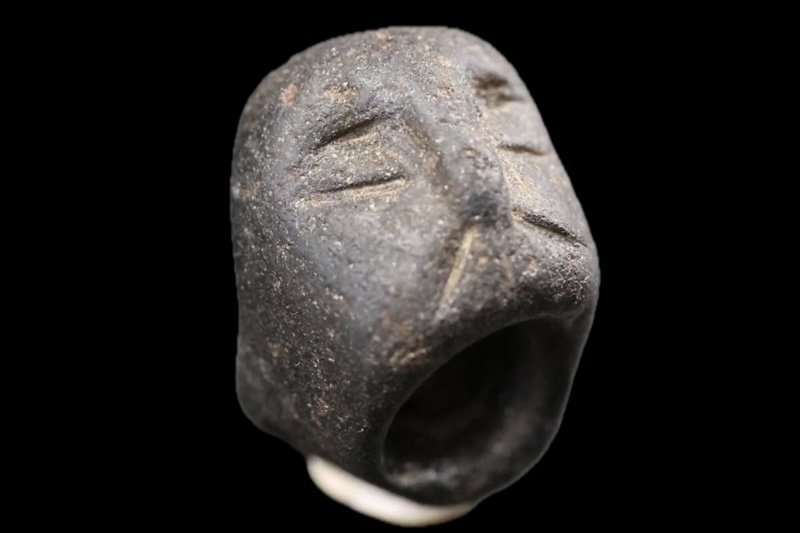
Sefertepe's beads are small worked-stone ornaments recovered from the site — the standout being a black serpentinite bead carved with a human face on each side, a portable version of the human image that appears monumentally elsewhere on the site.
Personal ornaments like beads are a recurring find across the Taş Tepeler world, evidence that symbolic and everyday life were woven together. Sefertepe's assemblage is not yet fully published, so the double-faced bead is its clearest, most-reported piece rather than the whole story.
Beads among the finds
Alongside its pillars, carved faces and skull chamber, Sefertepe has produced beads — small ornaments worked from stone, the kind of personal object that recurs across Neolithic sites.
Beads are easy to overlook next to monumental architecture, but they matter. They are objects made to be worn or carried, which means they belonged to individuals in a way that a T-pillar or a special building did not. They are one of the few finds that bring the scale of this world down to a single person.
The double-faced bead
The standout piece is a small black serpentinite bead carved with a human face on each side — a dual-faced, anthropomorphic ornament.
This is the quiet headline of the whole assemblage. The human face at Sefertepe is otherwise monumental: cut into a platform of limestone blocks, worked in relief. On the bead, that same image becomes tiny, double-sided and portable.
A face on each side is a deliberate choice, not a convenience. Whichever way the bead turned, it presented a face — an object that looked out in two directions at once, and that a person could carry against the skin.
Why a bead matters here
Sefertepe's signature is its concentration on the human head — carved onto stone, and gathered, as real skulls, into a room. The double-faced bead is the same preoccupation at the smallest possible scale.
Set the three together — the skull chamber, the carved faces on the platform, and the bead — and the site reads as an exploration of the human head across every size and material available to it: the actual head, the head in monumental stone, and the head reduced to something handheld.
That range, in one place, is what makes even a small object like the bead worth attention.
Beads across the Taş Tepeler world
Sefertepe is not unusual in having ornaments. Stone beads and bead production are reported from across the region — among the finds at Harbetsuvan Tepesi, for example, and in the domestic evidence at Göbekli Tepe.
That wider pattern is the point. Personal ornament was part of life in these communities, woven in alongside the monumental and the ritual. Beads are a reminder that the same people who raised T-pillars also made small things to wear.
What sets the Sefertepe bead apart is not that it is a bead, but that it carries the human face — linking a piece of personal ornament directly to the site's largest preoccupation.
What is established, and what is not
Secure: Sefertepe has produced beads, including the well-reported double-faced serpentinite bead.
Not yet settled: there is no full published catalogue of the bead assemblage. Its size, the range of materials and forms, and where the beads were found relative to the buildings and burials are not established in the available reporting.
So this is a page about a genuinely striking object and a real category of find, held honestly: the double-faced bead is well attested; the assemblage around it is still largely unpublished, as is much of this five-year-old excavation.
Common questions
What are the Sefertepe beads?
Small worked-stone ornaments recovered at the site. The best-reported is a black serpentinite bead carved with a human face on each side.
What is the double-faced Sefertepe bead?
A small black serpentinite bead with a carved human face on each of its two sides — a portable version of the human image that appears monumentally elsewhere at Sefertepe.
Why is a bead significant?
It shrinks the region's monumental obsession with the human head down to a handheld, personal object, linking individual ornament directly to the site's largest theme.
Are beads found at other Taş Tepeler sites?
Yes. Stone beads and bead production are reported from across the region, including finds at Harbetsuvan Tepesi and domestic evidence at Göbekli Tepe.
Is the bead assemblage fully published?
No. There is no full published catalogue. The double-faced bead is well attested, but the wider assemblage remains largely unpublished, like much of this recent excavation.
Sources & further reading4 references
- Çelik, B. (2006). Sefer Tepe: A New Pre-Pottery Neolithic Site in Southeastern Turkey. Neo-Lithics 1/06: 23–25.
- Çelik, B.. Differences and similarities between the settlements in Şanlıurfa region where 'T' shaped pillars are discovered. Comparative survey of the Şanlıurfa T-pillar sites. Consulted via open repository copy; full bibliographic details not verified.
- Clare, L. (2020). Göbekli Tepe, Turkey. A brief summary of research at a new World Heritage Site (2015–2019). e-Forschungsberichte des Deutschen Archäologischen Instituts 2020(2): 81–88.
- The Tepe Telegrams (official research blog of the Göbekli Tepe Project, DAI). The Tepe Telegrams. Deutsches Archäologisches Institut. link Accessible, authoritative running commentary from the excavation team.
Full bibliography: the Taş Tepeler reference library →