Short answer
Yes and no. Sayburç belongs to the same Taş Tepeler world as Göbekli Tepe — the same T-shaped pillars, the same communal buildings with benches, the same charged animals — but it is a little later, much smaller, and set inside a lived-in village, and its famous relief reads as a connected scene rather than a wall of separate symbols.
The honest answer is that Sayburç is not a miniature Göbekli Tepe. It is the same belief world staged in a different kind of place: where Göbekli Tepe is a great gathering site on a bare hill, Sayburç puts the same imagery on a bench inside a building among people's houses — and takes a step Göbekli never quite does, toward telling a story.
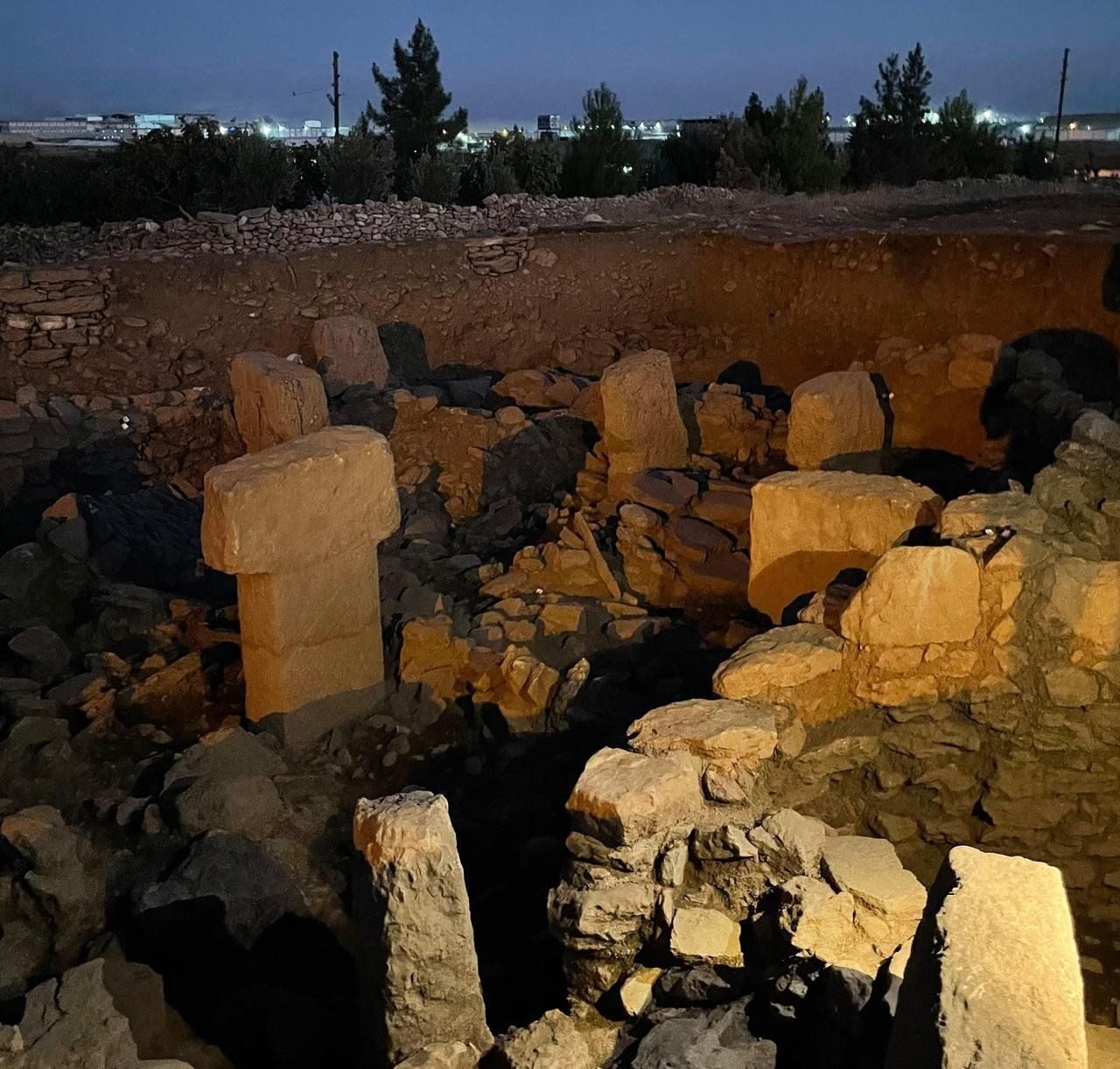
Göbekli Tepe and Sayburç, side by side
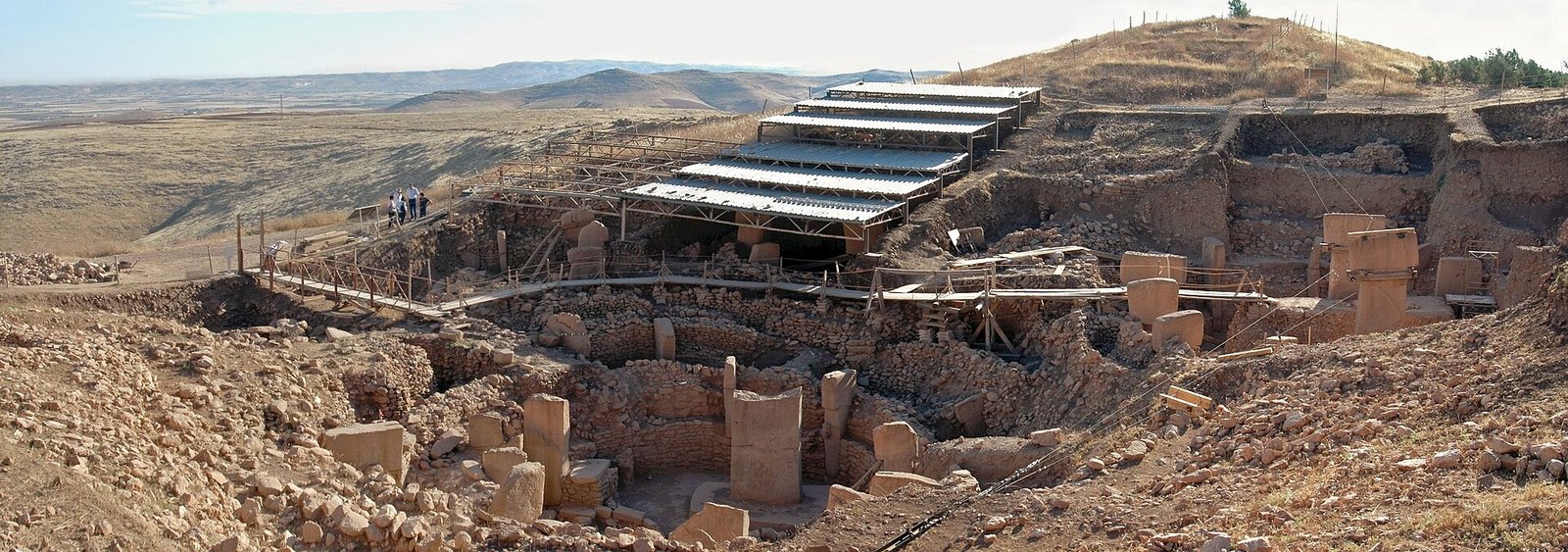
Photos via Wikimedia Commons and the Sayburç excavation.
The short answer: same world, different room
Sayburç is unmistakably part of the same Taş Tepeler tradition as Göbekli Tepe. Both are Pre-Pottery Neolithic sites of hunter-gatherers in the Şanlıurfa region; both have T-shaped pillars and communal buildings with benches; both carry bold figurative carving; and both favour dangerous animals — leopards, wild cattle — over the gazelle and other prey their makers actually ate.
But Sayburç is not a smaller copy of Göbekli Tepe. It is a little later, much smaller, built directly on bedrock, and — decisively — set inside a genuine village. The likeness is real; so is the difference. The interesting question is not whether they are alike, but what each one shows that the other does not.
What they genuinely share
The shared vocabulary is not vague resemblance — it is specific. Sayburç has T-pillars of the same broad family as Göbekli Tepe's, a round communal building with an interior bench, and reliefs of leopards and an aurochs, the same charged predators and wild cattle that dominate Göbekli Tepe's imagery.
Both sites also share a habit of carving the human figure and of building special communal space distinct from ordinary dwellings. Seen from a distance, they clearly belong to one cultural landscape — the twelve-site world that archaeologists now call Taş Tepeler, 'the stone hills.'
Later, and smaller
The chronology sets them apart. Göbekli Tepe's great early enclosures belong to the earliest monumental phase (PPNA), from around 9500 BCE. Sayburç is a short, essentially single-layer occupation spanning the late PPNA into the early PPNB, with radiocarbon framing discussed in the region of 8650–8300 BCE — a little later than Göbekli Tepe's founding monuments.
It is also far smaller in scale. Göbekli Tepe is a large mound with multiple monumental enclosures built and rebuilt over centuries; Sayburç is a modest settlement with one remarkable communal building. That single-phase simplicity is actually an advantage for archaeologists: a site with one main moment is far easier to read than one buried under centuries of rebuilding.
The decisive difference: a scene, not a set
The most important contrast is what the carving does. Göbekli Tepe gives us monumental T-pillars covered in individual animals and symbols — a rich vocabulary, but one where each creature largely stands on its own. Sayburç gives us a bench relief of five figures in two compositions — a man between two leopards, and a squatting figure facing a charging aurochs — that its excavator, Eylem Özdoğan, argues is a connected scene, figures acting on one another.
If that reading holds, it is a real step beyond Göbekli Tepe: where Göbekli's imagery is a vocabulary, Sayburç's may be a sentence — among the earliest depictions of a narrative anywhere. It is a strong but debated interpretation, not a settled fact; for the figures themselves, see [the Sayburç relief](/learn/what-is-the-sayburc-relief/).
Sanctuary versus settlement
The other great difference is where the imagery sits. Göbekli Tepe reads as a place set apart — a gathering site on a bare limestone ridge, monumental architecture that people came to. Sayburç puts the same charged imagery on a bench inside a building among the houses, at the height of people sitting against the wall.
That collapses a distinction the older Göbekli Tepe story leaned on: that monumental Neolithic art belonged only to special sanctuaries removed from daily life. At Sayburç the sacred and the domestic share a wall. (Even at Göbekli Tepe, domestic evidence has since turned up on the mound, softening the 'empty temple' picture — so the two sites are converging on the same lesson from opposite directions.)
What's settled, and what is still argued
Settled: the two sites belong to the same regional tradition and share T-pillars, communal buildings and a predator-heavy bestiary; Sayburç is later, smaller, single-layer and set in a genuine settlement; its bench carries a five-figure relief published in Antiquity in 2022.
Argued or unresolved: whether Sayburç's relief is truly a single narrative, and what it depicts; the precise dates and how the communal building relates in time to the houses; and how directly the two communities interacted. One clean negative is worth noting — Sayburç has no confirmed perforated skulls of the kind found at Göbekli Tepe, so the regional 'skull cult' theme is not simply repeated here.
The fair summary: Sayburç is like Göbekli Tepe in the way a cousin is like a cousin — same family, same era, same imagery — but younger, smaller, more domestic, and carrying a carving that may do something Göbekli Tepe's never quite does.
Common questions
Is Sayburç like Göbekli Tepe?
Yes and no. It shares the same Taş Tepeler tradition — T-pillars, communal buildings with benches, and dangerous animals — but Sayburç is later (late PPNA into early PPNB), smaller, built on bedrock inside a village, and its relief appears to show a connected narrative scene rather than isolated symbols.
What is the main difference between Sayburç and Göbekli Tepe?
Setting and storytelling. Göbekli Tepe is a large gathering site set apart on a hilltop with pillars carved in individual animals; Sayburç puts the same imagery on a bench inside a communal building among people's houses, in a scene that reads more like a told story than a set of symbols.
Is Sayburç older than Göbekli Tepe?
No. Göbekli Tepe's great early enclosures date to around 9500 BCE (PPNA); Sayburç is somewhat later, spanning the late PPNA into the early PPNB, with figures discussed in the region of 8650–8300 BCE.
Does Sayburç have T-shaped pillars like Göbekli Tepe?
Yes. Sayburç's communal building has T-shaped pillars of the same broad family as Göbekli Tepe's, along with an interior bench carrying the famous relief.
Does Sayburç have a skull cult like Göbekli Tepe?
Not as far as we know. Human remains were given secondary treatment at Sayburç, but the excavator reports no confirmed perforated or suspended skulls of the kind found at Göbekli Tepe.
Sources & further reading4 references
- Özdoğan, E. (2022). The Sayburç reliefs: a narrative scene from the Neolithic. Antiquity 96(390): 1599–1605. doi:10.15184/aqy.2022.125
- Özdoğan, E. (2025). Interviews on the Sayburç excavation and its reliefs. Transcribed interviews held in the Taş Tepeler research atlas. Spoken material, translated from Turkish; paraphrased rather than quoted. See Özdoğan 2022 for the published account.
- Schmidt, K. (2012). Göbekli Tepe: A Stone Age Sanctuary in South-Eastern Anatolia. Berlin: ex oriente. The foundational monograph by the site's first excavator.
- Clare, L. (2020). Göbekli Tepe, Turkey. A brief summary of research at a new World Heritage Site (2015–2019). e-Forschungsberichte des Deutschen Archäologischen Instituts 2020(2): 81–88.
Full bibliography: the Taş Tepeler reference library →