Two hills, one Neolithic world
If you only ever hear one name from the Neolithic of southeastern Türkiye, it is Göbekli Tepe. But about thirty-five kilometres to the east-southeast, in the Tek Tek hills, lies its close relation, Karahan Tepe — often called Göbekli's 'sister site'. They were raised by the same kind of people, in the same few centuries, in the same tradition of great carved pillars. Visitors constantly ask which is which, and whether one is 'better'.
The honest answer is that they are best understood together — and that the differences between them are as revealing as the things they share. Here is what actually sets them apart.
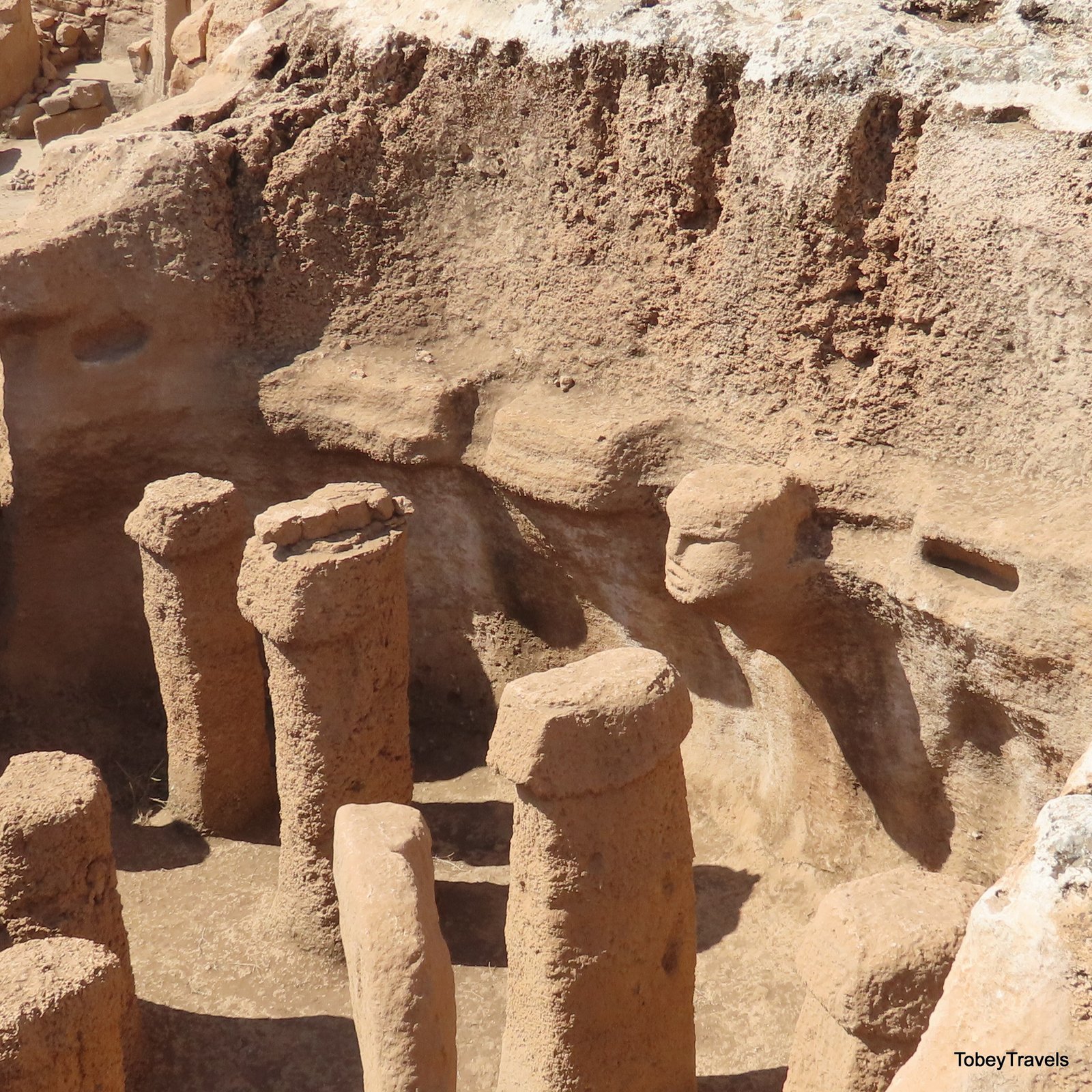
tobeytravels, Structure AB, Pillars Shrine with Porthole Window to AD and Carved Head, Karahantepe (Karahan Tepe), Turkey, CC BY-SA 4.0, via Wikimedia Commons.
How far apart, and are they the same age?
The two sites are roughly 35 to 40 kilometres apart, both within an easy drive of Şanlıurfa. You can, and many people do, see both in a single day.
On age, they are near-twins. Both belong to the Pre-Pottery Neolithic, the era before farming and pottery, with occupation running broadly from around 9600 to 8000 BCE. Göbekli's great rings are usually dated from about 9600 BCE; Karahan's signature rock-cut phase is often given a slightly later headline date, around 9400 BCE. But their lifespans overlap heavily, and Karahan's own excavated sequence runs right through the same span. It is safest — and truest — to call them roughly contemporaneous, and to be wary of anyone who tells you flatly that one is 'older' than the other. The fine chronology of Karahan is still being worked out.
One hill was built by lifting stone toward the sky. The other was made by cutting rooms down into the rock. Same people, same century — opposite gestures.
Built up, or carved down: the biggest difference
If you remember one thing, remember this. The two sites were made by opposite gestures.
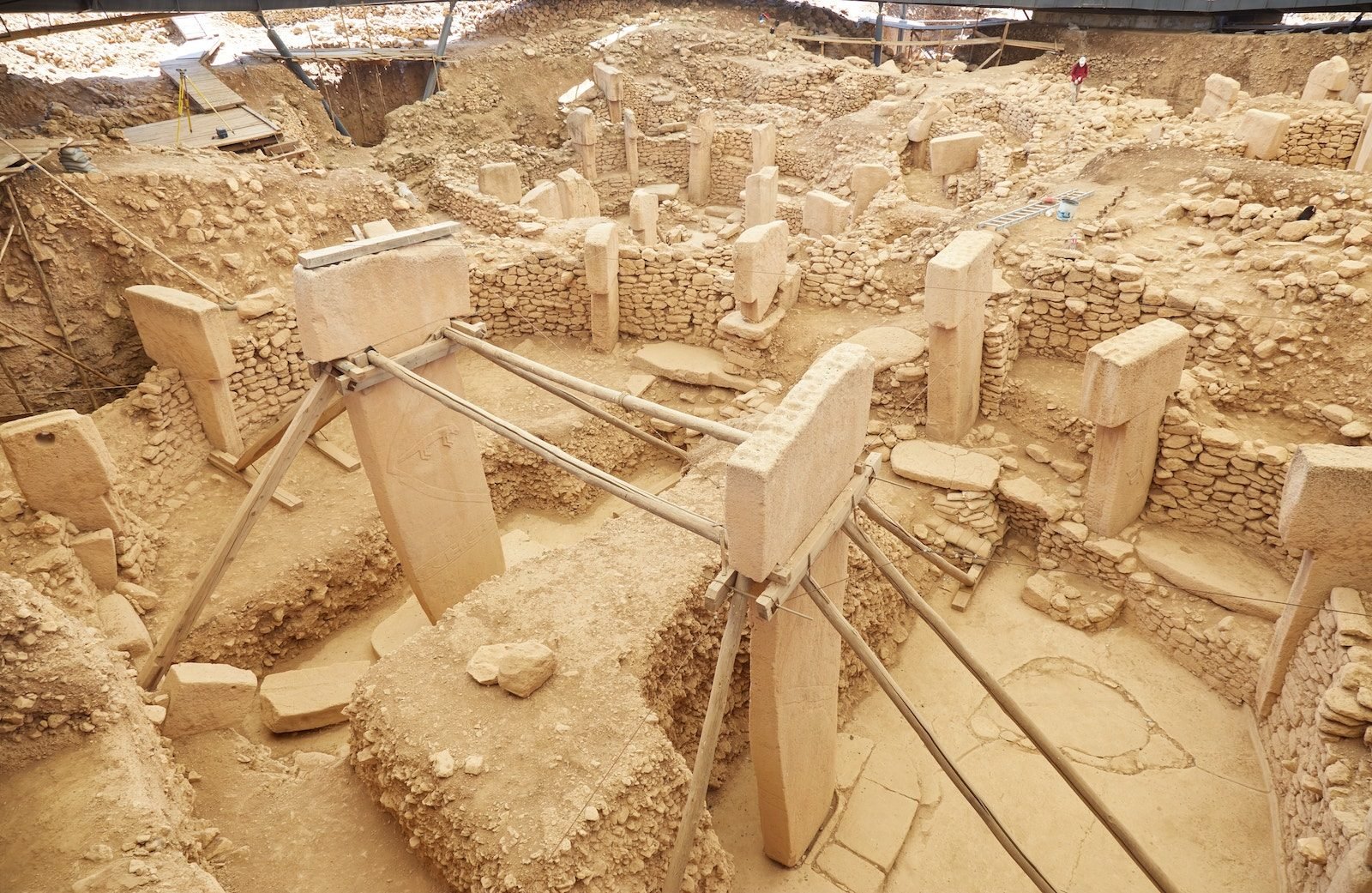
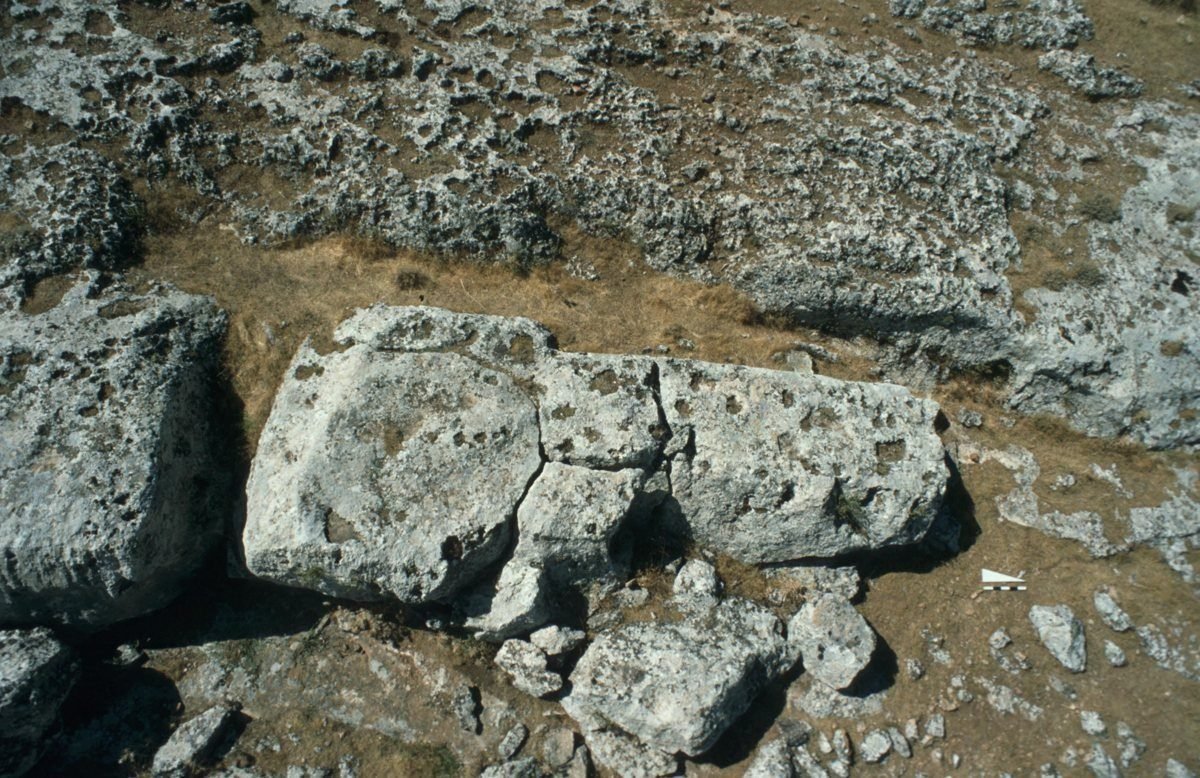
Göbekli Tepe was built up. Its T-pillars were quarried out of the bedrock, dragged from the surrounding plateau, and levered upright into rings — the two central pillars of Enclosure D stand over five metres tall and weigh several tonnes each. You can still see an unfinished pillar lying in the quarry where it was being cut free. It is additive architecture: stone moved and raised.
Karahan Tepe was carved down. In its signature space, Structure AB, the builders did not raise pillars at all — they cut a chamber down into the living rock, leaving pillars standing where the stone was removed from around them, and carving a human head straight out of the wall. A serpentine channel was cut into the bedrock to link the chambers. It is subtractive architecture: a building made by taking rock away. Same tradition of pillars and sunken rooms; entirely different way of making them.
Animals, or people: what they carved
The two sites also lean in different directions in what they depict — and this is the second great difference.
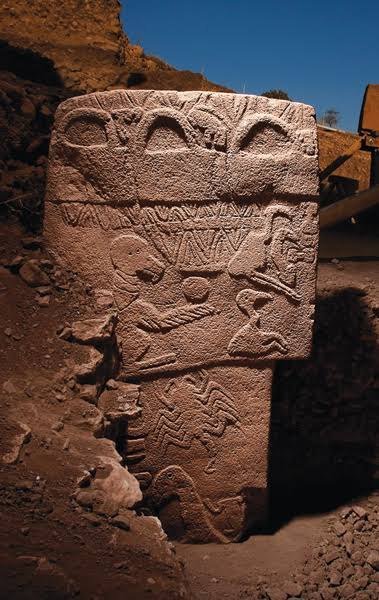
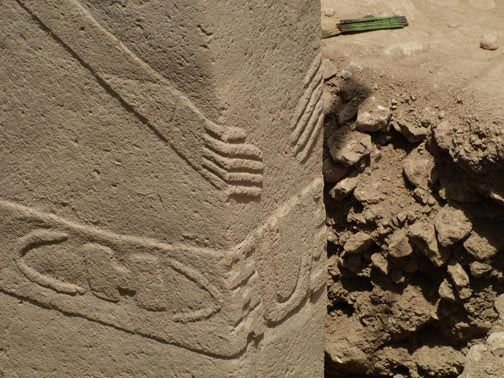
Göbekli is the site of the animal. Its surfaces crawl with a bestiary: foxes, wild boars, aurochs, snakes, cranes, scorpions, spiders and vultures, overwhelmingly the dangerous and the inedible. Its single most famous carving, the Vulture Stone (Pillar 43), is a dense scene of vultures and a headless man. When people picture Göbekli's art, they picture animals.
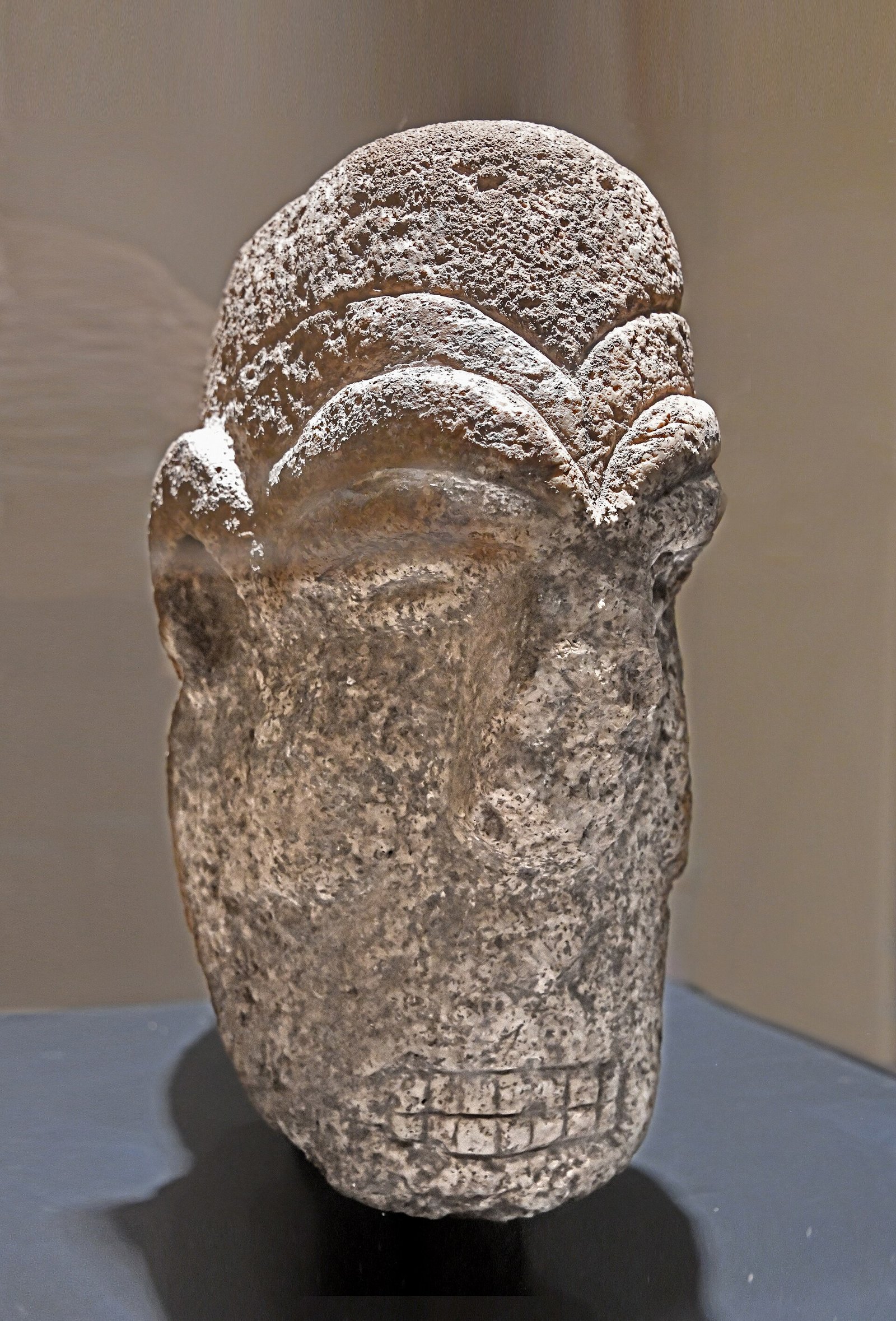
Karahan is the site of the human. Animals are present — there are leopards, a griffon vulture, snakes, a carved gazelle — but Karahan's genius is the human figure and the human head: the head carved from the wall of AB, a human face worked onto a T-pillar, the room of phallic pillars, and, above all, its statues. This is not a hard rule — Karahan has real animal art too — but the emphasis is unmistakable. Göbekli abstracts the human being into a faceless pillar; Karahan carves the human being as a person.
The statues Karahan has, and Göbekli doesn't
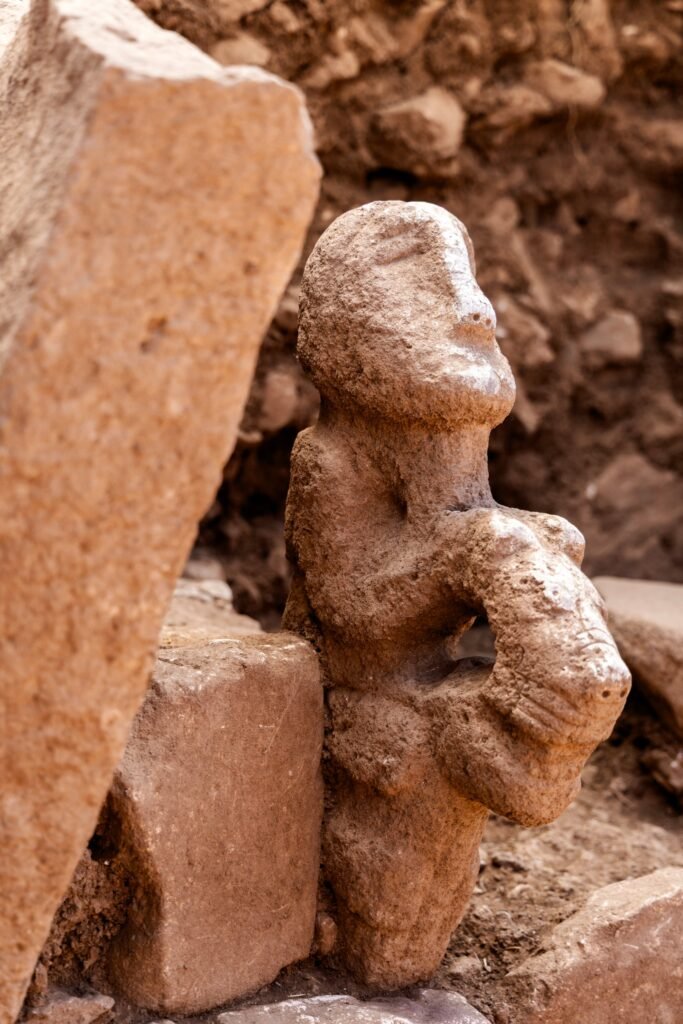
Nowhere is that clearer than in Karahan's recent finds. In 2023 its team lifted the 'Ribbed Man' — a life-size seated male, about 2.3 metres tall, carved from a single block, ribs and spine cut as deep ridges, hands to an explicit phallus. In 2026 they announced a ~70 cm statue of a person seated on the back of a leopard, a composition with no known parallel, reversing an earlier Karahan sculpture of a human carrying a leopard.
Göbekli Tepe, for all its scale, has produced nothing quite like these lifelike, free-standing human sculptures. (The famous 'Urfa Man' statue, often mentioned in the same breath, is not from Göbekli at all — it was found in the Yeni Mahalle district of Şanlıurfa.) These Karahan statues are, for now, announced by the excavation team and the ministry ahead of full publication, so their finer details may be refined — but the objects are real, and they are Karahan's signature contribution.
Dug then, dug now: why it matters
There is a difference you cannot see on site but that shapes everything we can say about the two places: when they were excavated.
Göbekli Tepe was first noted in a 1963 survey — and dismissed as a medieval cemetery. It took Klaus Schmidt, who recognised the T-pillars for what they were in 1994, to begin real excavation from 1995 with the German Archaeological Institute. Much of its digging therefore belongs to earlier decades, by the recording standards of its time.
Karahan Tepe was noted in 1997, but its major excavation only began in 2019, under Necmi Karul of Istanbul University, as the anchor of the Taş Tepeler project. That means Karahan is being dug with modern methods — careful stratigraphy, radiocarbon dating, conservation, statues recorded in situ. So the newer site is in some ways the better-documented one, and the finds coming out of Karahan now are actively helping to re-interpret Göbekli. The two sites are not rivals; they are each other's context.
What each is famous for
Göbekli Tepe is famous as the oldest known monumental architecture on Earth — rings of carved pillars raised by hunter-gatherers before farming, pottery, metal, writing or the wheel, and the site that forced archaeology to consider that ritual and gathering might have come before farming, not after. It is a UNESCO World Heritage Site and the household name.
Karahan Tepe is famous as Göbekli's sister sanctuary — for its startling rock-cut architecture, the phallic chamber with the watching head, and for producing the most lifelike human sculptures of the whole Neolithic. It is the flagship of the ongoing Taş Tepeler excavations and, season after season, one of the world's most productive digs.
Which should you visit?
Ideally, both — they are close enough to combine in a day, and seeing them back to back is the best way to feel the difference between building up and carving down.
Göbekli Tepe is the more developed visit: a UNESCO site (since 2018) with a large protective canopy and raised walkways from which you look down into the enclosures. Karahan Tepe is newer and rawer — a live excavation with its own protective roof going up, fewer facilities, and the immediacy of a site still giving up its secrets. Neither lets you wander among the pillars, and both are punishingly hot in summer, so go in the morning and in spring or autumn if you can. (For the practical details — getting there, the museum, current hours — see our dedicated visit guides.)
What is uncertain
A few honest caveats. The exact distance between the sites is quoted anywhere from 35 to 55 km depending on whether it is measured straight-line or by road — 'about 35–40 km east-southeast' is the fair figure. Whether either site is strictly older is genuinely unresolved; 'roughly contemporaneous' is the accurate statement, and Karahan's internal phasing is still being refined.
The contrast between 'animal Göbekli' and 'human Karahan' is a matter of emphasis, not an absolute — each site has some of the other. And Karahan's headline statues, though real, are reported ahead of full scholarly publication, so their dates and measurements may shift. What is not in doubt is the core of the comparison: two sites of the same people and the same century, one built upward and one carved downward, together giving us the fullest picture we have of the world's first monument-builders.
Common questions
Is Karahan Tepe older than Göbekli Tepe? Not clearly. Both are Pre-Pottery Neolithic and roughly contemporaneous (~9600–8000 BCE). Karahan's headline phase is sometimes dated a little later, but their occupations overlap, and the fine chronology is still being worked out.
What is the main difference between them? Method and emphasis. Göbekli's pillars were quarried and raised up; Karahan's chambers were carved down into bedrock. Göbekli is dominated by animal reliefs; Karahan by human figures — carved heads, phallic pillars and lifelike statues.
How far apart are Göbekli Tepe and Karahan Tepe? Roughly 35–40 km east-southeast, both near Şanlıurfa — close enough to visit both in one day.
Is Karahan Tepe a UNESCO World Heritage Site? No. Only Göbekli Tepe holds that status (inscribed 2018). Karahan is open to visitors but is not separately UNESCO-listed.
Key takeaways
- Göbekli Tepe and Karahan Tepe are ~35–40 km apart near Şanlıurfa, both Pre-Pottery Neolithic (~9600–8000 BCE) and roughly contemporaneous — not clearly one-older-than-the-other.
- The core difference is method: Göbekli was built up (pillars quarried and raised); Karahan was carved down (chambers cut into bedrock).
- Göbekli is the site of animal reliefs (the Vulture Stone); Karahan is the site of the human figure — carved heads, phallic pillars, and lifelike statues like the 'Ribbed Man' and the human-on-leopard.
- Göbekli was largely dug decades ago and is UNESCO-listed (2018); Karahan is being excavated now under Necmi Karul, with modern methods that are helping re-interpret Göbekli.
Sources
- Göbekli Tepe — site overview and current research (Taş Tepeler)
- Karahan Tepe — site overview and current research (Taş Tepeler)
- Göbekli Tepe Research Project (DAI), Tepe Telegrams — 20 years of research
- Archaeology Magazine (2023). New monumental statues at Göbekli Tepe and Karahan Tepe
- The Art Newspaper (2026). Neolithic sculpture of a human riding a leopard, Karahan Tepe
This article is written from the primary literature and excavators' reports cited above. Interpretations are attributed; uncertainties are stated in the text.