Getting there from Şanlıurfa
Göbekli Tepe sits on a limestone ridge north-east of Şanlıurfa. Sources differ slightly on the distance — you will see both 12 km and 15 km quoted, depending on whether the measurement is to the site or the visitor centre — but in practice it is a 20 to 30 minute drive from the city centre.
Three ways to do it. A taxi from Şanlıurfa is the simplest: agree the fare in advance or insist on the meter, and arrange the return, because taxis do not reliably wait at the site. A dolmuş (shared minibus) runs from the city and is the cheapest option, but schedules are irregular and it is not a good choice if you are working to a timetable. An organised tour removes the transport problem entirely and is the only option that comes with someone who can explain what you are looking at.
Tickets: what we can and cannot tell you honestly
Entry is ticketed, and the price is set by the Turkish Ministry of Culture and Tourism, not by the site. It changes — and because it is quoted in different currencies by different sources, published figures conflict badly.
In the course of researching this page in July 2026 we found the fee quoted as €21, as 230 TL, and as roughly $15, alongside a reduced Müzekart rate for holders of the Turkish museum card. Those cannot all be right at once. Foreign visitors are generally charged on a euro tariff while residents with a Müzekart pay a much lower rate, which explains part of the spread — but not all of it.
So we are not going to add a fifth number. Check the current price and opening hours at muze.gov.tr before you travel, or ask your guide to confirm. Published hours also vary between sources (08:00–19:00 and 08:30–17:30 both appear), which usually reflects a summer and winter schedule. Last admission is typically around 30 minutes before closing.
What you actually see
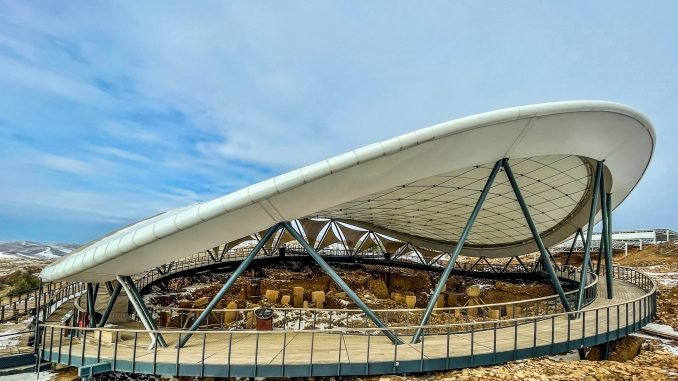
The main excavation area is covered by a large modern canopy, and you walk a raised walkway that runs around and above the enclosures. You do not walk among the pillars — you look down into the buildings from above and from the side.
That is the right way to understand what you are seeing, and it is also the most common source of visitor disappointment. People arrive expecting to stand beside a five-metre pillar. You will be several metres above and away from it. What you gain is the thing that actually matters: from the walkway you can read the plan — the rings, the twin central pillars facing each other, the wall pillars set into benches. From ground level you could not see that at all.
Enclosure D, the best preserved, is the one most people photograph. Bring a zoom if you want the carvings; the reliefs on the central pillars are legible from the walkway but not close.
Facilities and how long to allow
There is a visitor centre and ticket office at the main entrance, with a shop and café. A shuttle covers the short distance from the entrance up to the site itself; the ride is included in the ticket, and you can walk instead if you prefer.
Allow around 1.5 to 2 hours for the site and its interpretation displays. The ridge is exposed, with very little shade beyond the canopy — in summer the middle of the day is genuinely punishing, and early morning is both cooler and better for photography.
Pair it with Karahan Tepe and the museum
Most visitors treat Göbekli Tepe as a half-day and are then unsure what to do with the rest of the time. Two things are worth it.
Karahan Tepe is about 40 km further east and is the natural companion — the same world, built by carving down into bedrock rather than raising pillars on the surface. Seeing both in one day is the single best way to understand that Göbekli Tepe was not a one-off.
The Şanlıurfa Archaeology Museum in the city holds material from across the region, including Urfa Man — the oldest known life-sized human statue — and a full-scale reconstruction of an enclosure. If you only have time for one indoor stop, make it this one; it fills in everything the walkway cannot show you.
Practical notes worth knowing
Şanlıurfa summers are severe: temperatures well above 40°C are normal in July and August. Spring and autumn are far more comfortable for a site with no shade.
Ticket prices and opening hours are the two things most likely to have changed since any guide you read was written, including this one. Verify both before you set out.
Common questions
Can you visit Göbekli Tepe?
Yes. It is a UNESCO World Heritage Site open to the public, about 15 km north-east of Şanlıurfa, with a visitor centre, shuttle and raised walkways over the excavation.
How much does it cost to visit Göbekli Tepe?
Entry is ticketed at a rate set by the Ministry of Culture and Tourism, with a lower rate for Müzekart holders. Published figures conflict widely between sources and change over time — confirm the current price at muze.gov.tr before travelling.
How do you get to Göbekli Tepe from Şanlıurfa?
By taxi (20–30 minutes; arrange the return), by dolmuş (cheapest, irregular schedule), or on an organised tour.
How long do you need at Göbekli Tepe?
Around 1.5 to 2 hours for the site and displays. Go early in summer — the ridge has almost no shade.
Can you walk among the pillars?
No. You view the enclosures from raised walkways above and around them. That is what lets you read the layout of the rings, but it does mean you are not standing beside the stones.
Can you visit Göbekli Tepe and Karahan Tepe in one day?
Yes — Karahan Tepe is roughly 40 km further east and the two are commonly combined into a single full-day trip.
Sources & further reading3 references
- UNESCO World Heritage Centre (2018). Göbekli Tepe (inscription on the World Heritage List). UNESCO. link
- The Tepe Telegrams (official research blog of the Göbekli Tepe Project, DAI). The Tepe Telegrams. Deutsches Archäologisches Institut. link Accessible, authoritative running commentary from the excavation team.
- Clare, L. (2020). Göbekli Tepe, Turkey. A brief summary of research at a new World Heritage Site (2015–2019). e-Forschungsberichte des Deutschen Archäologischen Instituts 2020(2): 81–88.
Full bibliography: the Taş Tepeler reference library →