Sefertepe · Structure
A platform built from limestone blocks whose front carries two carved human faces — one in bold high relief, the other barely raised — reported in the 2025 season as evidence of a distinct local style at Sefertepe.
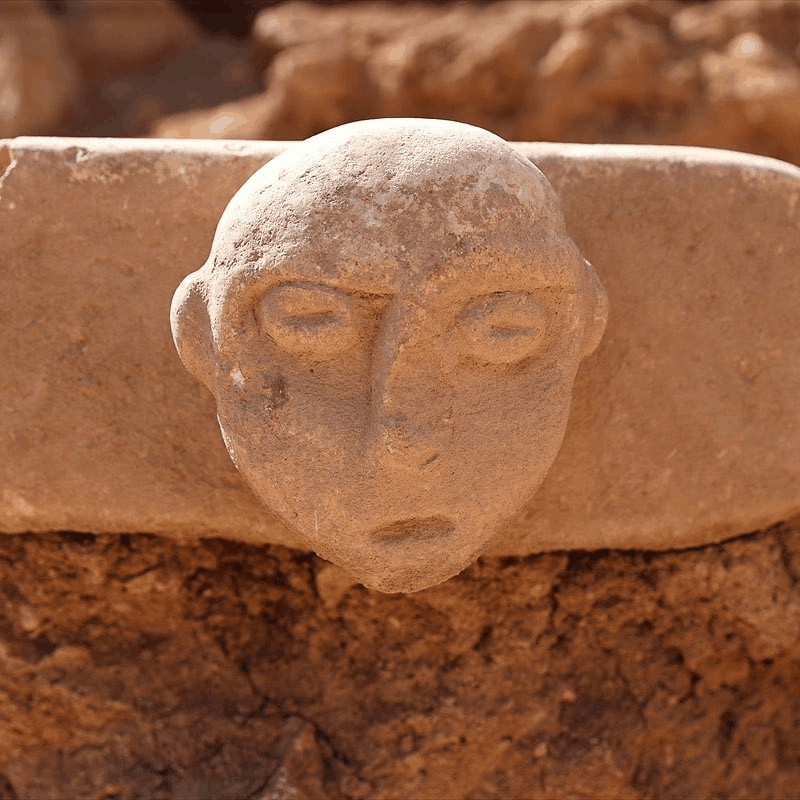
Şanlıurfa Neolithic Research Project — Taş Tepeler, Carved human face, Sefertepe, Used with permission, via .
01
02
Among the standout finds of Sefertepe's 2025 season is a platform carrying two carved human faces on its front. The excavation, led by Emre Güldoğan, reports the platform as built from four limestone blocks, with the faces worked onto their front surfaces and the heads set toward the front — described in the reporting as oriented north. One face is cut in high relief, standing boldly out of the stone; the other is in low or partial relief, barely raised.
This is field reporting, announced at the Taş Tepeler project's fifth-anniversary briefing and in interviews rather than in a peer-reviewed publication. The faces are dated, on the same reported basis as the site's other 2025 carvings, to roughly 8,500 years ago, within the Pre-Pottery Neolithic B.
03
The excavators read the difference between the two faces as meaningful rather than accidental — a bold, present face set beside a fainter one, which in their interpretation may express two identities or states on a single surface. That reading is offered in the field and should be held lightly until fuller study.
What the team stresses more firmly is style: they note that the Sefertepe faces do not simply repeat the human depictions of Göbekli Tepe, Karahan Tepe or Sayburç, and argue on that basis that Sefertepe was developing its own local sculptural idiom. That is a bounded interpretation, but a consistent one across the 2025 reporting.
04
The carved faces sit within a settlement unusually preoccupied with the human head. The same site holds Sefertepe's skull room, where crania were gathered and curated apart from their bodies, and, a few metres away, a contrasting cluster of intact burials. Carving faces into a platform, in a place where real human heads were also being arranged with care, invites the excavators to connect the two — the image of the head and the head itself as parallel expressions of memory and identity. The connection is suggestive rather than proven, and the platform's full construction and its relationship to the surrounding buildings are still being worked out.
05
A human face in high relief
A human face worked into a Sefertepe limestone block — oval eyes, a ridged brow and a straight nose. The excavators read details like the curve of the cheeks and the treatment of the nose as setting the Sefertepe faces apart from those of the neighbouring sites.
Photo: Sefertepe excavation
Full page →
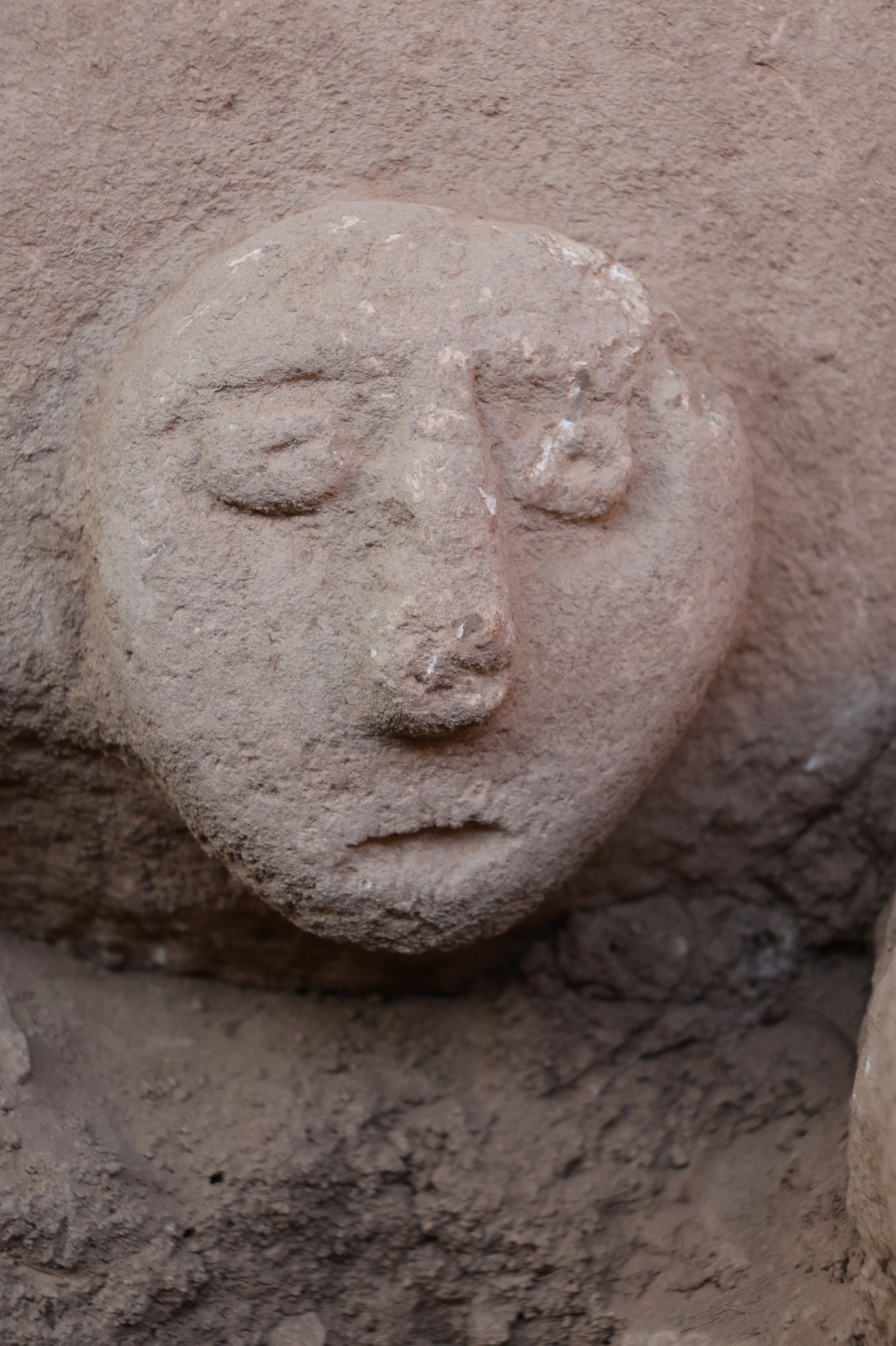
A second face, emerging in the trench
A second carved head photographed as it emerged in excavation — the recurring Taş Tepeler impulse to render and display the human head, here in stone rather than in bone.
Photo: Sefertepe excavation
06
The pairing of a bold, high-relief face with a faint, low-relief one is read by the excavators as a deliberate contrast — possibly life and death, presence and absence, or a shift between human and ancestral identity. This is a field interpretation of the pairing, not a decoded meaning.
The team's firmer argument is stylistic: the Sefertepe faces are said not to copy Göbekli Tepe, Karahan Tepe or Sayburç, pointing to a distinct local style. A bounded interpretation, consistent across the 2025 reporting but awaiting formal publication.
07
The objects recorded for this building, gathered as one catalogue. Where a full object page exists, it is linked from the card.

Object
The Paired Human Faces at Sefertepe
Two human faces carved on a single dressed block — one in bold high relief, the other barely raised — set at the front corners of a stone platform.
Full page →08
Full bibliography: the Taş Tepeler reference library →
Last reviewed 7 October 2026. Something wrong?