One block, two faces
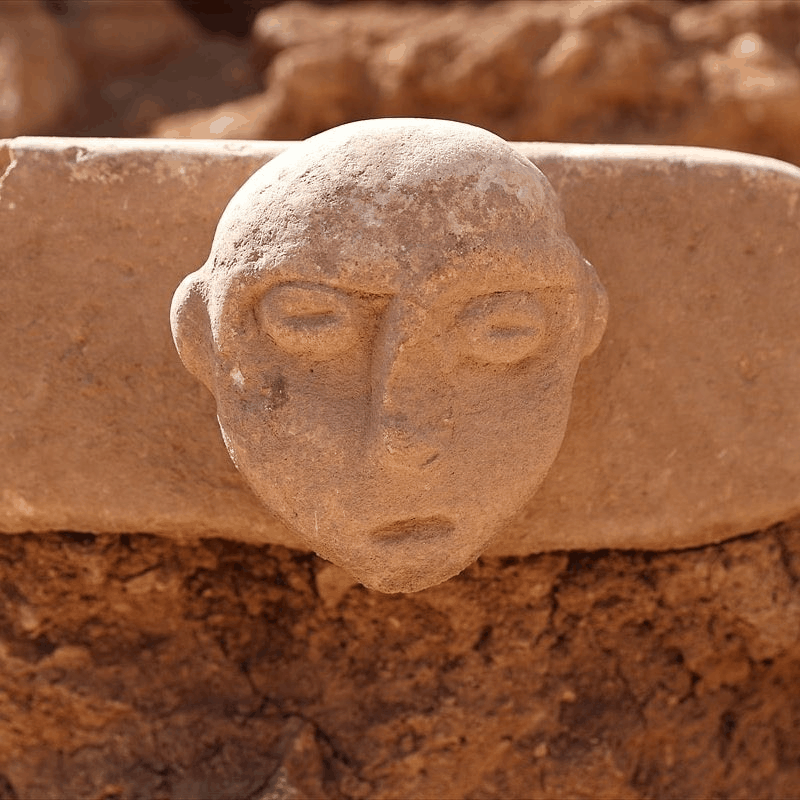
Among the most striking finds of Sefertepe's 2025 season is a dressed stone block carved with two human faces side by side. According to the excavation team, one face is worked in high relief, standing boldly out from the stone, while the other is rendered in low relief, barely raised from the surface. Photographs released by the dig show the block set into a platform, with the two carved heads placed at its front corners.
This is field reporting, announced at the Taş Tepeler project's fifth-anniversary briefing and in interviews with excavation director Emre Güldoğan, rather than a peer-reviewed publication. The faces are dated, on the same reported basis as the site's other 2025 carvings, to roughly 8,500 years ago, within the Pre-Pottery Neolithic B.
A deliberate contrast
The excavators read the difference between the two faces as meaningful rather than accidental — a deliberate pairing of a bold, present face with a fainter one. In the team's interpretation the contrast may express two identities or states on a single surface: life and death, presence and absence, or a shift between human and ancestral identity. That reading is an interpretation offered in the field, and it should be held lightly until fuller study.
What the team stresses more firmly is style. They note that the Sefertepe faces do not simply repeat the human depictions familiar from Göbekli Tepe, Karahan Tepe or Sayburç; details such as the curve of the cheeks, the brow and the treatment of the nose set them apart. On that basis they argue Sefertepe was developing its own local sculptural idiom within the wider Taş Tepeler world.
Faces, heads and the dead
The carved faces sit within a settlement unusually preoccupied with the human head. The same site holds Sefertepe's skull room, where crania were gathered and curated apart from their bodies, and, a few metres away, a contrasting cluster of intact burials. Carving faces into a platform, in a place where real human heads were also being arranged with care, invites the excavators to connect the two — the image of the head and the head itself as parallel expressions of memory, identity and ancestry.
The connection is suggestive rather than proven, and the specifics of the platform — its full construction, how many blocks it involved, and its relationship to the buildings around it — are still being worked out season by season. As with the rest of Sefertepe's 2025 finds, the definitive account waits on the excavation's own publication.
Sources & further reading3 references
- Erdoğan, K. (2025). 8,500-year-old carved faces, tiny double-faced bead reshape Sefertepe's role in Taş Tepeler. Türkiye Today, 28 November 2025. Field reporting; awaiting full publication. link
- Kayra, O. (2025). A stunning Taş Tepeler discovery: human faces emerge from Sefertepe. Arkeonews, 26 November 2025. Field reporting; describes the double-sided bead as black serpentinite. link
- Altuntaş, L. (2025). At Sefertepe, tiny carvings and a 10,000-year-old skull room reveal an unexpected symbolic world. Anatolian Archaeology, 1 December 2025. Field reporting; awaiting full publication. link
Full bibliography: the Taş Tepeler reference library →