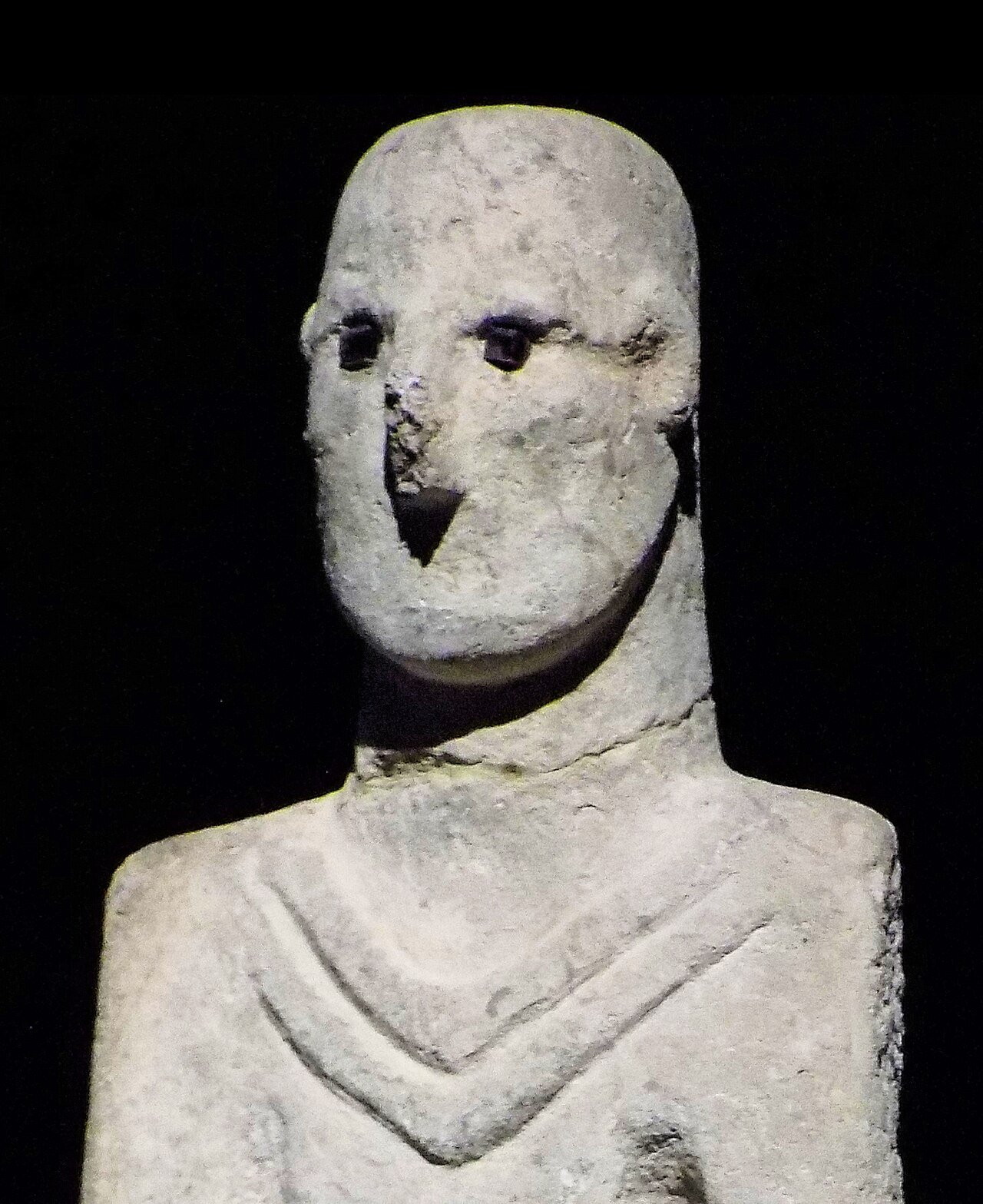
Dug up in the middle of Şanlıurfa, Urfa Man is a life-sized human figure carved in limestone around nine thousand BCE. He is the oldest naturalistic statue of a person we know of — and he still has his eyes, cut from obsidian and set into the stone.
The statue stands about 1.8 metres tall. The eyes are inlays of obsidian set in carved sockets; there is no mouth. A V-shaped collar is carved at the neck, the arms bring the hands together at the front, and the figure holds or points to its genitals. It was found at Yeni Mahalle / Balıklıgöl, in the heart of modern Şanlıurfa.
The missing mouth and the fixed obsidian stare give the figure a presence that is watchful rather than warm — closer to the T-pillars than to a portrait. We read Urfa Man as the face of the people who built Taş Tepeler: not a god handed down from a temple, but a person, standing, holding himself, meeting your eye.
This is interpretation; what the statue was for is unknown.
Why he belongs here
Göbekli Tepe and Karahan Tepe give us the architecture of these people and abstract bodies in stone. Urfa Man gives us the human one — the same world, the same centuries, a few hills away. He is the reason this landscape feels peopled rather than empty: someone carved a face, gave it eyes, and stood it up to be seen.
- Limestone statue about 1.8 m tall.
- Eyes inlaid with obsidian; no carved mouth.
- V-shaped collar; hands brought together at the front.
- Found at Yeni Mahalle / Balıklıgöl in central Şanlıurfa.
- The oldest known life-sized statue of a human, c. 9000 BCE.
Sources & further reading5 references
- Schmidt, K. (2012). Göbekli Tepe: A Stone Age Sanctuary in South-Eastern Anatolia. Berlin: ex oriente. The foundational monograph by the site's first excavator.
- Clare, L. (2020). Göbekli Tepe, Turkey. A brief summary of research at a new World Heritage Site (2015–2019). e-Forschungsberichte des Deutschen Archäologischen Instituts 2020(2): 81–88.
- Notroff, J., Dietrich, O. & Schmidt, K. (2014). Building Monuments, Creating Communities. Early monumental architecture at Pre-Pottery Neolithic Göbekli Tepe. In J.F. Osborne (ed.), Approaching Monumentality in Archaeology: 83–105. Albany: SUNY Press.
- The Tepe Telegrams (official research blog of the Göbekli Tepe Project, DAI). The Tepe Telegrams. Deutsches Archäologisches Institut. link Accessible, authoritative running commentary from the excavation team.
- Haklay, G. & Gopher, A. (2020). Geometry and Architectural Planning at Göbekli Tepe, Turkey. Cambridge Archaeological Journal 30(2): 343–357.
Full bibliography: the Taş Tepeler reference library →