The most crowded surface at Göbekli Tepe
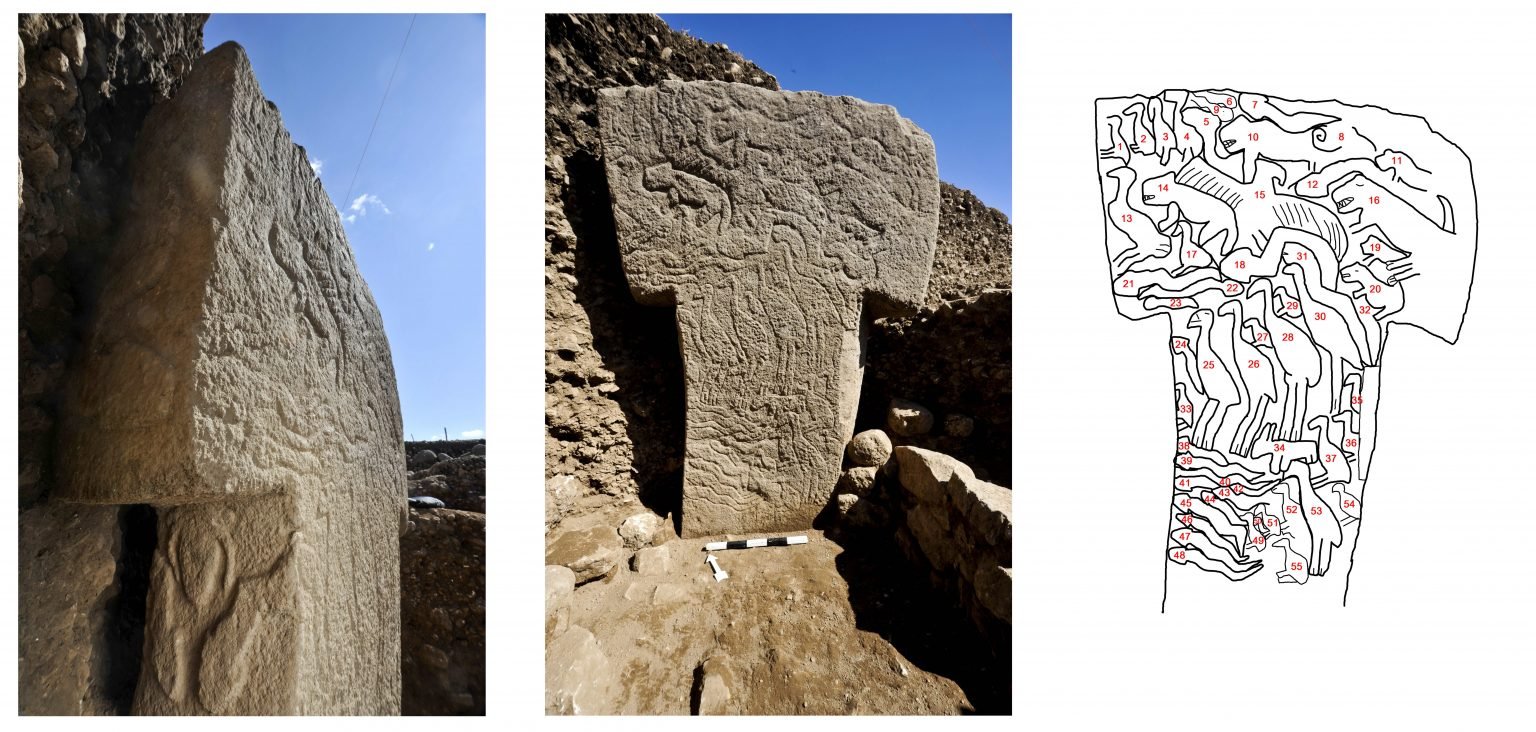
Pillar 56's southwestern broad side is covered edge to edge with animals — the excavators counted roughly 55 of them, packed so densely that the contour of one image becomes the contour of its neighbour, with almost no empty stone left between them. It is among the most intensely carved single surfaces known from the whole site.
Reading down the crowd, the upper part shows a group of ducks, followed by snakes and a run of quadrupeds most plausibly identified as felids (big cats). Set among them is a large bird of prey, shown gripping a snake in its claws. On the pillar's shaft appear cranes and again duck-like water birds, and below them more snakes. It is less a scene than a swarm — a whole bestiary compressed onto one face.
The snake-framed bull's head
Turn to the narrow front of the shaft and the crowding gives way to a single, deliberate motif: a bucranium — a bull's head shown frontally, horns spread — flanked by two snakes, one to each side. The narrow side of the pillar's T-shaped head carries a further snake curling downward.
The bucranium framed by serpents is a striking, self-contained emblem, quite different in feel from the teeming broad face. That contrast — a dense animal field on one side, a formal heraldic device on another — is part of what makes Pillar 56 so valuable: a single stone showing two very different ways of arranging the same vocabulary of creatures.
Measurements and placement
Pillar 56 stands in Enclosure H, in the northwestern depression of the mound, set into the eastern arc of the enclosure's ring wall. As excavated it stands about 2.15 m high, with a shaft roughly 0.94 m wide, a T-head about 1.55 m across, and a maximum thickness of only about 0.37 m — a relatively slender slab carrying an extraordinary amount of carving.
Enclosure H is one of the buildings brought to light in the more recent phases of excavation in the mound's northwestern hollow, and its imagery — big cats, birds, snakes — sits firmly within the repertoire known from the older, better-known enclosures.
What it can and can't tell us
The temptation with a surface this rich is to decode it — to treat the fifty-five animals as a list, a calendar, or a coded message. The evidence does not support that. As Peters and Schmidt observed for the site as a whole, the same creatures — snakes, birds, felids, the bull's head — recur across pillar after pillar, which means no single animal on Pillar 56 is likely to be a unique, one-off sign. What the pillar does show, unusually clearly, is a deliberate aesthetic of density and a repeated grammar of dangerous animals, worked with real control of the stone. Its meaning to the people who made it we can see but not translate.
Sources & further reading4 references
- Peters, J. & Schmidt, K. (2004). Animals in the symbolic world of Pre-Pottery Neolithic Göbekli Tepe, south-eastern Turkey: a preliminary assessment. Anthropozoologica 39(1): 179–218.
- Schmidt, K. (2012). Göbekli Tepe: A Stone Age Sanctuary in South-Eastern Anatolia. Berlin: ex oriente. The foundational monograph by the site's first excavator.
- Notroff, J., Dietrich, O. & Schmidt, K. (2014). Building Monuments, Creating Communities. Early monumental architecture at Pre-Pottery Neolithic Göbekli Tepe. In J.F. Osborne (ed.), Approaching Monumentality in Archaeology: 83–105. Albany: SUNY Press.
- The Tepe Telegrams (Göbekli Tepe Project, DAI) (2016). A tale of snakes and birds: Göbekli Tepe, Pillar 56. Deutsches Archäologisches Institut, 12 December 2016. link
Full bibliography: the Taş Tepeler reference library →