What's carved on it
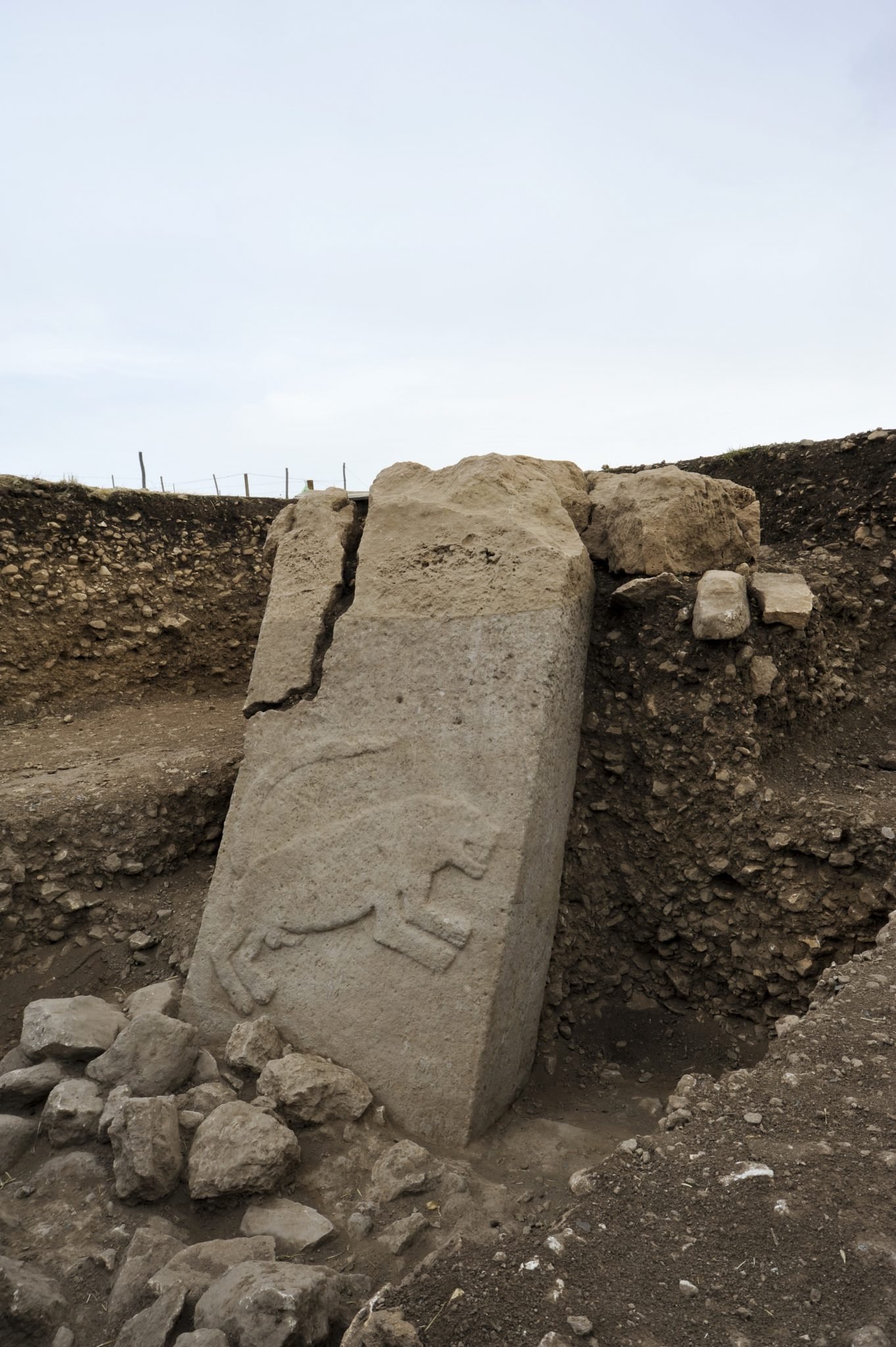
Pillar 51 is the eastern central pillar of Enclosure H — and, so far, the only central pillar of that building to be found; its western partner has not been recovered. Like the great central pillars elsewhere at Göbekli Tepe, its front side carries a stola-like band, the vertical garment marking that identifies these stones as stylised, clothed human figures rather than plain columns.
Its most distinctive carving is on the western broad side, where a big cat — a felid, shown in relief — prowls down the stone. Predatory cats belong to the core Göbekli Tepe repertoire of dangerous animals, and here one is given the prominent flank of a central pillar rather than a crowded wall surface.
Found toppled, near the surface
Pillar 51 was not excavated standing. It was found close to the modern surface, having toppled while still in its original position, with its head heavily damaged and fragments documented nearby. That state matters for reading it: the shaft and its imagery survive, but the top of the figure is broken, and the building around it is known only in part.
Enclosure H lies in the northwestern depression of the mound and belongs to the more recently investigated parts of the site. Pillar 51 gives the building its central-pillar anchor and balances the extraordinarily dense animal field of Pillar 56 on the enclosure wall — one stone a single commanding figure, the other a teeming menagerie.
The big cat, and a comparison to handle with care
The excavators have compared the animal on Pillar 51 in general terms to the felines of the later Lion Pillars Building, a Layer II structure at Göbekli Tepe named for its big-cat reliefs. That comparison is worth noting, but it should stay exactly that — a cautious, source-attributed observation about a shared motif, not a claim that the two buildings are the same in date or function. Enclosure H and the Lion Pillars Building are separate structures from different phases, and the resemblance is in the choice of animal, not in a proven link.
Beyond the felid, the honest limit is clear: with the head lost and only one central pillar recovered, the full original scheme of Enclosure H's centre cannot be reconstructed from Pillar 51 alone.
Where it stands, and how old it is
Pillar 51 is a central pillar of Enclosure H, part of Göbekli Tepe's monumental architecture raised by Pre-Pottery Neolithic hunter-gatherers. Like the site's other great enclosures it was built, used, and eventually buried, and its imagery — the garment band and the big cat — sits firmly within the visual language shared across the mound. It remains an object best described for what is actually preserved on it: a clothed central figure carrying a predator on its flank.
Sources & further reading3 references
- Peters, J. & Schmidt, K. (2004). Animals in the symbolic world of Pre-Pottery Neolithic Göbekli Tepe, south-eastern Turkey: a preliminary assessment. Anthropozoologica 39(1): 179–218.
- Schmidt, K. (2012). Göbekli Tepe: A Stone Age Sanctuary in South-Eastern Anatolia. Berlin: ex oriente. The foundational monograph by the site's first excavator.
- Notroff, J., Dietrich, O. & Schmidt, K. (2014). Building Monuments, Creating Communities. Early monumental architecture at Pre-Pottery Neolithic Göbekli Tepe. In J.F. Osborne (ed.), Approaching Monumentality in Archaeology: 83–105. Albany: SUNY Press.
Full bibliography: the Taş Tepeler reference library →