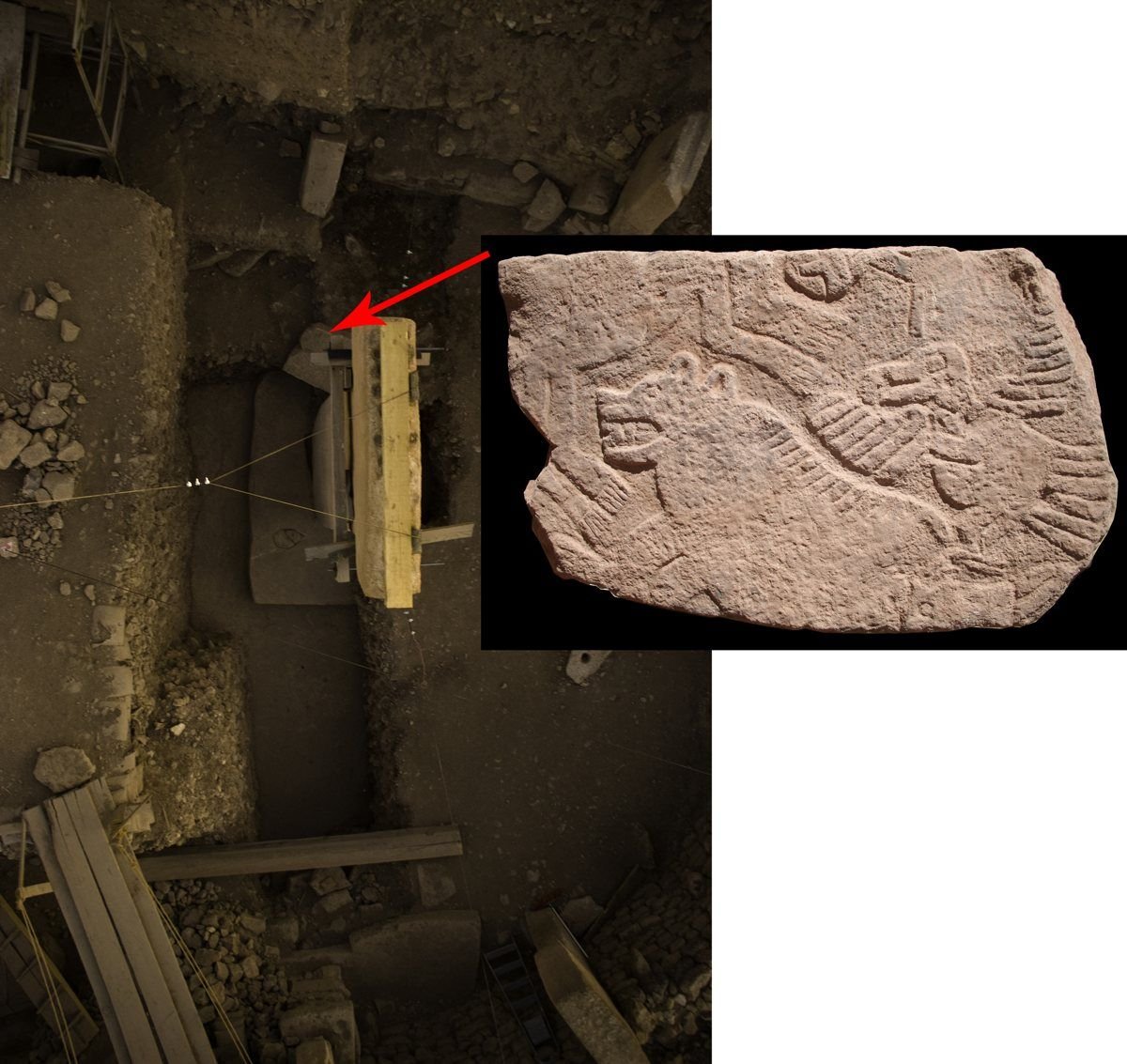
A limestone slab carved in low relief with a large bird of prey (a vulture), a carnivore with bared teeth (identified as a hyena or big cat), and a small ball or disc that most readers take to be a human head. It is one of Göbekli Tepe's small, dense scenes that bring a vulture and a human head together — the same pairing found on the famous Vulture Stone.
What is carved on it
The slab is worked in shallow relief rather than deep sculpture. To one side stands a quadruped with an open, toothed mouth — a carnivore, usually identified as a hyena, though some read it as a big cat. Dominating the scene is a large bird of prey with a spread wing, of the kind identified across Göbekli Tepe as a vulture. Set apart from both is a small round element, a ball or disc, that most interpreters take to be a human head shown detached from its body.
That combination — a vulture and a separated human head, with a scavenging carnivore alongside — is not random. It is the same vocabulary that fills the pillars of Enclosure D, gathered here onto a single flat stone.
The slab combines a bird of prey, a bared-toothed carnivore, and a small disc-shaped element in one low-relief scene. The disc is separated from any body and is widely read as a human head.
Across the ancient Near East, vultures are bound up with the treatment of the dead: birds that strip flesh from bone and, in belief, carry the dead onward. A scene that sets a vulture beside a detached human head fits squarely inside that world — and inside Göbekli Tepe's own preoccupation with the human head, seen in its carved skulls and its many headless figures.
We read the slab, then, as a piece of the site's death imagery rather than a hunting picture or a bestiary — a compact statement about bodies, heads and the birds associated with the dead. That is interpretation built on the wider pattern, not a caption the stone provides.
How it fits the site
The slab's real value is that it does not stand alone. The pairing of a vulture with a human head is the core of Pillar 43, the Vulture Stone, where a great bird appears above a headless human figure. Göbekli Tepe has also produced human skulls carved with deliberate cut marks and, in one case, a drilled perforation — the evidence its excavators describe as a skull cult.
Set against that background, the slab looks like the same idea worked at smaller scale: further proof that the separation of head from body, and the association of the dead with birds of prey, was a recurring theme carved again and again at the site rather than a one-off image.
What's established, and what's debated
What is established is the carving: a bird of prey, a bared-toothed carnivore, and a small disc-shaped element, worked in low relief on a limestone slab from Göbekli Tepe. Its membership in the site's vulture-and-head imagery is well founded, because the same pairing recurs elsewhere on the site.
What is debated is the detail. The carnivore's exact species (hyena or big cat) is not settled; the reading of the disc as a human head, while widely shared, is an interpretation rather than a proven identification; and the slab's precise findspot, date within the sequence and original setting are not things we should overstate. As with the rest of Göbekli Tepe's figural art, the scene can be described far more confidently than it can be translated.
Sources & further reading4 references
- Schmidt, K. (2012). Göbekli Tepe: A Stone Age Sanctuary in South-Eastern Anatolia. Berlin: ex oriente. The foundational monograph by the site's first excavator.
- Peters, J. & Schmidt, K. (2004). Animals in the symbolic world of Pre-Pottery Neolithic Göbekli Tepe, south-eastern Turkey: a preliminary assessment. Anthropozoologica 39(1): 179–218.
- Notroff, J., Dietrich, O. & Schmidt, K. (2014). Building Monuments, Creating Communities. Early monumental architecture at Pre-Pottery Neolithic Göbekli Tepe. In J.F. Osborne (ed.), Approaching Monumentality in Archaeology: 83–105. Albany: SUNY Press.
- Gresky, J., Haelm, J. & Clare, L. (2017). Modified human crania from Göbekli Tepe provide evidence for a new form of Neolithic skull cult. Science Advances 3(6): e1700564. doi:10.1126/sciadv.1700564
Full bibliography: the Taş Tepeler reference library →