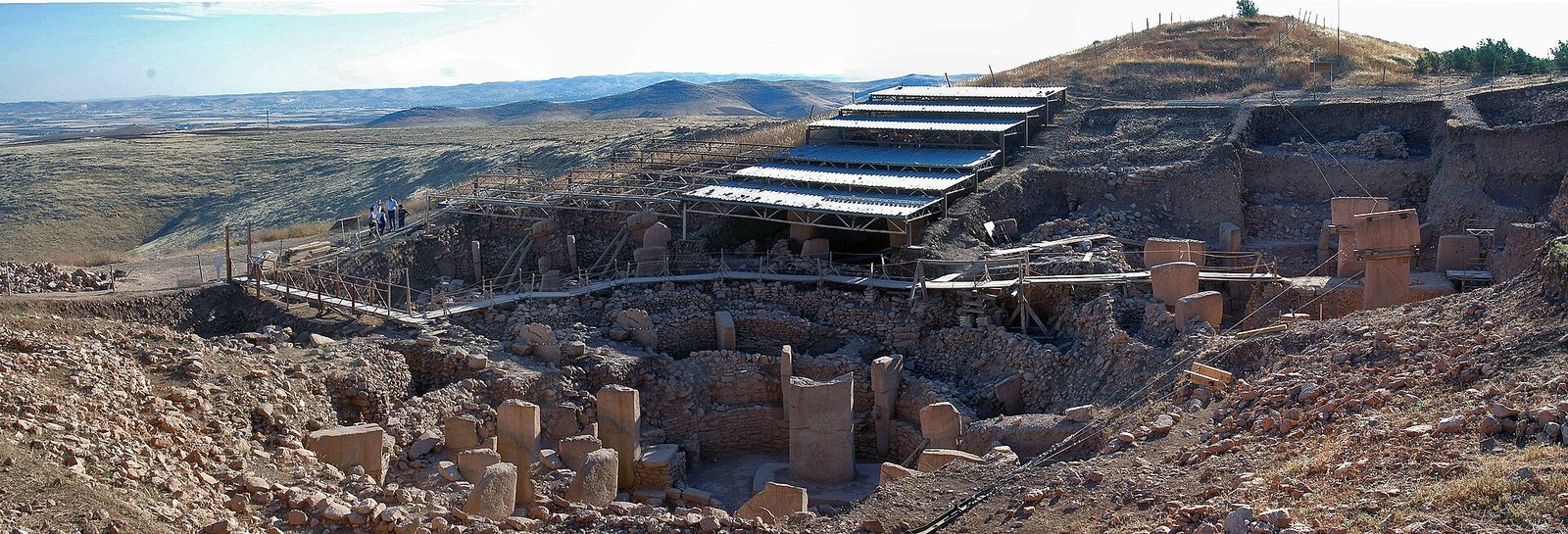
Göbekli Tepe is far older than Stonehenge — by more than six thousand years. Stonehenge was built by settled farmers around 3000 BCE. Göbekli's rings went up around 9500 BCE, raised by hunter-gatherers who had no farms, no pottery, and no metal.
Stonehenge's main stones were raised roughly 3000–2500 BCE, by farming communities using antler picks and, later, bronze tools. Göbekli Tepe's enclosures date to about 9500–8000 BCE — the Pre-Pottery Neolithic — and were built with stone tools alone, before agriculture reached the region. Both use large upright stones set in circles; the resemblance is real, the gap is enormous.
The comparison is useful precisely because it breaks an assumption: we tend to think monuments follow farming, towns, and kings. Göbekli shows the opposite is possible — that people who still hunted and gathered could raise something on Stonehenge's scale, and do it millennia earlier. Stonehenge is the famous stone circle; Göbekli is the one that resets the clock.
This framing is ours; the two sites were built by unrelated cultures and served their own purposes.
- Göbekli Tepe: c. 9500 BCE, built by hunter-gatherers.
- Stonehenge: c. 3000–2500 BCE, built by farmers.
- Göbekli is older by more than 6,000 years.
- Both raise large stones in rings; the cultures are unrelated.
- Göbekli predates farming, pottery, and metal in the region.
Sources & further reading5 references
- Schmidt, K. (2012). Göbekli Tepe: A Stone Age Sanctuary in South-Eastern Anatolia. Berlin: ex oriente. The foundational monograph by the site's first excavator.
- Clare, L. (2020). Göbekli Tepe, Turkey. A brief summary of research at a new World Heritage Site (2015–2019). e-Forschungsberichte des Deutschen Archäologischen Instituts 2020(2): 81–88.
- Notroff, J., Dietrich, O. & Schmidt, K. (2014). Building Monuments, Creating Communities. Early monumental architecture at Pre-Pottery Neolithic Göbekli Tepe. In J.F. Osborne (ed.), Approaching Monumentality in Archaeology: 83–105. Albany: SUNY Press.
- The Tepe Telegrams (official research blog of the Göbekli Tepe Project, DAI). The Tepe Telegrams. Deutsches Archäologisches Institut. link Accessible, authoritative running commentary from the excavation team.
- Haklay, G. & Gopher, A. (2020). Geometry and Architectural Planning at Göbekli Tepe, Turkey. Cambridge Archaeological Journal 30(2): 343–357.
Full bibliography: the Taş Tepeler reference library →