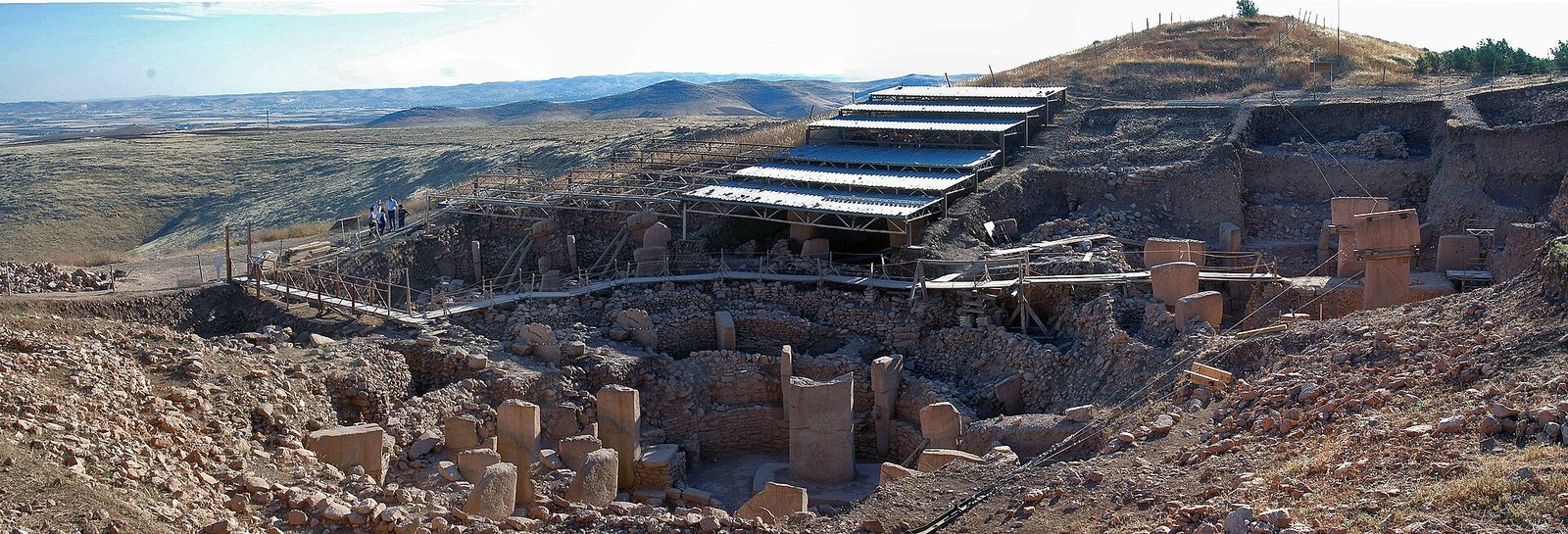
You'll see Göbekli Tepe called the Garden of Eden all over the internet. The idea isn't crazy — it even started with the site's own excavator — but it is a metaphor, not a claim that this hill is the literal Eden of scripture.
Göbekli Tepe sits in the uplands of the Fertile Crescent, near the headwaters of rivers, in the region where wild wheat was first domesticated soon after. Its excavator, Klaus Schmidt, noted the resonance with Eden: a lush foraging world that people gave up for farming and labour. Some link the Bible's four rivers and the 'expulsion' from an easy life to exactly this transition. No text, inscription, or find at Göbekli names Eden or connects it to any scripture.
We read the Eden comparison as a good story about a real change. Something did end here: the long age when people lived by gathering and hunting gave way to fields, ownership, and toil. That memory of a lost, easier world may echo in many later myths. But treating Göbekli as the actual Garden is faith or fancy, not archaeology — and we keep the two apart.
Offered as interpretation. The site is Neolithic; the Eden link is modern.
Why the idea sticks
Göbekli lands on a genuine hinge in the human story — the end of foraging and the start of farming. That is the same hinge the Eden story dramatises: paradise, then the sweat of the field. The overlap is thematic and powerful, which is why the comparison spreads. It is a lens for feeling the change, not evidence of it.
- The Eden comparison is a metaphor, not a documented claim.
- It began partly with excavator Klaus Schmidt's own musings.
- Göbekli lies in the Fertile Crescent, where farming soon began.
- Nothing found at the site references Eden or scripture.
- It resonates because both mark the end of the foraging world.
Sources & further reading5 references
- Schmidt, K. (2012). Göbekli Tepe: A Stone Age Sanctuary in South-Eastern Anatolia. Berlin: ex oriente. The foundational monograph by the site's first excavator.
- Clare, L. (2020). Göbekli Tepe, Turkey. A brief summary of research at a new World Heritage Site (2015–2019). e-Forschungsberichte des Deutschen Archäologischen Instituts 2020(2): 81–88.
- Notroff, J., Dietrich, O. & Schmidt, K. (2014). Building Monuments, Creating Communities. Early monumental architecture at Pre-Pottery Neolithic Göbekli Tepe. In J.F. Osborne (ed.), Approaching Monumentality in Archaeology: 83–105. Albany: SUNY Press.
- The Tepe Telegrams (official research blog of the Göbekli Tepe Project, DAI). The Tepe Telegrams. Deutsches Archäologisches Institut. link Accessible, authoritative running commentary from the excavation team.
- Haklay, G. & Gopher, A. (2020). Geometry and Architectural Planning at Göbekli Tepe, Turkey. Cambridge Archaeological Journal 30(2): 343–357.
Full bibliography: the Taş Tepeler reference library →