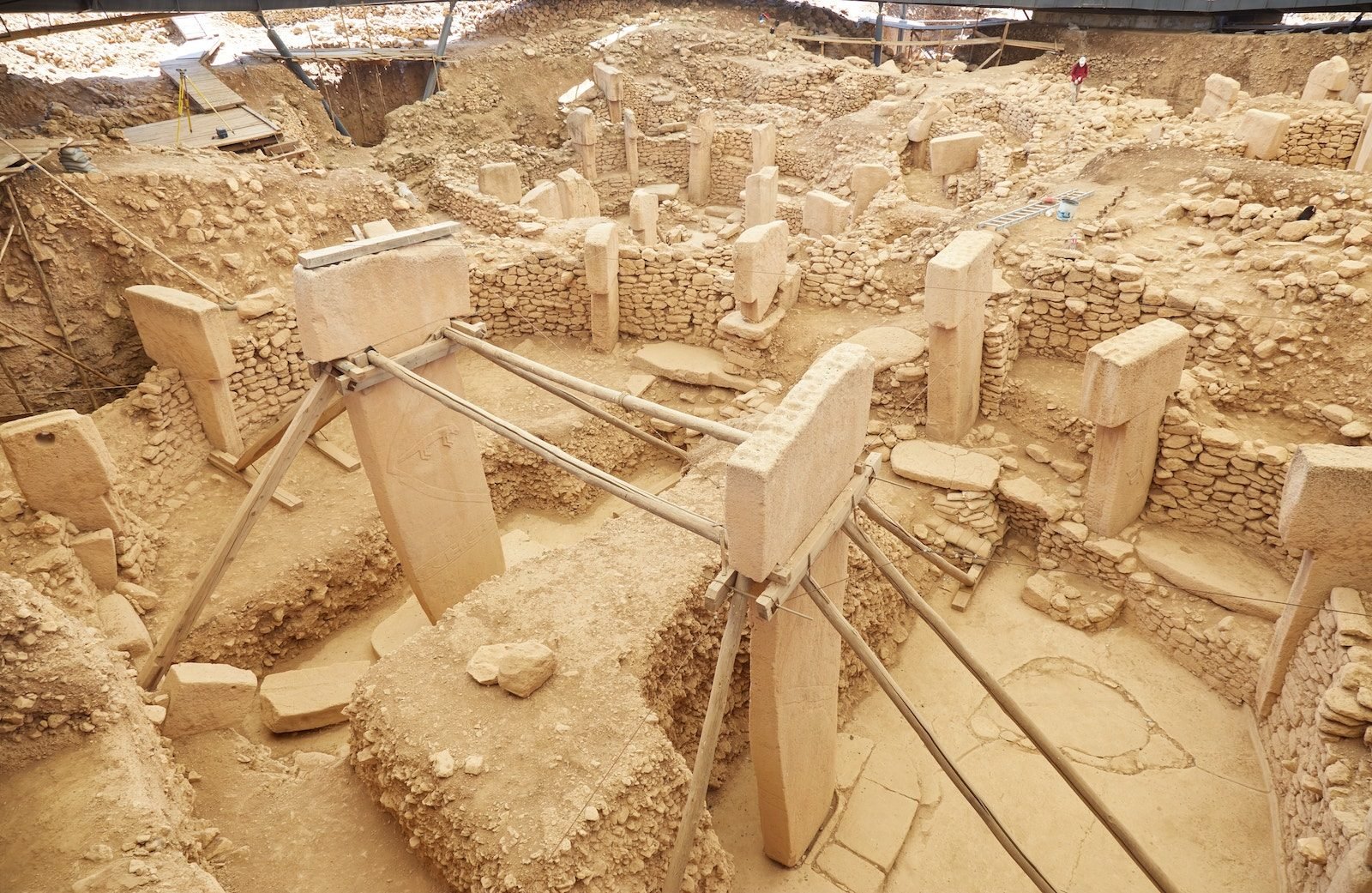
In its earliest, monumental phase, Göbekli Tepe shows no ordinary houses — no domestic quarters around the great enclosures. That absence is why Klaus Schmidt read it as a sanctuary people travelled to, not a village. But the later phases, and newer excavation, complicate the picture.
A sanctuary, or a home?
The classic picture, from the site's first excavator, was stark: Göbekli Tepe was a mountain sanctuary. People gathered there to build and to feast, then left. The evidence was the absence of houses and the presence of enormous quantities of feasting debris — a destination, not a dwelling.
Newer work has softened that line. The later, Layer II buildings are smaller and more house-like, and features such as water cisterns suggest people may have stayed longer than Schmidt allowed — perhaps seasonally, perhaps in growing numbers as the Neolithic advanced.
Why the question is so important
This is not a minor detail. If people built monuments before they built permanent homes, it overturns the old assumption that settling down and farming had to come first. Göbekli Tepe would then suggest the reverse: that the desire to gather and to mark meaning helped pull people toward settled life.
The honest answer today is that the line between sanctuary and settlement blurred over the site's long life — and exactly where it blurred is one of the liveliest debates in Neolithic archaeology.
Sources & further reading3 references
- Clare, L. (2020). Göbekli Tepe, Turkey. A brief summary of research at a new World Heritage Site (2015–2019). e-Forschungsberichte des Deutschen Archäologischen Instituts 2020(2): 81–88.
- Dietrich, O., Heun, M., Notroff, J., Schmidt, K. & Zarnkow, M. (2012). The role of cult and feasting in the emergence of Neolithic communities. New evidence from Göbekli Tepe, south-eastern Turkey. Antiquity 86(333): 674–695.
- Schmidt, K. (2012). Göbekli Tepe: A Stone Age Sanctuary in South-Eastern Anatolia. Berlin: ex oriente. The foundational monograph by the site's first excavator.
Full bibliography: the Taş Tepeler reference library →