Short answer
It is the oldest known monumental, non-domestic architecture on Earth — so 'oldest temple' holds up on age, but 'temple' is the wrong word, because it imports priests, gods and organised religion we cannot demonstrate for 9500 BCE.
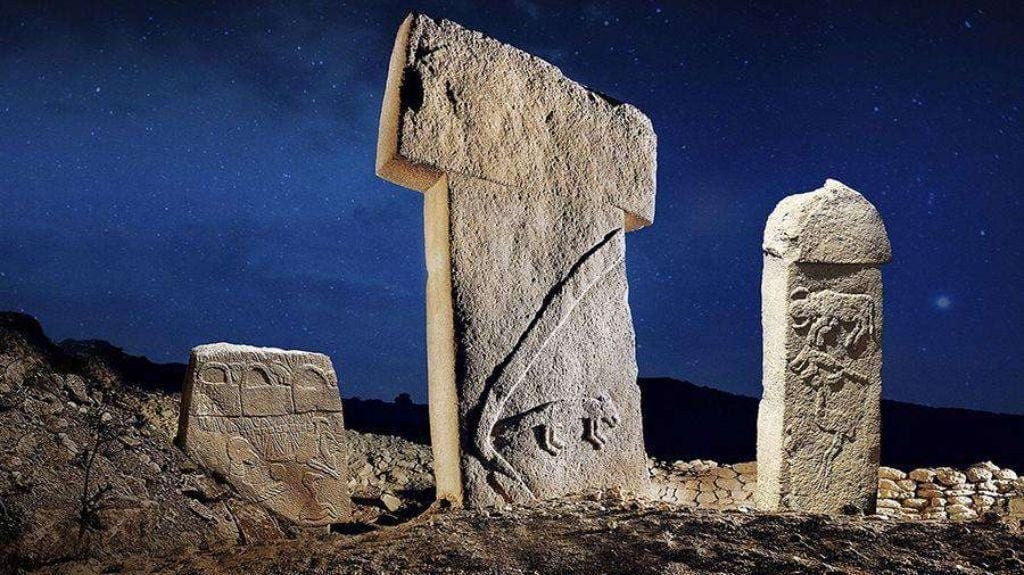
The enclosures are clearly special — benched, centred on giant human-like pillars, heavy with imagery and built at huge collective cost — which is why Klaus Schmidt's 'world's first temple' stuck. But the current excavation directors prefer neutral terms like 'special building' or 'assembly space', and Göbekli Tepe is the oldest known example of a wider Taş Tepeler tradition, not the first that ever existed.
The short answer: oldest of its kind — but 'temple' is the wrong word
Göbekli Tepe is the oldest known site of monumental, clearly non-domestic architecture — buildings raised around 9500 BCE for gathering and belief rather than daily living. On that measure, the popular label 'the world's first temple,' made famous by excavator Klaus Schmidt, holds up: nothing older on this scale has been found. The problem is the word 'temple' itself, which quietly imports a whole world of later assumptions.
What makes it look like a temple
Several features mark the enclosures as special rather than ordinary. In the earliest phase there are no normal houses — people came to the hill, they didn't live on it. The buildings are ringed with stone benches, as if for gathering, and centred on towering human-like pillars. The walls carry deliberate, repeated imagery of animals and, in the treatment of the dead, of mortality itself. And the sheer effort — quarrying and raising multi-ton stones — points to something a community cared about deeply and collectively. That combination is why 'temple' stuck.
Why archaeologists wince at the word
A temple, as we normally mean it, is a purpose-built house for a god, tended by priests, in a society that separates the sacred from the everyday. None of that is demonstrable for people 11,000 years ago — there is no evidence of named deities, a priesthood, or a sacred/secular split. So most researchers prefer 'monumental gathering place' or 'ritual site.' The spirit of Schmidt's phrase is right; the machinery it implies is not.
A different way to see it (the angle worth having)
Here is a framing you'll rarely find on tourist pages: for these people, the distinction we draw between a 'temple' and everything else may simply not have existed. The enclosures aren't obviously buildings about belief so much as buildings that are belief made physical — and the central T-pillars are not statues placed inside a temple, they are the temple's inhabitants. Each enclosure reads less like a room with idols and more like a permanent assembly of stone persons, forever gathered. Calling that a 'temple' isn't just imprecise; it may put a wall between sacred and ordinary that its builders never built.
It's also worth puncturing the 'first' in 'first temple.' Göbekli Tepe is not a lone miracle — it belongs to the Taş Tepeler world, alongside Karahan Tepe, Nevalı Çori and others built in the same centuries. It is the oldest known example, which is not the same as the first that ever existed. It is the earliest surviving chapter of a tradition, not the opening sentence of human religion.
The honest version
The safest true statement: Göbekli Tepe is the oldest known monumental ritual site in the world. Whether you call it a temple, a sanctuary, or a gathering place depends on how much later meaning you're willing to read into it. What isn't in doubt is that it was built for something beyond survival — and that it's older than any comparable place we know.
What the excavation directors actually call these buildings
It is worth knowing that the two people currently directing work in this landscape both avoid the word this page is named after.
Necmi Karul, who directs Karahantepe and the wider Taş Tepeler project, prefers the more neutral term special building to temple. His reasoning is precise: 'temple' implies a defined religion and an established cultic institution, and neither of those has been demonstrated for the Pre-Pottery Neolithic. The word imports a whole social structure that the evidence has not yet produced.
Lee Clare, who directs the Göbekli Tepe project, has suggested in lecture and interview material that the special buildings may have functioned as assembly or social-mediation spaces — places where sedentary hunter-gatherer communities under social pressure came together and negotiated — rather than only as temples.
Neither is saying nothing religious happened. They are saying that 'temple' is a stronger claim than the evidence supports, and that other readings fit the same buildings. When almost every headline about this landscape uses the word, it is worth knowing that the excavators are more careful with it than the coverage is.
Common questions
Is Göbekli Tepe the world's first temple?
It's the oldest known site of monumental, non-domestic buildings, so 'world's first temple' is a fair popular label. Archaeologists often prefer 'monumental gathering place,' since 'temple' imports later religious ideas we can't confirm.
Is Göbekli Tepe older than any church, mosque, or ancient temple?
Yes — by thousands of years. At around 11,000 years old it predates every known temple, and organised religion as we'd recognise it.
Sources & further reading5 references
- Schmidt, K. (2012). Göbekli Tepe: A Stone Age Sanctuary in South-Eastern Anatolia. Berlin: ex oriente. The foundational monograph by the site's first excavator.
- Notroff, J., Dietrich, O. & Schmidt, K. (2014). Building Monuments, Creating Communities. Early monumental architecture at Pre-Pottery Neolithic Göbekli Tepe. In J.F. Osborne (ed.), Approaching Monumentality in Archaeology: 83–105. Albany: SUNY Press.
- Dietrich, O., Heun, M., Notroff, J., Schmidt, K. & Zarnkow, M. (2012). The role of cult and feasting in the emergence of Neolithic communities. New evidence from Göbekli Tepe, south-eastern Turkey. Antiquity 86(333): 674–695.
- Karul, N. (2025). Public lectures and interviews on Karahantepe and the Taş Tepeler project. Transcribed talks and interviews held in the Taş Tepeler research atlas. Spoken material rather than a peer-reviewed publication; positions may be refined in print.
- Clare, L. (2025). Public lectures and interviews on Göbekli Tepe (Göbekli Tepe Project, DAI). Transcribed talks and interviews held in the Taş Tepeler research atlas. Spoken material rather than a peer-reviewed publication; positions may be refined in print.
Full bibliography: the Taş Tepeler reference library →