Short answer
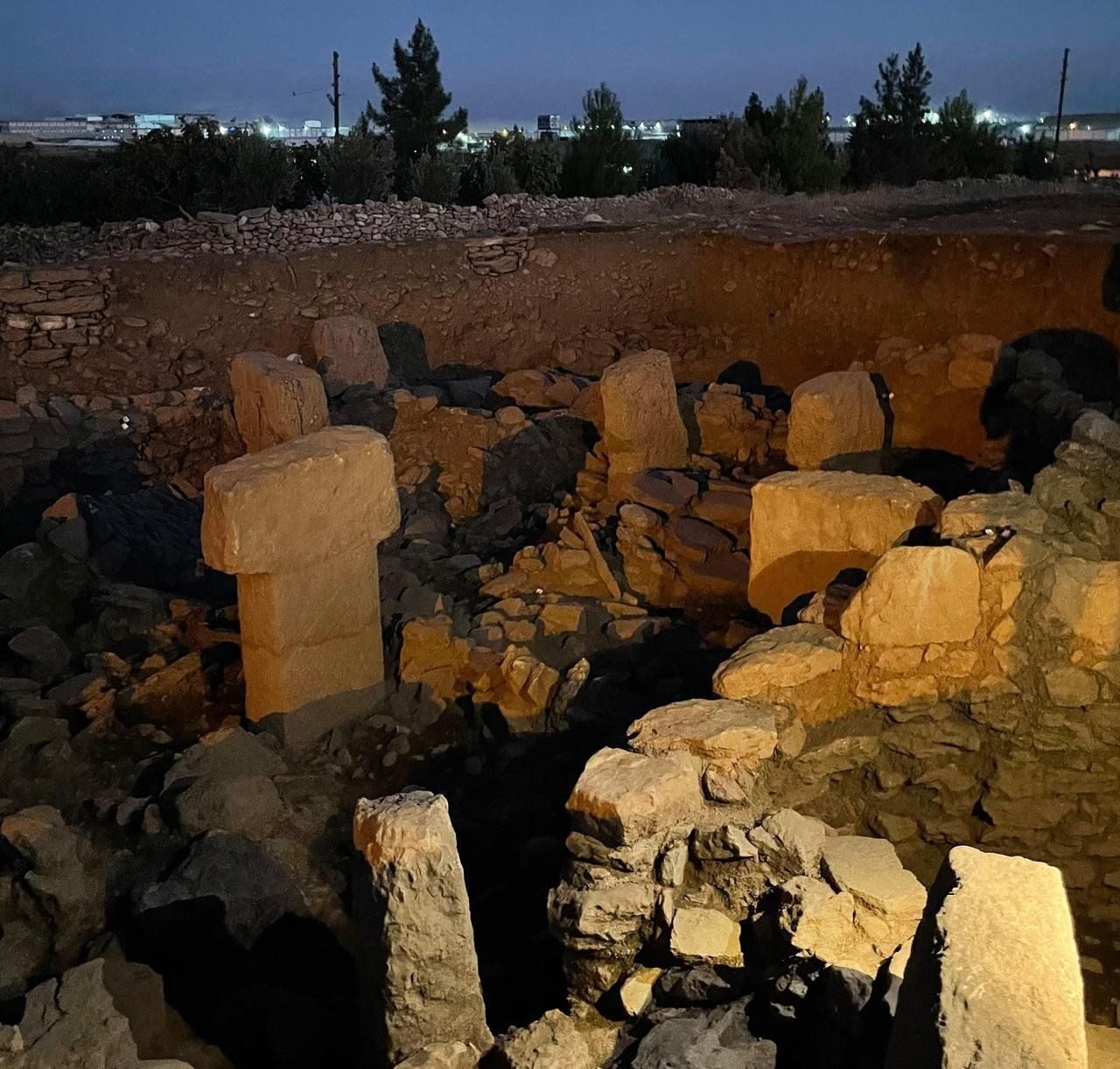
The northern communal building at Sayburç is the round, bench-lined, bedrock-cut structure whose bench carries the site's famous narrative relief — a purpose-built gathering room, not an ordinary house.
It is the architecture around the carving: a special building in the Taş Tepeler tradition, with a bench running around its interior wall. The relief itself — five figures of humans and dangerous animals — was found carved into the front of that bench, in place, in the room it was made for. For the carving in detail, see the Sayburç relief.
The room that holds the relief
The northern communal building at Sayburç is the round, bench-lined structure in which the site's famous narrative relief was carved. It is a communal building in the Taş Tepeler tradition — not an ordinary house, but a space made for gathering.
Its bench is not plain. Cut into the front of it is the five-figure scene of humans, leopards and an aurochs that its excavator argues is the earliest known narrative in art. The carving itself, and the debate over what it means, we keep on [the Sayburç relief](/learn/what-is-the-sayburc-relief/) — this page is about the room.
How it was built
Like the rest of Sayburç, the building was set directly on bedrock, with the builders working with the rock rather than against it — cutting the round plan and its bench down into the living stone where that was easier than building up.
A bench runs around the interior wall, and it is on the front face of that bench, at the height of a seated person, that the reliefs were carved. This is a recurring Taş Tepeler idea — the special building with a bench and carved imagery — realised here at the scale of a room people could sit inside together.
Not a house — a place to gather
Sayburç has ordinary residential buildings, with hearths, storage and food-preparation areas. The northern communal building is not one of them. Its size, its bench and above all its carved scene mark it as a special building — a place for the community rather than a single household.
What is striking is how close that special room sat to everyday life. This is not a sanctuary on a distant hilltop; the gathering room stood among the houses, so the charged imagery of leopards and aurochs was part of the settlement, not set apart from it.
Where the relief meets you
Because the reliefs are on the front of the bench, they sat at the eye level of people seated against the wall. A carving in a museum case is an object; a carving on the bench of the room it was made for is part of a place.
Finding the relief in place is much of what makes Sayburç so valuable. We can see where people sat, what they faced, and how the scene met them as they gathered — which turns the relief from an artwork into an experience the community was meant to have.
What is known, and what is still being dug
Known: it is a round, bedrock-cut communal building with an interior bench carrying a five-figure relief, found in place; it belongs to Sayburç's short, essentially single-layer 9th-millennium occupation.
Still open: Sayburç is an active excavation, and the building's full plan, its exact relationship to the houses around it, and how it was used are still being studied. Human remains given secondary treatment — skulls and long bones, some burnt — have been reported on and in front of a bench at the site, but how that practice connects to this particular room is not settled.
Common questions
What is the Sayburç northern communal building?
The round, bench-lined, bedrock-cut communal building at Sayburç whose bench carries the famous five-figure narrative relief — found in place, in the space it was made for.
Is it a house?
No. It is a special building made for gathering, set among the site's ordinary residential buildings — marked out by its size, its interior bench and its carved scene.
What is carved in it?
A relief of five figures — a man between two leopards and a squatting figure facing a charging aurochs — cut into the front of the interior bench. The carving is covered in detail on the Sayburç relief page.
Sources & further reading2 references
- Özdoğan, E. (2022). The Sayburç reliefs: a narrative scene from the Neolithic. Antiquity 96(390): 1599–1605. doi:10.15184/aqy.2022.125
- Özdoğan, E. (2025). Interviews on the Sayburç excavation and its reliefs. Transcribed interviews held in the Taş Tepeler research atlas. Spoken material, translated from Turkish; paraphrased rather than quoted. See Özdoğan 2022 for the published account.
Full bibliography: the Taş Tepeler reference library →