Short answer
Sayburç is a roughly 10,500-year-old Neolithic village in the Şanlıurfa region of southeastern Türkiye, buried beneath a still-inhabited modern village, and famous for a carved bench scene that may be the earliest known story in art.
It was excavated under Eylem Özdoğan and published in Antiquity in 2022. It belongs to the Taş Tepeler world of Göbekli Tepe and Karahan Tepe, but is a little later, and it stands out for one thing above all: a round communal building whose bench carries a five-figure relief of humans and dangerous animals, read as a possible narrative.
The short version
Sayburç is a Pre-Pottery Neolithic settlement in the Şanlıurfa region of southeastern Türkiye, dating to the 9th millennium BCE — a little later than Göbekli Tepe's great early enclosures. It lies beneath a still-inhabited modern village, which is part of why it came to wider attention only recently, through work connected to the Taş Tepeler program.
It was excavated under Eylem Özdoğan and published in the journal Antiquity in 2022. It has become one of the most important sites of the whole landscape for a single reason: a carved relief on a bench inside a communal building, argued to be the earliest known narrative scene in art.
A village, not a lone sanctuary
Unlike Göbekli Tepe, which in its famous phase looks like a place people travelled to rather than lived in, Sayburç is plainly a settlement. It has residential buildings alongside its special buildings, with hearths, storage and food-preparation areas — ordinary domestic life next to the extraordinary room.
Its buildings sit directly on bedrock, and the builders worked with the rock rather than against it, cutting where they had to and filling where that was easier. The occupation is short and essentially single-layer — one main phase, without the centuries of rebuilding that complicate the bigger sites — which makes the relationship between the communal building and the houses around it unusually easy to read.
The famous carving, in brief
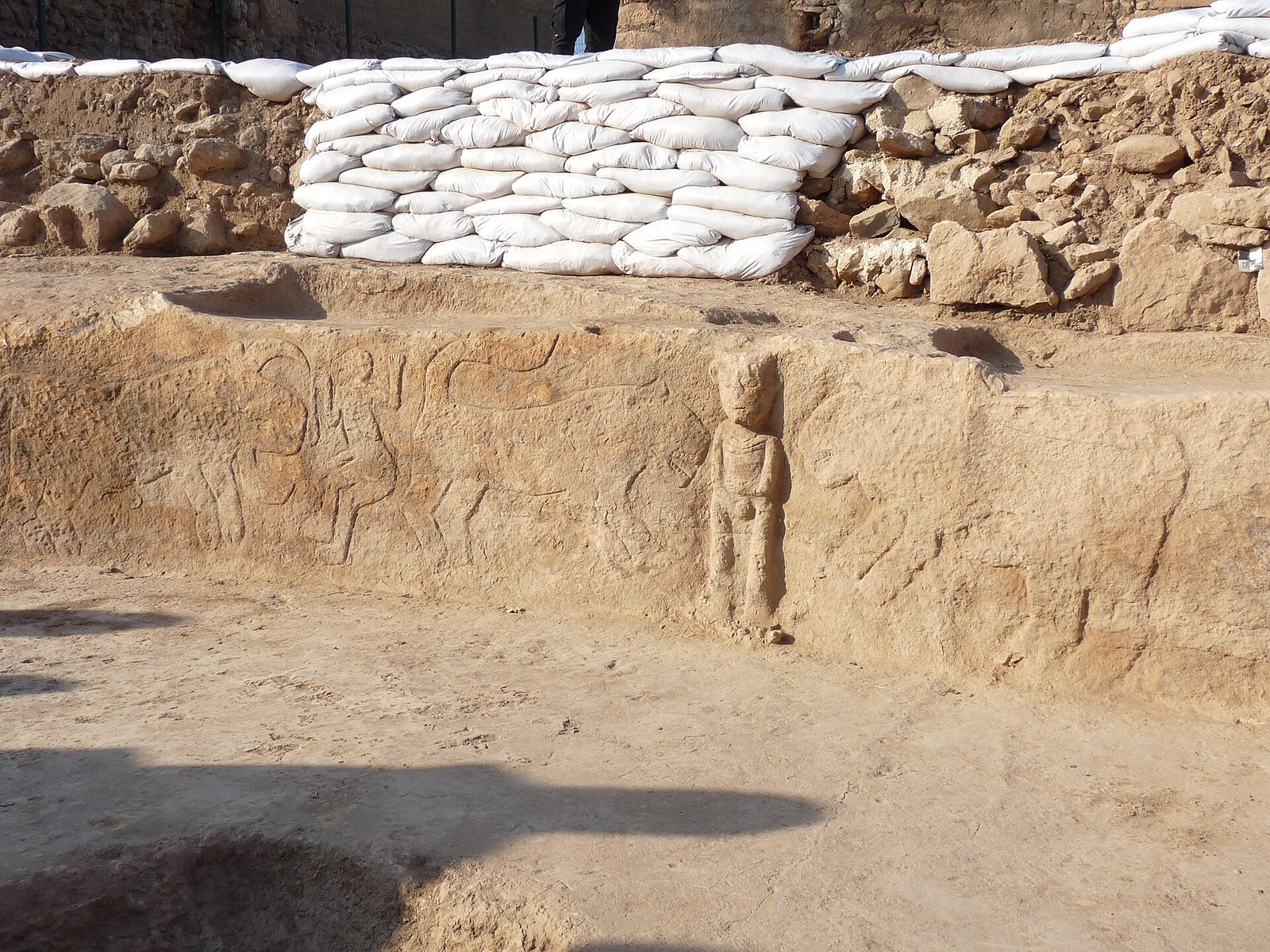
At the heart of Sayburç is a round communal building with a bench running around its inside. Carved into the front of that bench is a row of five figures — humans and dangerous animals — arranged in what its excavator argues is a single connected scene rather than a set of separate images. One human figure is even sculpted in three dimensions, projecting from the wall.
We keep the blow-by-blow on its own page. For the figures, the leopards, the bull and the arguments about what it all means, see [the Sayburç relief](/learn/what-is-the-sayburc-relief/).
Why Sayburç matters
The relief's importance is not just its age but its legibility: Neolithic art is full of animals, but animals arranged so that they appear to be acting on one another — a scene rather than a set — are rare. If that reading holds, this is among the earliest depictions of a story anywhere.
And it sat in a room people used. This was not a remote hilltop shrine; the charged imagery of leopards and aurochs ran along a bench at the height of people sitting against the wall, inside everyday communal space. At Sayburç the sacred and the social shared a wall.
What is settled, and what is debated
Settled: Sayburç is a 9th-millennium BCE Neolithic settlement with residential and communal buildings; a five-figure relief runs along a bench in a round communal building; the site was excavated under Eylem Özdoğan and published in 2022.
Debated: whether the relief is truly a single 'narrative' and what story, if any, it tells; the precise radiocarbon range; and how the communal building relates in time to the houses around it. The 'earliest narrative' reading is a strong and widely reported interpretation, not a closed case.
Common questions
What is Sayburç?
A Pre-Pottery Neolithic settlement in the Şanlıurfa region, dating to the 9th millennium BCE, famous for a carved relief of five figures on a bench inside a communal building — argued to be the earliest known narrative scene in art.
Where is Sayburç?
In the foothills near Şanlıurfa in southeastern Türkiye, beneath a modern village of the same name. It is studied as part of the Taş Tepeler program.
Who excavated Sayburç?
It was excavated under Eylem Özdoğan, who published the site and its relief in the journal Antiquity in 2022.
Sources & further reading3 references
- Özdoğan, E. (2022). The Sayburç reliefs: a narrative scene from the Neolithic. Antiquity 96(390): 1599–1605. doi:10.15184/aqy.2022.125
- Özdoğan, E. (2025). Interviews on the Sayburç excavation and its reliefs. Transcribed interviews held in the Taş Tepeler research atlas. Spoken material, translated from Turkish; paraphrased rather than quoted. See Özdoğan 2022 for the published account.
- Clare, L. (2020). Göbekli Tepe, Turkey. A brief summary of research at a new World Heritage Site (2015–2019). e-Forschungsberichte des Deutschen Archäologischen Instituts 2020(2): 81–88.
Full bibliography: the Taş Tepeler reference library →