Short answer
Ayanlar Höyük — also called Gre Hut — is a large (about 14-hectare) Pre-Pottery Neolithic settlement roughly 30 km west of Şanlıurfa, surveyed in 2013, published in 2017, and excavated only from September 2025 under a Türkiye–Japan partnership.
That scale puts it in the same size class as Göbekli Tepe and Karahan Tepe, yet almost nothing is known of its interior, because systematic digging began only in 2025. Everything published so far rests on surface survey and museum finds, so its dating and character are provisional.
The short version
Ayanlar Höyük — also recorded as Gre Hut — is a Neolithic mound about 30 km west of Şanlıurfa, in southeastern Türkiye. It was identified during surface surveys in 2013 and published by Bahattin Çelik in Documenta Praehistorica in 2017.
For years it existed in the literature as a single survey paper and a drawer of finds in the Şanlıurfa Museum. In 2025 it became one of the active excavations of the Taş Tepeler programme, which studies the dozen or so Pre-Pottery Neolithic sites of the region as one connected landscape.
A very large mound
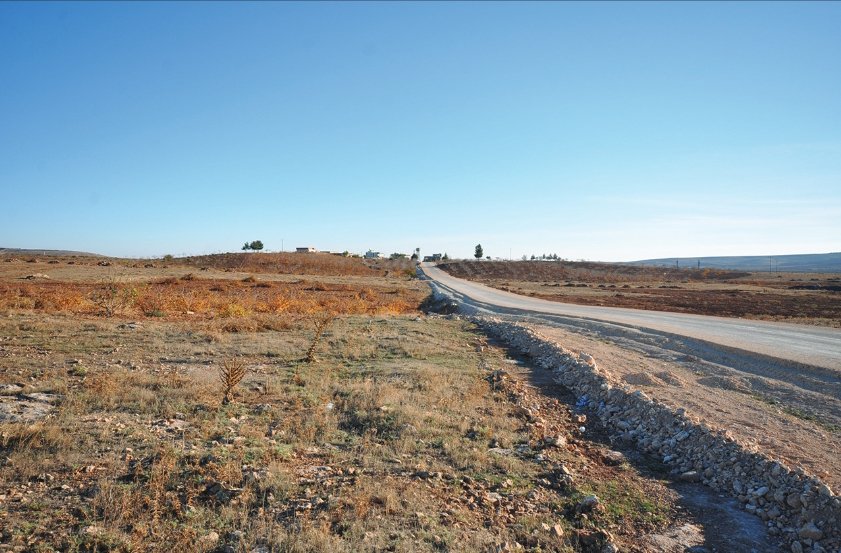
The scale is the headline fact. The mound covers roughly 14 hectares — about 250 by 300 metres — and rises close to 10 metres above the surrounding bedrock. Its surface breaks into several low hillocks rather than forming one clean rise, a pattern seen at other large Neolithic sites nearby.
For comparison, that is the size class of Göbekli Tepe and Karahan Tepe. Ayanlar is not a minor outlying station; it is one of the bigger sites in the whole group — which is part of why its late excavation is so striking.
What the surface finds suggested
Before excavation, the case for Ayanlar rested entirely on surface survey and on artefacts already held in the Şanlıurfa Museum, including a decorated stone vessel and a fragment of a carved leopard head.
Çelik assessed the material as sharing characteristics with finds from Körtik Tepe, Göbekli Tepe, Nevalı Çori and Karahan Tepe — a striking range that spans the Tigris region as well as the Urfa group. On that basis he dated the site broadly to the early-to-middle Pre-Pottery Neolithic B. That is a survey-based assessment, and excavation may revise it.
Excavation began in 2025
Ayanlar was added to the Taş Tepeler project as its twelfth active excavation, with work beginning in September 2025 under a Türkiye–Japan partnership. The opening ceremony drew international attention, including the participation of Princess Akiko of Mikasa of Japan.
This means that almost everything about Ayanlar's interior — its buildings, its layout, whether it has T-pillars or special buildings — is, at the time of writing, either extremely new or not yet published. What exists is a very large mound, a survey-based date, and a first season.
One name to get right
Ayanlar Höyük is sometimes called Gre Hut. It should not be confused with Gre Filla, a separate Neolithic mound near Bismil in Diyarbakır province. The similar nicknames cause genuine mix-ups in popular coverage.
What is settled, and what is not
Settled: Ayanlar is a large (about 14 ha) Neolithic mound west of Şanlıurfa, surveyed in 2013, published in 2017, and excavated from 2025 within the Taş Tepeler programme.
Still open: its internal architecture, its precise dating, and its exact role in the network all await excavation. Ayanlar is a thinly published site whose most important findings have not been made yet — a place to watch rather than one with a settled story.
Common questions
What is Ayanlar Höyük?
A large Pre-Pottery Neolithic mound about 30 km west of Şanlıurfa, also known as Gre Hut. It was surveyed in 2013, published by Bahattin Çelik in 2017, and excavated from September 2025 within the Taş Tepeler programme.
How big is Ayanlar Höyük?
About 14 hectares — roughly 250 by 300 metres, rising close to 10 metres above bedrock — which puts it in the size class of Göbekli Tepe and Karahan Tepe.
How old is Ayanlar Höyük?
Surface finds suggest the early-to-middle Pre-Pottery Neolithic B, but that is a survey-based estimate. A firm date awaits the results of the excavation begun in 2025.
Who is excavating Ayanlar Höyük?
A Türkiye–Japan partnership within the Taş Tepeler project, with work beginning in September 2025; the launch was attended by Princess Akiko of Mikasa of Japan.
Is Ayanlar Höyük the same as Gre Filla?
No. Ayanlar is nicknamed Gre Hut; Gre Filla is a different Neolithic site near Bismil in Diyarbakır province. The two are often confused.
Sources & further reading5 references
- Çelik, B. (2017). A new Pre-Pottery Neolithic site in Southeastern Turkey: Ayanlar Höyük (Gre Hut). Documenta Praehistorica 44: 360–367. doi:10.4312/dp.44.22 link
- Çelik, B.. Differences and similarities between the settlements in Şanlıurfa region where 'T' shaped pillars are discovered. Comparative survey of the Şanlıurfa T-pillar sites. Consulted via open repository copy; full bibliographic details not verified.
- Şanlıurfa Neolithic Research Project — Taş Tepeler (2026). Official project site (Istanbul University / Şanlıurfa Museum). tastepeler.org link
- Büyükyıldırım, O. (2025). Japanese Princess Akiko launches excavations at Ayanlar Höyük: Türkiye–Japan partnership expands the Taş Tepeler project. Anatolian Archaeology, 22 September 2025. link
- Clare, L. (2020). Göbekli Tepe, Turkey. A brief summary of research at a new World Heritage Site (2015–2019). e-Forschungsberichte des Deutschen Archäologischen Instituts 2020(2): 81–88.
Full bibliography: the Taş Tepeler reference library →